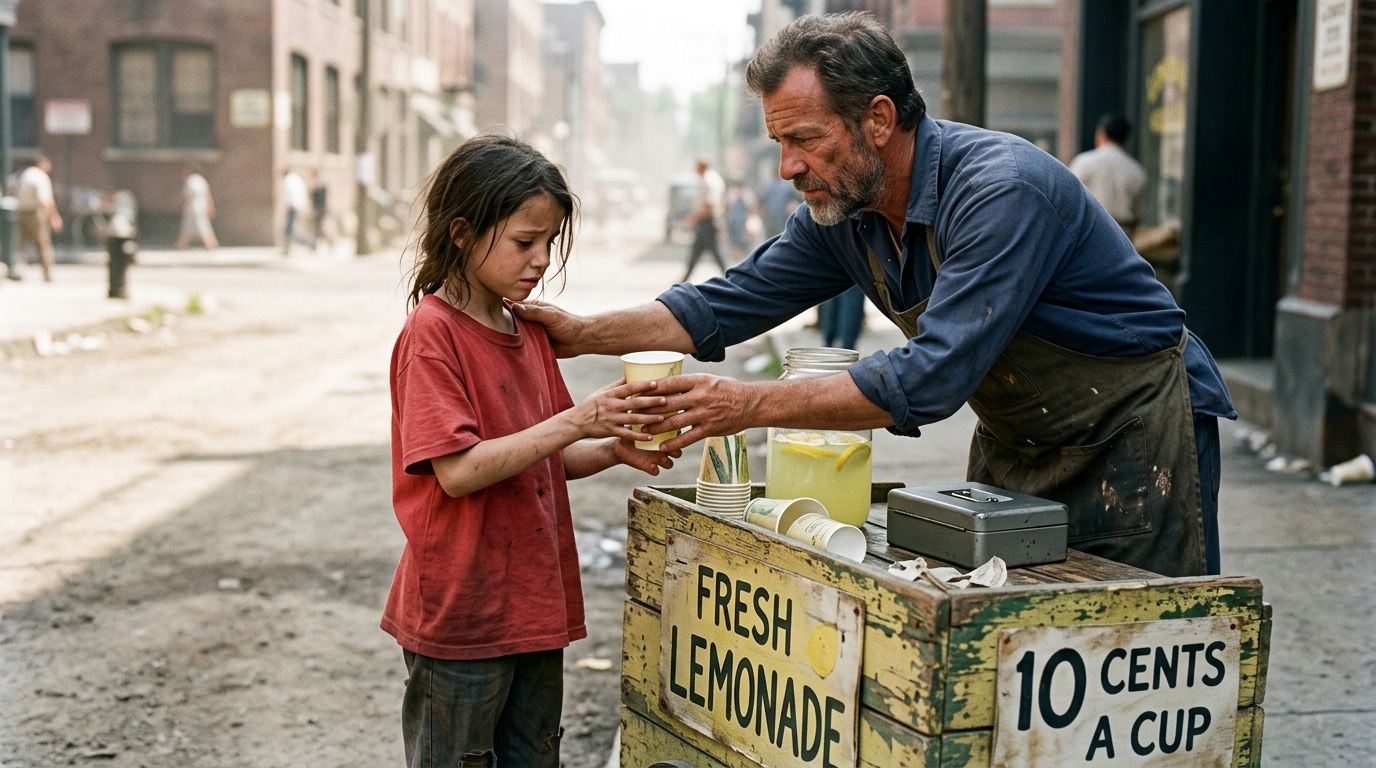
The Girl in the Red Shirt
She looked too weak to ask twice.
The little girl stood in front of the lemonade cart with both hands pressed against her stomach, her worn red shirt hanging loose over one shoulder. Her lips were dry. Her cheeks were streaked with dust. One of her shoes had no lace, and the other looked too large, as if it had belonged to someone else first.
The afternoon sun burned over the narrow street.
Cars rolled by slowly.
A bus groaned at the corner.
People walked past with grocery bags, phones, iced coffees, and the practiced blindness of city life.
The girl stared at the glass pitcher on the cart.
Cold lemonade.
Ice floating near the top.
Drops of water sliding down the outside.
Her throat moved as she swallowed nothing.
Behind the cart stood Elias Boone.
Most people on that block called him Eli.
He was not a warm-looking man.
His shoulders were broad, his beard rough, his voice low from years of shouting over traffic. His hands were scarred from work, burns, and one old accident he never talked about. His lemonade cart was faded yellow, patched with metal strips near the wheels, and older than most of the shops around it.
He had been selling lemonade on Hawthorne Street for twenty-six years.
Long enough to see bakeries become phone stores.
Phone stores become coffee bars.
Coffee bars become empty windows with lease signs.
He trusted very little.
Not strangers.
Not landlords.
Not promises.
Not tears, because life had shown him that tears could be real and still followed by lies.
But this child’s tears were not trying to convince him of anything.
They were just there.
She looked up at him.
“Sir…” Her voice barely rose above the traffic. “Please… just one sip.”
Eli stared at her for a long moment.
Behind her, people kept walking.
A man in a suit glanced over, then looked away.
A woman with a stroller slowed, saw the girl, tightened her grip, and continued forward.
Two teenagers laughed at something on a phone.
Nobody stopped.
Eli looked at the child’s trembling hands.
Then at the pitcher.
He reached for a cup.
The girl’s shoulders tensed, as if she expected him to pour only a little and then snatch it away if she moved wrong.
But Eli filled it to the top.
Not half.
Not a few drops.
A full cup.
Ice.
Lemonade.
One extra spoonful of sugar from the jar, because children in trouble deserved sweetness when the world forgot to offer it.
He placed the cup into her hands.
“Careful,” he said gruffly.
The girl held it with both hands and drank so fast he almost reached forward to slow her down.
“Easy,” he murmured. “You’ll hurt your stomach.”
She stopped just long enough to breathe.
Then drank again.
When the cup was empty, she stared at it as though she could not believe it had been allowed to remain hers until the end.
Eli took the cup gently.
“You got someone looking for you?”
The girl’s face changed.
Fear moved through her so quickly it made him stand straighter.
Before he could ask again, she looked over her shoulder.
Across the street, near the boarded entrance of an old tailor shop, a man stood beneath the shade of a striped awning.
Gray suit.
Dark glasses.
One hand in his pocket.
Watching.
Not watching the street.
Watching her.
The little girl turned back to Eli.
Her voice dropped.
“When I come back…” she whispered, “you’ll know who I am.”
Eli frowned.
“What does that mean?”
But she was already stepping backward.
“Hey,” he said. “Wait.”
She ran.
Not fast at first.
Then faster.
Down the dusty sidewalk.
Around the corner.
Gone.
Eli looked across the street.
The man in the gray suit was gone too.
Only the closed tailor shop remained, its window cracked, its sign hanging crooked in the heat.
Eli stood behind his lemonade cart with the empty cup in his hand, feeling something he had not felt in years.
The sense that he had just watched the beginning of a tragedy.
And had been too slow to stop it.
The Man Across the Street
Eli told himself he should call someone.
Police.
A shelter.
Child services.
Anyone.
But what would he say?
A thirsty girl asked for lemonade.
A man across the street watched her.
She ran.
In that neighborhood, things like that happened too often for people to know when the ordinary had crossed into danger.
Still, that night, Eli could not sleep.
He lived in a narrow room above a pawn shop, four blocks from the corner where he kept the cart. The room was hot in summer, cold in winter, and smelled faintly of old wood no matter how much he cleaned.
He lay awake listening to traffic.
The girl’s words kept returning.
When I come back, you’ll know who I am.
Not if.
When.
Children said strange things sometimes.
But she had not said it like a dream.
She had said it like a promise.
The next morning, Eli brought an extra sandwich to the cart.
Turkey.
Mustard.
Wrapped in wax paper.
He told himself it was for him.
It was not.
He watched the corner all day.
The girl did not come.
Nor the next day.
Nor the next week.
On the ninth day, Eli walked to the corner where she had vanished. There was a laundromat, a shuttered pharmacy, and an alley behind a fruit market. He asked the fruit seller if he had seen a little girl in a red shirt.
The man shrugged.
“This street is full of little girls.”
“This one looked hungry.”
The fruit seller gave him a tired look.
“This street is full of that too.”
Eli tried three more shops.
Nobody knew her.
Or nobody wanted to.
A month passed.
Then six.
Then years.
But the memory stayed.
Some memories do that.
Not because they are large.
Because they remain unfinished.
Eli remembered the girl every time a child stared too long at his pitcher.
He remembered her when someone asked for a free cup and laughed because they were only joking.
He remembered her when he saw men in gray suits near the courthouse, near the bank, near the hotel where wealthy people stepped out of black cars and never looked down at the sidewalk.
The man across the street bothered him most.
Eli never saw him again.
At least, not clearly.
Sometimes he thought he saw the same posture in a crowd.
The same stillness.
The same way of watching without appearing to watch.
But by the time he looked twice, the man was always gone.
The neighborhood changed.
Hawthorne Street began to attract developers.
First came surveyors in orange vests.
Then city notices.
Then rumors.
A company had bought the buildings.
A luxury complex was planned.
Old tenants would be relocated, though nobody could say where.
Shopkeepers worried.
Street vendors worried more.
Eli’s cart had no lease.
No protection.
No powerful friends.
He had his corner because he had always been there.
In cities, “always” means nothing once land becomes expensive.
The years took their toll.
His knees began to ache.
His hands shook when he poured.
His beard turned white.
Customers passed him more often now, choosing sleek coffee shops and bottled drinks with labels that looked cleaner than his cart.
Most days ended with more dust than dollars.
Still, he came.
Every morning.
Same corner.
Same faded yellow cart.
Same habit of looking down the street whenever a child in red passed by.
The Black SUV
It happened on a Tuesday afternoon.
The kind of afternoon that seemed too ordinary to hold anything important.
The sun was high. The pavement shimmered. Eli had sold only four cups since noon, and one of those had been to a delivery driver who paid in coins from his ashtray.
He was wiping the counter when the black SUV pulled up.
Not just any SUV.
Sleek.
Tinted.
Expensive enough to make the whole street notice.
It stopped beside the curb directly in front of Eli’s cart.
For a second, Eli thought it was city inspectors.
His stomach tightened.
He had been expecting them.
Everyone had.
The company that bought the street had begun sending letters to businesses and “informal vendors,” which was a polite way of saying people like Eli.
The rear door opened.
A woman stepped out.
Dark green blazer.
White blouse.
Gold watch.
Hair smooth and pinned back.
Sunglasses hiding her eyes.
Behind her came a suited man holding a leather folder.
A second man remained near the SUV, scanning the street like security.
Hawthorne Street quieted.
Shopkeepers looked through windows.
A man sweeping outside the barber shop stopped mid-stroke.
Two women waiting at the bus stop turned.
Eli straightened as much as his back allowed.
“If this is about the permit,” he said, “I already filed the extension.”
The woman did not answer.
She walked directly toward him.
Then she removed her sunglasses.
The moment Eli saw her eyes, something inside him shifted.
He did not know her face.
Not exactly.
But he knew those eyes.
Fear had once lived in them.
Thirst had once brightened them.
And something else.
A promise.
“You gave lemonade to a girl everyone else ignored,” she said quietly.
Eli’s hand tightened around the cloth.
The street seemed to fade.
He stared at her.
“No.”
Her expression softened.
“Yes.”
His voice dropped.
“Red shirt.”
A tear appeared before she could stop it.
“Yes.”
Eli gripped the edge of the cart.
“You came back.”
“I told you I would.”
He swallowed hard.
“You were a child.”
“I know.”
“I looked for you.”
Her eyes moved over his weathered face.
“I believe that.”
The suited man stepped forward gently.
“Mr. Boone,” he said, “my name is Daniel Mercer. I represent Ms. Clara Vale.”
Eli blinked.
“Vale?”
The name meant something now.
Everyone in the city knew Vale Horizon Group.
The company that had bought half of Hawthorne Street.
The company whose signs had appeared on boarded windows.
The company people cursed under their breath while wondering how long they had left.
Daniel continued carefully.
“Ms. Vale is the new owner of the company that purchased this street.”
Eli’s breath caught.
He looked back at the woman.
The little girl in the red shirt was now the owner of the company threatening to erase his corner.
Clara Vale did not look away.
“I came back for one reason,” she said.
Eli felt dread settle into his chest.
Not because she was cruel.
Because life had taught him that powerful people rarely returned to old streets with simple intentions.
He tried to joke, but his voice came out dry.
“To shut me down yourself?”
Something like pain crossed her face.
“No.”
She reached into her leather bag.
Pulled out an old, faded photograph.
Held it toward him.
“Do you remember the man who was standing across the street the day you gave me that lemonade?”
Eli looked down.
The photograph was grainy, clearly taken from an old security camera or newspaper clipping.
A man in a gray suit.
Dark glasses.
One hand in his pocket.
Standing beneath a striped awning.
The blood seemed to drain from Eli’s hands.
“Yes,” he whispered. “I remember him.”
Clara’s voice became very still.
“Good. Because he’s the reason I disappeared.”
The Girl Who Was Hidden
Her name had not been Clara then.
Not to the people holding her.
Not to the woman who dragged her between apartments.
Not to the man in the gray suit.
Back then, she was called Rosie.
Sometimes Lily.
Sometimes “the girl.”
Never Clara Vale.
She learned her real name much later.
The day Eli gave her lemonade, she was eight years old.
She had been living for six months in a back room above a closed dry cleaner with a woman named Marla, who told neighbors Clara was her niece. Marla was not her aunt. Not family. Not kind.
Marla was paid to keep her.
Paid by the man in the gray suit.
His name was Victor Sloane.
Clara remembered him as a shadow first.
A shape in doorways.
A voice behind thin walls.
A hand placing envelopes on tables.
She did not know then that Victor had once been her father’s closest business partner.
She did not know her father, Adrian Vale, had founded Vale Horizon Group as a small construction firm with a plan to rebuild neglected neighborhoods without pushing out the people who lived there.
She did not know he had died in a car crash that was no accident.
She did not know her mother had vanished after asking too many questions.
She did not know Victor had taken control of the company while claiming the Vale family had no surviving heirs.
She only knew that Marla said she was lucky to have food.
Lucky to have a mattress.
Lucky not to be sent somewhere worse.
On the day of the lemonade, Clara had escaped for twenty minutes.
Marla fell asleep after drinking.
The door had not latched.
Clara ran.
She did not know where to go.
She had no address.
No phone number.
No one to ask for.
She only had one memory that felt warm enough to follow: her mother once buying lemonade from a yellow cart on a sunny street, telling her, “If you’re ever lost, find someone who looks like they’ve stayed in one place a long time.”
A child’s logic took her to Eli’s cart.
She had not remembered his face.
Only the yellow.
Only the lemons.
Only the corner.
By the time she reached him, she was too thirsty to explain.
So she asked for a sip.
And he gave her a full cup.
What Eli did not know was that the man in the gray suit had found her before she reached the cart.
Victor had crossed the street and stood under the awning, watching to see who she approached.
If Eli had asked too many questions, Victor would have intervened.
If Eli had called police openly, Victor would have vanished with her faster.
But Eli gave her lemonade.
He rested one hand softly on her shoulder.
And in that tiny moment, Clara remembered what kindness felt like.
That mattered.
Because when she ran again later that night, she kept running.
Not because she knew she would survive.
Because one stranger had treated her like a child worth helping.
The Photograph
The photograph Clara handed Eli had been taken from a traffic camera.
It took her lawyers six years to find it.
The image was blurry, but it showed enough.
Victor Sloane.
Across the street.
Watching.
Proof that he was present on Hawthorne Street the day Clara disappeared from Marla’s apartment.
Proof that he lied when he later claimed he had not seen her since her father’s funeral.
Proof that the girl’s survival and the company’s ownership were connected in ways the courts could no longer ignore.
Eli stared at the photo.
“I should have stopped him.”
Clara shook her head.
“You couldn’t have known.”
“I knew something was wrong.”
“You were one man with a lemonade cart.”
“That doesn’t make it feel better.”
“No,” she said softly. “It doesn’t.”
He looked at the photo again.
“What happened after?”
Clara drew a slow breath.
“I ran from him that night. A woman from a church shelter found me sleeping behind a bus station two towns over. I didn’t know my real name. I only remembered pieces.”
“Then how did you become…” He gestured helplessly toward the SUV, the lawyer, the expensive blazer. “This?”
Her smile was sad.
“Slowly.”
She told him.
Not everything.
There were some memories she no longer handed to strangers, even kind ones.
But enough.
The shelter woman, Mrs. Alvarez, took Clara to a children’s advocacy center. Clara gave several names. None matched missing-child databases at first because Victor had made sure no proper report survived.
For years, Clara grew up as Clara Mercer, named after the lawyer who eventually became her guardian.
Daniel Mercer.
The suited man beside her.
He had been a young legal aid attorney then, overworked and underpaid, but he believed her when she said she had once lived in a house with a blue door, a piano, and a mother who smelled like oranges.
He kept digging.
Through sealed records.
Old company documents.
News clippings.
Estate filings.
Eventually, a photograph surfaced of Adrian Vale, his wife Elise, and their missing daughter Clara.
The child in the photograph had the same eyes.
The same birthmark near the wrist.
The same scar on her chin from falling on the garden steps at age four.
DNA confirmed the rest.
Clara Vale was alive.
And Victor Sloane had spent over a decade controlling a company that was never his.
The court battles lasted years.
Victor delayed.
Appealed.
Threatened.
Moved assets.
Destroyed records.
But he had not destroyed everything.
The traffic photo survived.
Marla’s old payment logs survived.
A retired nurse came forward.
Daniel found trust documents naming Clara as sole heir.
And finally, three months before Clara returned to Hawthorne Street, the court restored controlling ownership of Vale Horizon Group to her.
Eli listened without moving.
The street around them remained silent, watching from windows and doorways.
Finally, he said, “So you own the company now.”
“Yes.”
“And the company bought this street.”
“Yes.”
His face tightened.
“You came here to ask me about Victor.”
“I came here because of what Victor planned to do here.”
The Street Victor Wanted to Erase
Victor Sloane had never cared about Hawthorne Street.
Not as a place.
Not as a neighborhood.
Only as land.
Under his control, Vale Horizon changed from a community rebuilding company into a luxury development machine. Victor specialized in buying “undervalued corridors,” clearing out small businesses, replacing affordable rentals with glass towers, and naming the result after whatever history he had just destroyed.
Hawthorne Street was supposed to become The Vale District.
Luxury apartments.
Underground parking.
Boutique retail.
A wellness club.
A rooftop bar.
And in the promotional renderings, no lemonade cart.
No barber shop.
No old bakery.
No pawn shop.
No families above storefronts.
No people who had stayed when the street was not profitable enough to be loved by investors.
Clara had seen the plans two weeks after gaining control.
At first, she only saw numbers.
Then Daniel placed an old city map beside the development proposal.
“This is Hawthorne Street,” he said.
Clara went still.
“The lemonade cart street?”
“Yes.”
She read the acquisition file.
Victor had targeted the street years earlier, partly because it was cheap, partly because he knew its history with her would be buried if the entire block vanished.
The old tailor shop with the striped awning was scheduled for demolition.
So was the fruit market.
So was the corner where Eli’s cart stood.
Clara stared at the plan for a long time.
Then said, “Cancel it.”
Daniel adjusted his glasses.
“All of it?”
“All of it.”
“There are contracts.”
“Break them.”
“Investors.”
“Refund them.”
“Penalties.”
“Pay them.”
He studied her face.
“And what do you want instead?”
Clara looked at the map.
She remembered the cup in her hands.
The cold lemonade.
The way Eli did not ask her to prove she deserved it.
“A street that remembers who was here,” she said.
So she came back.
Not for a press conference.
Not first.
First, she came to the lemonade cart.
To the man who had stayed.
The Offer
Eli did not trust offers.
Especially not from developers.
Especially not from people who arrived in black SUVs with lawyers.
Clara seemed to know that.
She did not begin with speeches.
She opened Daniel’s folder and placed several documents on the cart counter.
“This is a protection agreement,” she said.
Eli stared.
“For what?”
“Your cart.”
He laughed once.
“This cart?”
“Yes.”
“It’s barely holding together.”
“I know.”
“You protecting it from gravity too?”
For the first time, Clara smiled properly.
“We can try.”
Daniel explained.
Vale Horizon would designate Eli’s lemonade cart as part of the neighborhood heritage plan. He would receive a permanent vendor license for the corner, rent-free, transferable only by his choice. The company would restore the cart if he wanted, or build a safer version preserving its appearance. His permits, taxes, and health upgrades would be covered through a community vendor grant.
Eli listened with suspicion slowly giving way to confusion.
“Why?”
Clara looked at him.
“Because when everyone else walked past me, you didn’t.”
“I gave you lemonade.”
“You gave me proof I wasn’t invisible.”
Eli swallowed.
“That’s too much weight for a cup.”
“Maybe,” she said. “But children carry small kindnesses when they have nothing else.”
He looked away.
The barber across the street stepped out of his shop.
“You saving his cart only, or the rest of us too?”
Clara turned.
“The rest too.”
More doors opened.
More people gathered.
Clara stood beside the faded yellow cart and explained that the luxury development was canceled. Existing tenants would receive long-term protections. Small businesses would be offered renovation grants instead of eviction notices. Vacant buildings would become affordable apartments, a clinic, a child advocacy center, and a public market.
The old tailor shop with the striped awning would not be demolished.
It would become a legal aid office named for missing children and families displaced by fraudulent guardianships.
Hawthorne Street would not become The Vale District.
It would remain Hawthorne Street.
People did not applaud at first.
They were too used to disappointment.
Then the barber began clapping.
Slowly.
The fruit seller joined.
The bus stop women.
The pawn shop owner.
The delivery driver who had bought lemonade in coins.
Soon the whole block was clapping.
Eli did not.
He was crying too hard.
Victor’s Shadow
But Victor Sloane was not gone.
Not entirely.
Power rarely disappears just because court documents change hands.
He had lost control of the company, but he still had allies, money, and enough arrogance to believe Clara would eventually become tired of fighting.
Three days after her visit to Hawthorne Street, Eli found a note tucked beneath his cart.
Old men should not involve themselves in family business.
He took it to Clara.
She read it without expression.
Then passed it to Daniel.
“Add it to the file.”
Eli stared.
“You expected this?”
“Yes.”
“Then why come here publicly?”
“Because secrets protected him.”
That answer stayed with Eli.
Secrets had protected Victor.
Public memory might not destroy him alone, but it made his old methods harder.
The traffic photograph, now paired with Eli’s witness statement, became part of the criminal case against Victor.
Eli testified months later.
He wore his best shirt, which was still not very good, and sat in a courtroom that smelled of polished wood and money.
Victor sat across the aisle in a dark suit.
Older now.
Still cold.
Still watching.
When Eli took the stand, Victor’s lawyer tried to make him look unreliable.
“You are describing an event from more than twenty years ago?”
“Yes.”
“You see thousands of people on that street.”
“Not like him.”
“You claim you remember a man you saw briefly?”
Eli looked at Victor.
“I remember the way he watched a thirsty child.”
The courtroom went quiet.
The lawyer tried again.
“Mr. Boone, isn’t it true you were struggling financially when Ms. Vale offered to protect your cart?”
“Yes.”
“So your testimony benefits you.”
“My testimony hurts the man who made a child disappear.”
The judge told him to answer only the question.
Eli nodded.
But the jury had heard him.
The Photograph on the Cart
Victor was eventually convicted on charges tied to fraud, conspiracy, unlawful concealment of a minor, and destruction of estate records. Other accusations remained tangled in time, missing witnesses, and legal limits. It was not perfect justice.
But it was public.
And public mattered.
Marla testified as part of a plea agreement.
She admitted she had kept Clara under false names.
She admitted Victor paid her.
She claimed she had not known Clara’s full identity.
Clara did not believe her.
But she did not need to.
Belief was no longer the only thing carrying truth.
There were records now.
Witnesses.
Photographs.
Documents.
A company returned.
A street protected.
A name restored.
Eli’s cart was repaired but not replaced. He insisted.
The wheels were strengthened. The counter refinished. The faded yellow paint matched exactly. A small brass plaque was added near the handle.
It read:
One cup of kindness can become a road home.
Eli complained it was too sentimental.
Clara told him to live with it.
A framed copy of the old photograph hung inside the cart, not visible to every customer, but close enough for Eli to see when he opened each morning.
The man across the street.
The day everything might have ended differently.
At first, Eli hated looking at it.
Then he understood why Clara wanted it there.
Not to remember fear.
To remember that even when danger was watching, kindness still happened.
The Lemonade Fund
Clara created a fund through Vale Horizon in partnership with the legal aid center on Hawthorne Street.
She named it The First Cup Fund.
Eli groaned when he heard.
“That sounds like coffee.”
“You sell lemonade,” Clara said. “You don’t get branding authority.”
The fund paid for emergency food, water, transport, and legal support for children and vulnerable adults found in public spaces by street vendors, shopkeepers, transit workers, and other everyday witnesses.
“People on the street see things first,” Clara said at the opening. “But for too long, they’ve had no safe way to act.”
The program trained vendors to recognize signs of distress, contact advocates, and document concerns without putting children in greater danger.
Eli became its reluctant symbol.
He refused interviews at first.
Then one day, a girl about nine came to the cart with a school group touring the legal aid center. She asked him, “Are you the lemonade man?”
Eli sighed.
“Depends who’s asking.”
“My teacher said you helped somebody.”
He looked toward Clara, who was standing near the door of the center, speaking with Daniel.
“I gave her a drink.”
The girl thought about that.
“My mom says helping doesn’t have to be big.”
Eli’s throat tightened.
“Your mom sounds smart.”
“She is.”
After that, Eli agreed to one interview.
Then another.
But he always corrected reporters.
“I didn’t save her,” he would say. “I just didn’t send her away.”
Clara once heard him say that and replied quietly:
“Sometimes that is where saving starts.”
Years Later
Years changed Hawthorne Street again.
But differently this time.
The barber shop got a new roof.
The fruit market expanded.
The pawn shop became a repair café run by the owner’s daughter.
The old tailor shop became the Vale-Mercer Child Advocacy Center, though most people simply called it the Blue Door House because Clara painted the front door bright blue in memory of the house she had tried so hard to remember.
Affordable apartments rose on vacant lots, not over demolished lives.
Murals appeared on brick walls.
One showed a little girl in a red shirt holding a cup of lemonade, while behind her a street bloomed into color.
Eli hated the mural.
He secretly cleaned graffiti off it twice.
Clara saw him once and said nothing.
By then, Eli was too old to run the cart every day.
He hired neighborhood kids during summer, paying more than he could afford until Clara quietly increased the vendor grant.
He knew.
He pretended not to.
Some afternoons, Clara came by in ordinary clothes, no SUV, no lawyer, no sunglasses. She would sit on a folding chair behind the cart and drink lemonade that was too sweet because Eli insisted that was the correct way.
“You ever find your mother?” he asked once.
Clara looked down at the cup.
“No.”
Elise Vale remained missing.
Victor never admitted what happened to her.
Some records suggested she had survived for years under confinement in a private facility.
Others suggested she died soon after searching for Clara.
There was no grave.
No final answer.
Eli regretted asking.
Clara placed one hand over his.
“It’s all right.”
“No, it isn’t.”
She smiled sadly.
“No. It isn’t.”
They sat in silence.
Then Eli said, “She bought lemonade from me once.”
Clara looked up.
“My mother?”
“Yes.”
“When?”
“The day you remembered. You were little. She bought two cups. One for you, one for herself. You spilled half yours and cried like the world had ended.”
Clara laughed, then covered her mouth.
“I don’t remember that.”
“She told you, ‘Don’t worry. Sweet things come back.’”
Clara’s eyes filled.
Eli looked away, embarrassed by his own memory.
“I should have told you sooner.”
“You told me now.”
She wiped her eyes.
And for once, the unfinished part of her past felt less empty.
The Last Pour
Eli died on a spring morning.
Not dramatically.
Not painfully.
He simply did not wake up.
The neighborhood found out before noon, and by evening, the corner was covered in flowers, lemons, handwritten notes, and paper cups.
Clara stood beside the cart long after everyone else left.
Daniel stood nearby, older now, still carrying documents even when no one needed him to.
“He left instructions,” Daniel said softly.
Clara smiled through tears.
“Of course he did.”
The instructions were written on lined notebook paper.
Messy.
Blunt.
Very Eli.
Don’t turn the cart into a shrine.
Don’t let people sell fancy ten-dollar lemonade out of it.
Give kids water first if they’re thirsty.
If Clara cries, tell her I said she’s being dramatic.
She laughed and cried at the same time.
The cart did not become a shrine.
But it did remain.
Operated by the First Cup Fund, staffed by local teens, free drinks for children, pay-what-you-can for everyone else.
Behind the counter, near the framed traffic photograph, Clara placed one more picture.
A newer one.
Eli standing beside her, scowling at the camera, holding a cup of lemonade.
On the back, she wrote:
He stayed in one place long enough for a lost girl to find him.
The Question in the Photograph
Years after Victor’s conviction, Clara was asked in an interview why she returned to Eli first.
Not the courthouse.
Not the company headquarters.
Not the mansion she had inherited but never lived in again.
The lemonade cart.
She answered slowly.
“Because power was taken from me by people who knew my name,” she said. “But kindness was given to me by someone who didn’t.”
The interviewer asked about the photograph.
The man across the street.
The evidence.
The fear.
Clara looked toward Hawthorne Street outside the window.
“That photograph proved Victor was there,” she said. “But Mr. Boone proved I was there.”
“What do you mean?”
“For years, my life was argued through documents. Records. Claims. Testimony. People asked who owned the company, who signed the trust, who controlled the estate.”
She paused.
“Eli remembered a thirsty little girl. Not an heir. Not a case. Not a problem. A child. He remembered me when remembering brought him nothing.”
That was the heart of it.
The photograph exposed the man who watched.
But Eli was the man who saw.
There is a difference.
Victor watched to control.
Eli saw to help.
And that difference changed the direction of Clara’s life.
Sweet Things Come Back
On the anniversary of the day Clara returned, Hawthorne Street held a small festival.
No speeches if Eli could have helped it.
Unfortunately for him, he was gone, and Clara allowed one short speech each year.
Children painted cups.
The barber grilled corn.
The fruit seller gave away sliced oranges.
The legal aid center opened its doors.
And at the old yellow cart, every child received one free cup of lemonade.
Full.
Not half.
Not a few drops.
A full cup.
One year, a small boy in a torn blue hoodie stood at the cart, staring at the pitcher exactly the way Clara once had.
The teenager working the cart looked unsure.
Clara, watching from nearby, stepped closer.
The boy whispered, “I don’t have money.”
The teen glanced at Clara.
She nodded.
He filled the cup to the top.
The boy drank quickly.
Too quickly.
Clara’s chest tightened.
When he finished, she crouched.
“You got someone looking for you?”
The boy hesitated.
This time, Clara did not let the moment vanish.
She signaled gently to the advocate standing near the blue door.
No panic.
No crowd.
No shame.
Just help moving quietly into place.
As the boy sat with a sandwich, Clara looked at the lemonade cart.
For a moment, she could almost see Eli behind it.
Scowling.
Pretending not to care.
Adding too much sugar.
She smiled.
Sweet things come back.
Not always as expected.
Not always in time to fix everything.
But sometimes, a cup given freely travels through years.
It becomes a witness.
A fund.
A protected street.
A child believed sooner.
A cart that stays.
A memory that refuses to let danger be the only thing remembered.
And once, long ago, a little girl in a worn red shirt made a promise to an old lemonade vendor.
“When I come back… you’ll know who I am.”
She returned as Clara Vale.
Owner.
Survivor.
Daughter of a stolen legacy.
But to Eli, she was first and always the thirsty child no one else stopped for.
And maybe that was the truest name anyone had given her.
Not because it held her weakness.
Because it held the moment she was seen.