The Woman at the Edge of the Village
“They called her names.”
Not once.
Not in a moment of anger.
Not because of one mistake.
For ten years.
Every morning, when Mara carried water from the old stone well, the whispers followed her.
When she walked past the market with a basket of vegetables balanced against her hip, the women behind the fruit stalls lowered their voices just enough to make sure she still heard.
When she entered the small village church and sat in the back row with her son, people shifted away from her as if shame could spread by touch.
No husband.
No father.
No proper family.
That was what they said.
Sometimes in whispers.
Sometimes with smiles.
Sometimes directly, when cruelty felt safe because everyone else seemed to agree.
Mara lived at the far edge of the village in a small, crumbling house with a tin roof that rattled in the rain. The walls leaned slightly. The front steps were cracked. Smoke often curled from the clay stove outside because she cooked over open flames when there was not enough money for gas.
The villagers saw all of it.
They saw her patch her son’s school uniform by lantern light.
They saw her sell handwoven baskets at the market.
They saw her work in other people’s fields when the harvest was short.
They saw her carry firewood on her back while her son, Eli, walked beside her with a smaller bundle in his arms, trying to be strong before he was old enough to understand why.
And they judged her for surviving.
To them, Mara’s house was not a home.
It was proof.
Proof that she had been foolish.
Proof that she had been abandoned.
Proof that a woman who raised a child alone had no one to blame but herself.
Mara never answered them.
That made them angrier.
If she had cried, they would have felt powerful.
If she had shouted, they would have called her unstable.
If she had begged for respect, they would have denied her even that.
So she stayed quiet.
She kept her back straight.
She kept her son clean.
She kept food in his bowl even when hers remained empty.
And every night, when Eli asked questions she could not yet answer, she touched his hair and said the same thing:
“One day, people will know who you are.”
At first, Eli believed her because children believe their mothers.
Then he grew older.
And belief became harder.
The Boy Without a Father
Eli was ten when the black SUVs came.
He had his mother’s eyes.
Dark.
Steady.
Too serious for a child.
He also had something else — something the villagers noticed but never understood.
A quiet presence.
A way of standing still when others mocked him.
A way of looking directly at adults who expected him to lower his gaze.
It made some people uncomfortable.
The village children repeated what they heard at home.
“Where is your father?”
“My mother says your mother doesn’t even know.”
“Maybe he ran away because of you.”
The first time Eli came home with a split lip, Mara washed his face without speaking.
Her hands trembled only once.
“Did you fight back?” she asked.
Eli looked down.
“No.”
“Why?”
His small jaw tightened.
“Because you said we don’t answer dirt with dirt.”
Mara closed her eyes.
She had said that.
She had meant it.
But seeing blood at the corner of her son’s mouth made dignity feel like a cruel lesson.
She pressed a cloth gently to his lip.
“You did right.”
He looked at her.
“Then why does it feel like losing?”
Mara had no answer.
That night, after Eli slept, she sat outside their house beneath the broken porch beam and stared at a small wooden box hidden beneath the floorboards.
Inside that box were the pieces of a life no one in the village knew.
A photograph.
A ring.
A folded certificate.
Three letters tied with blue thread.
And one sealed envelope she had sworn never to open unless the past came looking for them.
For ten years, it had not.
So Mara waited.
Not because she wanted rescue.
Because she had made a promise.
And promises, once made to a dying man, become heavier with time.
The Man They Never Saw
The villagers believed Mara had been abandoned by a nameless man.
They had invented many versions of him.
A traveling merchant.
A married soldier.
A criminal.
A wealthy man who had used her and left.
Every version made Mara smaller.
None of them was true.
His name had been Adrian Voss.
But not the Adrian Voss the world knew from newspapers, military reports, and state ceremonies.
Not the decorated commander.
Not the heir to one of the oldest families in the capital.
Not the man whose portrait once hung in government offices after a border crisis turned him into a national symbol.
Mara knew a different Adrian.
She knew the man who arrived in the village twelve years earlier under a false name, wounded and feverish, with mud on his boots and secrets behind his eyes.
He had collapsed near the river after a storm.
Mara found him at dawn while gathering herbs.
At first, she thought he was dead.
Then he opened his eyes and said:
“Don’t call anyone.”
Most women would have run.
Mara did not.
She brought him to the storage shed behind her aunt’s house. Cleaned his wound. Burned his bloodied shirt. Fed him rice porridge until he could sit up without shaking.
He told her his name was Arun.
She knew it was a lie.
But she accepted it because his fear was real.
Over the next weeks, he healed.
He helped repair her roof.
Carried water.
Cut firewood.
Spoke little.
Listened much.
There was sadness in him that felt older than his body.
One evening, when rain trapped them inside and thunder rolled over the fields, he told her the truth.
His name was Adrian Voss.
He had been betrayed by men close to his family.
A political alliance had collapsed.
Documents had been stolen.
People were hunting him, not because he was guilty, but because he knew who was.
Mara should have been afraid.
Instead, she asked:
“Are you a good man?”
He looked at her for a long time.
“I am trying to be.”
That answer mattered more than any title.
They fell in love quietly.
Not like songs.
Not like market gossip.
Like two people who had both lived long enough to understand that tenderness is dangerous when the world wants to own you.
They married in secret with a priest from a neighboring town and two witnesses who were later moved away for safety.
Adrian gave her a ring.
Simple silver.
Inside, engraved in tiny letters:
Where truth survives, I return.
Three months later, he received word that he had to leave.
He promised to come back.
Mara was already carrying his child, though she did not know it yet.
He kissed her hands before dawn and said:
“If anyone comes asking, you never knew me.”
She asked him why.
He looked toward the sleeping village.
“Because if they know I loved you, they will use you to kill what I am trying to save.”
Two weeks later, the capital announced Adrian Voss had died.
Heroically.
Conveniently.
Without a body the public could see.
Mara read the notice in an old newspaper someone used to wrap fish at the market.
She did not cry there.
She went home.
Opened the wooden box.
Placed his ring beside the marriage certificate.
And understood that silence was no longer weakness.
It was protection.
Ten Years of Names
Pregnancy made the village crueler.
A woman without a husband could sometimes be pitied.
A pregnant woman without one became entertainment.
At first, they asked questions.
Then they stopped pretending they wanted answers.
When Mara refused to name the father, the village named her instead.
Shameless.
Loose.
Cursed.
Stubborn.
Some said she should leave.
Others said she stayed because she had nowhere else to go.
When Eli was born, old Mrs. Halden from the market looked into the baby’s face and whispered:
“Poor thing. Born without a name.”
Mara held him closer.
“He has a name.”
The woman smiled.
“A mother’s name is not enough for a boy.”
Mara looked at her newborn son.
Small.
Warm.
Alive against all the weight of the world.
“It will be,” she said.
But even then, she knew the truth.
Eli had a father’s name.
A dangerous one.
So she gave him hers and hid the rest.
For ten years, she let herself be insulted so her son could remain alive.
That was the part the village never saw.
They saw poverty and called it failure.
They saw silence and called it guilt.
They saw no husband and called it shame.
They never saw the letters hidden beneath the floorboards.
They never saw the men who passed through at night, asking the wrong questions.
They never saw Mara sleep with a kitchen knife beneath her pillow for three years after Eli was born.
They never saw her burn one of Adrian’s letters because it contained a name too dangerous to keep.
They never saw the cost of being quiet.
And quiet women, to cruel people, look easy to defeat.
The Morning Everything Changed
The morning the SUVs arrived began like any other.
The village woke under pale sunlight.
Roosters called from the back lanes.
Vendors opened their stalls.
Children walked toward the schoolhouse in wrinkled uniforms.
Mara had risen before dawn to bake flatbread over the outdoor flame. Eli sat on the low step, reading from a borrowed schoolbook with one hand and holding his breakfast in the other.
He had an exam that day.
He was trying to pretend he was not nervous.
Mara noticed.
She always noticed.
“You know the answers,” she said.
Eli looked up.
“What if I forget?”
“Then remember who taught you.”
“You?”
She smiled.
“And yourself.”
He rolled his eyes, but the corner of his mouth lifted.
Then a voice called from the road.
“Mara!”
She turned.
A group of village women stood near the well, looking toward her house. Their faces carried the usual mixture of curiosity and judgment.
Behind them stood Elder Bastian, the village headman, dressed in his best vest even though it was not a feast day.
He had never liked Mara.
Not openly.
He was too careful for that.
But he often spoke of “village morality” while looking in her direction.
That morning, his wife had spread a new rumor.
That Eli should not be allowed to compete for the regional scholarship because “children from improper households should not represent the village.”
Mara had heard.
So had Eli.
He had said nothing, but she saw how tightly he held his pencil afterward.
Now Elder Bastian walked toward them with a folded paper in his hand.
“I need to speak with you,” he said.
Mara stood.
Eli rose too.
The elder glanced at the boy.
“Inside.”
“No,” Mara said.
The elder’s eyes narrowed.
“No?”
“You can speak where my son can hear.”
A few villagers gathered closer.
Elder Bastian’s mouth tightened with pleasure.
He enjoyed witnesses when he believed he held power.
“There has been a complaint,” he said.
Mara remained still.
“About Eli’s school application. The regional scholarship requires character review. Some families feel that without proper paternal record—”
“My father is dead,” Eli said.
His voice was quiet.
The elder looked at him.
“Is he?”
Mara’s face hardened.
The villagers leaned in.
Eli’s hands curled at his sides.
The elder continued:
“No one has ever seen proof.”
Mara took one step forward.
“That is enough.”
“No,” Elder Bastian said. “For ten years this village has been asked to accept your silence. Perhaps now, for the boy’s future, truth should finally be required.”
Truth.
The word struck Mara like a slap.
Before she could answer, a sound came from the far road.
Low at first.
Distant.
A hum.
Then louder.
Engines.
Not tractors.
Not motorbikes.
Something heavier.
The elder turned.
So did the villagers.
Dust rose beyond the bend near the main road.
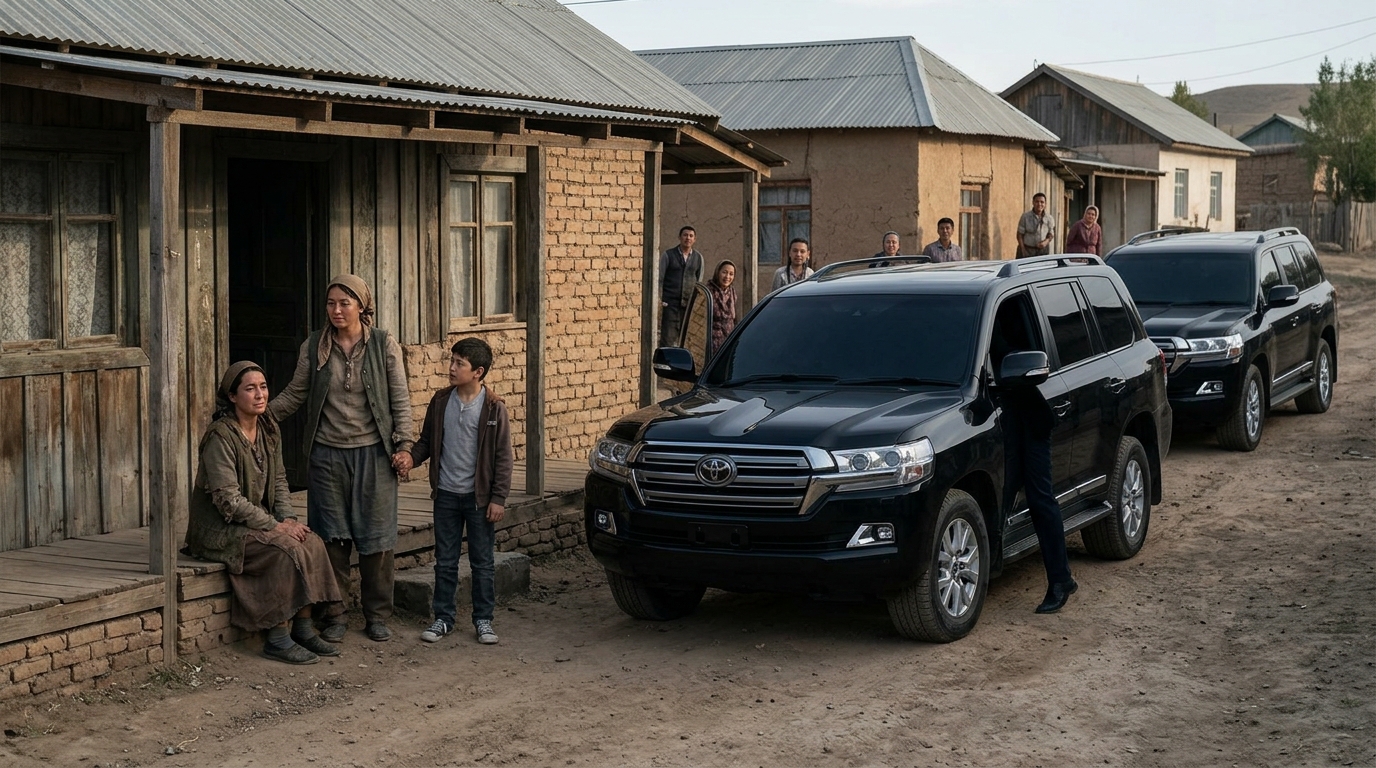
Then the first black SUV appeared.
Sleek.
Polished.
Completely out of place against the narrow village lane.
Then another.
And another.
Five in total.
They moved slowly but with unmistakable authority.
Every conversation stopped.
The women near the well fell silent.
Children paused in the road.
Even Elder Bastian lowered his folded paper.
The convoy did not stop at the elder’s house.
It did not stop at the wealthy landowner’s home.
It did not stop near the church.
It drove straight to Mara’s crumbling house.
Eli’s hand found his mother’s.
Mara gripped it tightly.
Her eyes filled with tears.
Not from fear.
From recognition.
Because on the hood of the leading SUV was a small silver emblem.
A compass inside a laurel wreath.
The seal of the Voss family.
The past had finally found them.
The Man in the Black Suit
The first door opened.
A polished black shoe stepped onto the dusty ground.
Then a man emerged.
Tall.
Middle-aged.
Dressed in a dark suit despite the heat.
His hair was gray at the temples, his face stern, and his eyes carried the exhaustion of someone who had spent years hunting a truth others wanted buried.
Two security officers stepped out behind him.
Then another man holding a leather document case.
The villagers stared.
No one breathed.
The man in the suit looked at Mara.
For one long second, he did not speak.
Then he bowed.
Deeply.
Not a polite nod.
Not a greeting.
A bow of respect.
The village gasped.
Mara’s lips trembled.
“Lord Voss,” she whispered.
Elder Bastian went pale.
Lord Elias Voss was Adrian’s uncle.
One of the most powerful men in the capital.
For years, newspapers had described him as reclusive, severe, and impossible to influence.
Now he stood in the dirt outside Mara’s house, bowing to the woman the village had mocked.
When he straightened, his eyes moved to Eli.
Something broke across his face.
A flicker of pain.
Then wonder.
“You look like him,” he said.
Eli looked up at his mother.
Mara nodded once.
Only once.
That was all the permission he needed to keep standing.
Lord Voss stepped closer, slowly, as if afraid sudden movement might shatter the moment.
“You are Eli?”
The boy swallowed.
“Yes, sir.”
Lord Voss lowered himself to one knee before him.
The villagers recoiled in shock.
A nobleman.
A national figure.
Kneeling in the dust before Mara’s son.
“My name is Elias Voss,” he said. “I was your father’s uncle.”
Eli stopped breathing.
Mara closed her eyes.
The word had finally entered the open.
Father.
Not rumor.
Not shame.
Not absence.
A man.
A name.
A bloodline.
A history.
Eli’s voice shook.
“My father?”
Lord Voss looked toward Mara.
“May I?”
She nodded.
He opened the leather case and removed a photograph.
Old.
Worn.
Carefully preserved.
It showed Adrian Voss in uniform, younger than in the newspapers, standing beside a river.
Eli reached for it with trembling hands.
The resemblance was undeniable.
The same eyes.
Same brow.
Same solemn mouth.
A murmur moved through the village.
Elder Bastian’s face turned gray.
Mara saw it.
And for the first time in ten years, she did not look away.
The Truth in the Wooden Box
Lord Voss stood and faced the villagers.
His voice carried without effort.
“I understand this village has had many opinions about Mara.”
No one moved.
“Opinions about her child.”
The women near the well looked down.
Elder Bastian tried to recover.
“My lord, we were only concerned with proper records—”
Lord Voss turned his head.
The elder stopped.
“You were concerned with judgment,” Lord Voss said. “Do not dress it as procedure.”
The silence turned sharp.
Mara felt Eli’s hand trembling in hers.
Lord Voss looked back at her.
“We searched for you for years.”
Her face tightened.
“I could not risk answering.”
“I know.”
That answer nearly broke her.
For ten years, part of her had wondered if silence had become abandonment in the other direction.
If Adrian’s family had forgotten.
If no one had ever tried.
Lord Voss continued:
“Adrian’s death was not as reported. His records were sealed. His allies were hunted. We found fragments of his final communications only after the men who betrayed him lost power.”
He looked toward Eli.
“Your father was not merely a soldier. He was a witness. He died protecting evidence that saved many lives.”
Mara’s tears fell silently now.
Eli stared at the photograph.
The lawyer beside Lord Voss stepped forward and opened a folder.
“There are legal matters,” he said carefully. “Recognition documents. Inheritance protections. Formal confirmation of marriage.”
The villagers stirred again.
Marriage.
The word struck harder than any insult.
Elder Bastian whispered:
“Marriage?”
Mara turned and walked into her house.
Everyone watched.
When she returned, she carried the wooden box.
The one she had hidden for a decade.
She opened it in front of them.
Inside lay the silver ring.
The marriage certificate.
The letters tied with blue thread.
Proof.
Not that she owed it to them.
But because her son deserved to see shame die in daylight.
She handed the certificate to Lord Voss.
He unfolded it.
Read it.
Then bowed his head.
“My nephew’s wife,” he said quietly.
Mara covered her mouth.
The villagers looked as if the ground beneath them had shifted.
For ten years, they had called her abandoned.
Immoral.
Nameless.
But she had been a widow.
A wife.
A woman protecting her child from enemies far larger than village gossip.
Eli looked at her.
“You were married?”
She turned to him, tears in her eyes.
“Yes.”
“To my father?”
“Yes.”
“Why didn’t you tell me?”
The question held pain.
Not accusation.
Mara knelt before him.
“Because there were people who would have used your name to find you. I thought silence would protect you until I knew it was safe.”
He looked at the photograph again.
“Was he good?”
Mara’s voice broke.
“He was trying to be.”
Eli nodded slowly.
As if that answer mattered.
As if he understood more than a child should.
Then he stepped into his mother’s arms.
She held him tightly.
In front of the whole village.
And this time, no one dared whisper.
The Elder’s Apology
Elder Bastian tried to apologize.
Not immediately.
At first, he tried to explain.
“My lady, had we known—”
Mara lifted her head.
The title sounded strange.
My lady.
From a man who had called her household improper less than ten minutes earlier.
“Had you known what?” she asked.
The elder swallowed.
“That you were connected to—”
“To power?” Mara’s voice remained calm. “You would have respected me if you knew powerful men might come?”
His face flushed.
“That is not what I meant.”
“It is exactly what you meant.”
The villagers stood frozen.
Mara stepped toward him.
“For ten years, I was still a mother. Still a worker. Still a woman feeding her child with her own hands. None of that was enough for you.”
The elder looked down.
“I apologize.”
Mara studied him.
“No,” she said quietly. “You are embarrassed.”
He flinched.
“There is a difference.”
Lord Voss watched silently.
Mara turned to the gathered villagers.
Some would change after this.
Some would pretend they had never been cruel.
Some would claim they always suspected there was more to her story.
Some would apologize because the SUVs frightened them.
But fear was not remorse.
And Mara had learned too much to confuse the two.
Mrs. Halden from the market began crying.
“I said terrible things.”
Mara looked at her.
“Yes.”
The woman wiped her cheeks.
“I’m sorry.”
Mara did not answer immediately.
Then said:
“Tell that to my son.”
Mrs. Halden turned to Eli.
Her lips trembled.
“I am sorry.”
Eli looked at her for a long moment.
Then said:
“You should say sorry to every child you taught to laugh at me.”
The old woman lowered her head.
That was the first time Mara saw her son not as the boy she had protected, but as someone who had survived with a dignity of his own.
The Choice
Lord Voss expected them to leave.
Not harshly.
But naturally.
The SUVs were waiting.
The capital was waiting.
A house prepared under protection.
Tutors.
Doctors.
Lawyers.
A life Eli had inherited without knowing it.
He explained it gently inside Mara’s small home while the villagers remained outside, still pretending not to listen.
“You are not safe here now that the truth is public,” he said.
Mara looked around the room.
The patched curtain.
The clay stove.
The floorboards that had hidden her marriage.
The wall where she had marked Eli’s height every birthday.
Safe.
What a strange word.
This house had never been safe.
But it had been theirs.
Eli stood beside the window, still holding his father’s photograph.
“Do we have to go?” he asked.
Mara looked at Lord Voss.
He answered carefully.
“No. But I would strongly advise it.”
Eli looked at his mother.
“What do you want?”
For ten years, every choice Mara made had been for survival.
For protection.
For food.
For secrecy.
No one had asked what she wanted in so long that the question felt almost impossible.
She looked at Adrian’s ring in her palm.
Then at her son.
“I want you to grow without lowering your head.”
Eli’s eyes filled.
“I already learned that from you.”
Lord Voss turned away slightly.
Even the stern lawyer blinked too often.
Mara took a breath.
“Then we will go. Not because they shamed us out.”
She looked toward the village outside.
“But because we do not have to remain where pain is familiar.”
Eli nodded.
“Can we take the height marks?”
Mara smiled through tears.
“We can take the doorframe.”
Lord Voss, to his credit, did not laugh.
He simply turned to one of his men.
“Remove it carefully.”
And that was how the most powerful convoy the village had ever seen waited while two security officers removed a cracked wooden doorframe from a crumbling house because a ten-year-old boy wanted proof that he had grown there.
The Departure
When Mara stepped outside with Eli, the whole village had gathered.
No one spoke.
The same people who had once watched her carry water now watched guards carry her wooden box, her few bags, and the marked doorframe toward the SUVs.
The same women who had mocked her patched clothes now stared at the silver ring on her finger.
The same men who had dismissed her son now avoided his eyes.
Elder Bastian stood near the well, folded paper still in hand.
The scholarship complaint.
Mara looked at it.
So did Lord Voss.
The elder slowly tore it in half.
It was a small gesture.
Too late.
But Eli watched it with satisfaction.
As they approached the lead SUV, a little girl from Eli’s school stepped forward.
Her name was Lina.
She had never mocked him, but she had never defended him either.
She held out a small pencil.
“You forgot this yesterday,” she said.
Eli looked at it.
Then at her.
She whispered:
“I’m sorry I didn’t say anything when they laughed.”
Eli took the pencil.
“Next time say something.”
Lina nodded.
“I will.”
Mara watched.
That, she thought, was where change might begin.
Not in the adults who feared power.
In children learning that silence has a side.
Lord Voss opened the SUV door.
Before entering, Mara turned back toward the village.
Her crumbling house stood behind her.
Small.
Tired.
Sacred in ways no mansion could be.
She did not hate it.
She did not hate the village either.
Hate required carrying them longer.
She was done carrying more than necessary.
Eli climbed in first.
Then stopped.
“Mother?”
“Yes?”
He looked at the villagers.
“Should I wave?”
Mara almost smiled.
“Only if you want to.”
He thought about it.
Then lifted his hand.
Not grandly.
Not bitterly.
Just once.
A farewell.
A few villagers waved back.
Most stood frozen.
The door closed.
The SUV began to move.
As the convoy rolled away, dust rose behind them, softening the village into a blur.
Mara looked through the window until her house disappeared.
Eli leaned against her.
“Were they wrong about us?”
Mara put her arm around him.
“Yes.”
“Were we always important?”
She looked down at her son.
Not Adrian’s heir.
Not Lord Voss’s nephew.
Not a secret bloodline.
Her boy.
The child she had fed, held, protected, and loved through ten years of names.
“Yes,” she said. “Long before the cars came.”
What the Village Remembered
After Mara left, the village changed in the way places change when shame has nowhere to hide.
Slowly.
Unevenly.
Some people insisted they had never said anything cruel.
Others corrected them.
For once.
Mrs. Halden stopped gossiping at the market for almost a month, which the villagers considered a miracle.
Elder Bastian retired the following spring after parents complained about how he had handled Eli’s scholarship review.
The schoolteacher began a rule that no child’s family history could be used as insult without consequence.
Lina became the first to raise her hand when someone broke it.
The old house at the edge of the village remained empty.
For a while, people avoided passing it.
Then one day, the schoolteacher brought her students there and told them:
“This is where a mother protected her son while we judged what we did not understand.”
The children listened.
Some understood.
Some would understand later.
As for Eli, he did not forget the village.
He studied in the capital.
He learned his father’s name and his mother’s strength were both parts of him.
He visited the memorial where Adrian Voss was finally honored truthfully.
Not as a convenient dead hero.
But as a man betrayed, a witness silenced, and a father whose son had survived because Mara kept silence like a shield.
Years later, when Eli was old enough to speak publicly, reporters asked him what it felt like to discover he had noble blood.
He answered:
“I discovered no such thing.”
The reporter blinked.
“But Lord Voss confirmed—”
“My blood did not become noble because black SUVs came to my mother’s house,” Eli said. “My mother made our life noble when she carried firewood, cooked over open flames, and never let me believe cruelty was truth.”
The clip spread quickly.
People praised him.
Mara watched from the back of the hall, wearing a simple blue dress and Adrian’s ring.
When Eli stepped down, she touched his cheek.
“You spoke well.”
He smiled.
“I learned from you.”
The Truth About Judgment
The villagers had thought the convoy made Mara important.
They were wrong.
The convoy only revealed what their judgment had hidden.
Mara had been important when she stood alone at the well.
Important when she worked with blistered hands.
Important when she swallowed insults so Eli could walk home safely.
Important when she hid a ring beneath the floorboards not because she was ashamed, but because love sometimes survives by staying silent.
Important when she taught her son not to answer dirt with dirt.
Important before Lord Voss bowed.
Important before the village gasped.
Important before the black SUVs turned the road to dust.
That was the terrifying blunder the villagers made.
They believed dignity needed witnesses.
They believed a woman’s worth depended on the man standing beside her.
They believed poverty was proof of failure.
They believed silence meant guilt.
Then the door of the SUV opened.
And the truth stepped out in polished black shoes.
But by then, Mara no longer needed the village to understand.
She had already survived them.
And survival, when done with love, is its own kind of royalty.