Chapter 1: The Flower in the Mud
The sky hung heavy and gray over the graveyard.
Cold wind moved through rows of black umbrellas, bending the white flowers around the open grave. Rain had not fully started yet, but the air already carried that damp, metallic chill that makes every breath feel heavier than it should.
Around the flower-covered coffin stood the city’s wealthiest families.
Men in tailored black coats.
Women in pearls and veils.
Executives with solemn faces.
Politicians pretending grief was not another form of networking.
They had gathered to bury Elias Whitmore.
Hotel owner.
Real estate magnate.
Philanthropist.
One of the most powerful men in the state.
The newspapers called him a visionary.
The mourners called him generous.
The priest called him beloved.
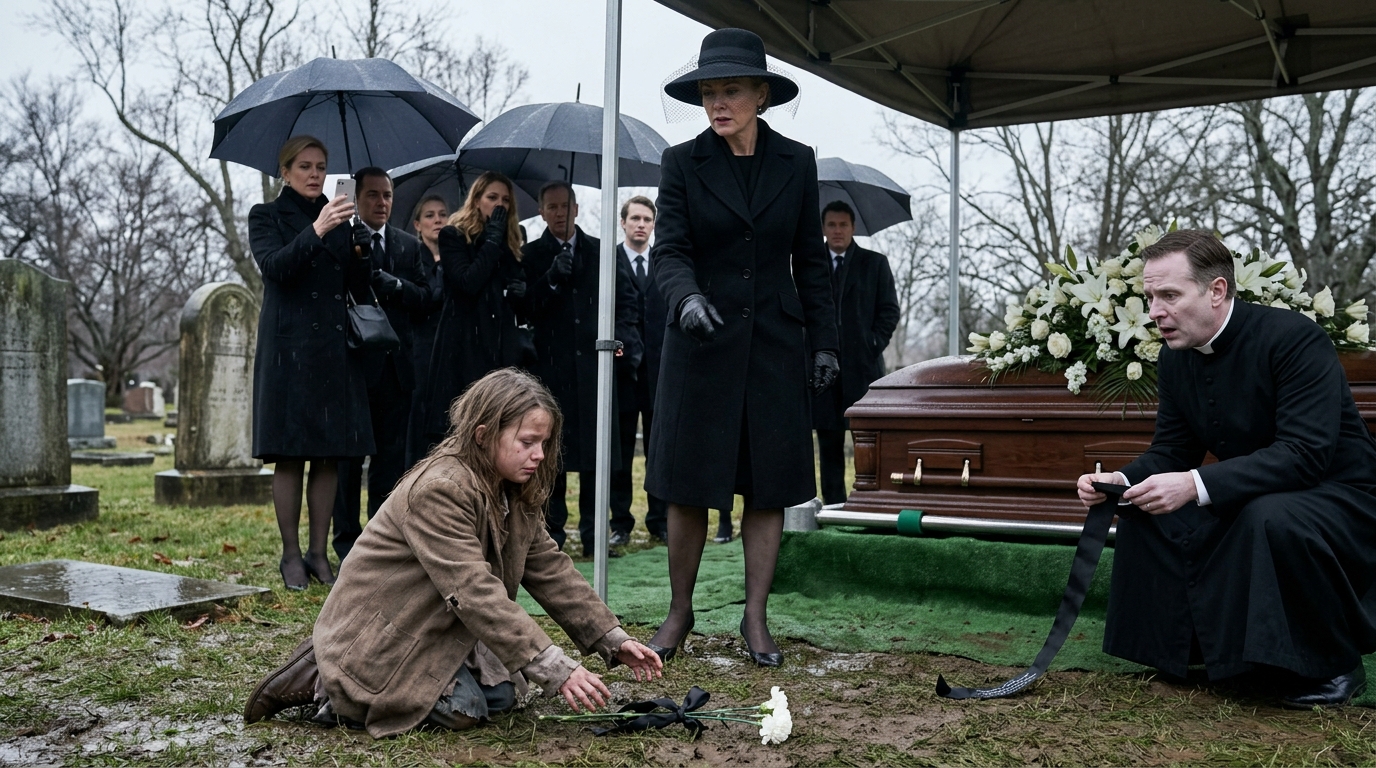
But near the edge of the graveyard, a little girl stood alone in a ragged brown coat, clutching a single white flower tied with a black ribbon.
She looked no older than seven.
Small.
Thin.
Wet from the wind.
Her shoes were muddy, and one sleeve of her coat had been mended with thread that did not match.
She did not belong among the polished mourners.
Everyone could see that.
But she kept walking toward the coffin.
Step by step.
Frightened.
Yet determined.
A few people noticed her first.
A woman near the back whispered:
“Whose child is that?”
Another murmured:
“She looks homeless.”
The girl ignored them.
Her eyes stayed fixed on the coffin.
Then the widow saw her.
Vivienne Whitmore stood at the head of the grave in a fitted black dress and veil, her gloved hands folded around a handkerchief. Her grief looked perfect. Elegant. Controlled.
Until she saw the child.
Something flashed across her face.
Not confusion.
Not sympathy.
Fear.
Then fury.
She stepped forward quickly, cutting through the mourners before the girl could reach the coffin.
“You,” Vivienne hissed.
The little girl stopped.
Her fingers tightened around the flower.
“I need to give this to him.”
Vivienne’s expression hardened.
“You do not come near this family with your dirty little lies.”
The girl’s lips trembled.
“My mother said—”
Vivienne slapped the flower from her hands.
The white bloom fell into the mud.
A few mourners gasped.
Someone raised a phone.
The little girl dropped to her knees instantly, tears spilling down her cheeks as she reached for the flower with trembling hands.
“My mother said this had to touch the coffin before they buried him,” she cried.
Vivienne scoffed.
“Your mother was a liar.”
The girl flinched as if struck.
The priest, Father Gabriel, had been watching from beside the coffin. He was an older man, quiet and careful, with a face shaped by years of hearing people confess things they were too afraid to say anywhere else.
He stepped forward.
“Mrs. Whitmore,” he said softly, “she is only a child.”
Vivienne did not look at him.
“She is a disturbance.”
Father Gabriel crouched beside the girl and picked up the flower from the mud.
The petals were bent but not broken.
The black ribbon had partly loosened.
As he unfolded it gently, his fingers stopped.
There, stitched inside the ribbon in tiny silver thread, was a name.
Amelia Rose Whitmore
Father Gabriel went still.
The wind moved through the umbrellas.
His face drained of color.
Slowly, he looked toward the coffin.
White lilies covered the lid.
Too many lilies.
Too carefully arranged.
With one trembling hand, he brushed aside part of the floral blanket near the lower edge.
A second plaque was hidden beneath the flowers.
Not the main plaque bearing Elias Whitmore’s name.
Another one.
Smaller.
Almost concealed.
Father Gabriel stared at it.
His lips parted.
The same name was engraved there.
Amelia Rose Whitmore
Beloved Daughter
His voice trembled as he turned back toward the child.
“Why is the same daughter named both on the ribbon…”
He looked at the coffin again.
“…and on the coffin?”
The cemetery went silent.
Vivienne’s face lost all color.
The mourners turned toward the coffin in bewilderment.
And in that heavy silence, everyone realized—
Something buried here was never meant to be uncovered.
Chapter 2: The Daughter Who Was Supposed to Be Dead
The little girl looked from the priest to the coffin.
Then to Vivienne.
She did not understand everything.
But she understood enough to be afraid.
“My name is Amelia,” she whispered.
The words moved through the crowd like wind through dry leaves.
A man near the grave muttered:
“That’s impossible.”
A woman in a black hat crossed herself.
Vivienne’s jaw tightened.
“This is obscene,” she snapped. “Someone sent her here. This is a performance.”
Father Gabriel remained crouched beside the child.
His eyes did not leave her face.
“What was your mother’s name?”
The girl swallowed.
“Clara.”
The priest closed his eyes.
For a moment, he looked as if the grave beneath them had opened.
Clara Whitmore.
Everyone old enough to remember the family knew that name.
Clara had been Elias Whitmore’s first wife.
Not the wife in the portraits.
Not the wife at charity galas.
The first one.
The quiet one.
The one who disappeared eight years earlier.
Officially, Clara had died in a mountain-road accident while pregnant.
At least, that was what the family statement said.
A tragic crash.
A mother and unborn child lost.
Elias had grieved privately.
Vivienne, then a close family adviser, had stepped into his life during the aftermath.
Two years later, she became his wife.
And now, on the day of Elias’s burial, a child stood in the mud claiming to be the daughter who had supposedly never lived.
Father Gabriel’s voice grew faint.
“Clara had a daughter?”
Amelia nodded.
“My mom said they told him I died.”
Vivienne moved forward sharply.
“That is enough.”
The priest stood now, holding the black ribbon.
“No,” he said.
The word was quiet.
But it stopped her.
Vivienne stared at him.
“Excuse me?”
Father Gabriel looked at the second plaque again.
“Why is this child’s name on Mr. Whitmore’s coffin?”
Vivienne’s face hardened.
“It was symbolic. Elias never recovered from losing his unborn daughter. I wanted them joined in memory.”
A murmur passed through the mourners.
It almost sounded reasonable.
Almost.
Then Amelia spoke again.
“My mother said the coffin would have my name.”
Vivienne froze.
The priest looked back at the child.
“What?”
Amelia wiped her cheeks with the back of her hand.
“She said if the flower touched the coffin, Grandpa would know I came.”
The crowd shifted.
Grandpa.
The word landed differently.
Father Gabriel lowered his gaze to the ribbon.
“Who gave you this flower?”
“My mother.”
“Where is she?”
The girl’s lips trembled.
“She didn’t wake up.”
The cemetery went colder.
Vivienne looked away.
Just once.
But Father Gabriel saw it.
So did a tall man standing near the back of the mourners.
His name was Julian Whitmore, Elias’s younger brother.
And for the first time since the service began, his face changed from grief to suspicion.
Chapter 3: The Widow’s Perfect Grief
Vivienne had spent years becoming untouchable.
She did not come from the Whitmore family, but she learned quickly how to move inside it.
She knew which lawyers mattered.
Which board members could be flattered.
Which relatives could be bought with invitations.
Which servants could be dismissed before they became witnesses.
After Clara disappeared, Vivienne became essential.
She handled Elias’s schedule.
Then his estate communications.
Then the charity foundation.
Then the family office.
Then, eventually, Elias himself.
People said she rescued him from grief.
People said she restored order.
People said Elias was lucky to have found such a devoted woman after tragedy.
No one asked why Clara’s belongings vanished from the house within a week.
No one asked why the accident file was sealed.
No one asked why Elias stopped speaking publicly about Clara after Vivienne moved into the estate.
No one asked because wealth teaches people not to ask questions that might make dinner uncomfortable.
But Father Gabriel had asked once.
Years ago.
He had officiated Clara and Elias’s small private wedding.
He remembered how Elias looked at Clara.
Not like a powerful man showing off a bride.
Like a man who had finally found someone he could be human beside.
He remembered Clara’s hand on her stomach during the final blessing.
She had whispered afterward:
“If it’s a girl, we’ll name her Amelia.”
Father Gabriel had smiled.
“Does Elias know?”
Clara laughed.
“He knows. He pretends we are discussing it, but we are not.”
Then she vanished.
And Father Gabriel was told grief had made Elias too fragile to receive visitors.
Later, he was told Elias had accepted the loss.
Then Vivienne became Mrs. Whitmore.
Father Gabriel never fully believed the story.
But doubt without proof becomes another kind of silence.
Now proof stood at his feet, muddy and trembling.
Vivienne reached for Amelia’s arm.
“Come with me,” she said coldly. “This ends now.”
The girl recoiled.
Father Gabriel stepped between them.
“Do not touch her.”
The mourners gasped again.
Vivienne’s eyes widened.
“Father.”
His voice was firm.
“I said do not touch her.”
For the first time that day, the widow’s perfect grief cracked.
Chapter 4: The Hidden Note
Julian Whitmore stepped forward.
“Father Gabriel,” he said, voice low, “what exactly is happening?”
Vivienne turned sharply.
“Julian, do not encourage this.”
He ignored her.
His eyes were on the child.
“Little girl,” he said gently, “do you have anything else from your mother?”
Amelia hesitated.
She looked at Father Gabriel.
He nodded.
“You are safe.”
For a moment, she seemed to consider whether safety was a real thing or only another word adults used before taking something away.
Then she reached inside her coat.
From an inner pocket, she pulled out a folded plastic pouch, carefully wrapped and tied with string.
“My mom said only give this if they tried to stop me.”
Vivienne’s face drained further.
Julian saw.
So did Father Gabriel.
The priest took the pouch carefully and opened it.
Inside was a letter.
The paper was worn, but the ink was still legible.
At the top was written:
To Father Gabriel, if my daughter reaches the grave.
The priest’s hands began to shake.
He unfolded it.
The wind quieted for one strange moment, as if the cemetery itself were listening.
Father Gabriel read aloud:
Father, if Amelia is standing before you, then I am gone, or close enough to gone that the truth must walk without me.
His voice faltered.
Then continued.
My daughter is alive. She is Elias Whitmore’s child. They told him she died because Vivienne needed the estate clean before she married him.
Vivienne shouted:
“Lies!”
Julian turned toward her.
“Let him finish.”
The priest read on.
The accident was not an accident. I was taken from the road before the car was pushed into the ravine. I was told Elias had chosen silence. I was told if I ever returned, my daughter would vanish. So I hid. I raised her with nothing because nothing was safer than the Whitmore name in the wrong hands.
Amelia began to cry silently.
Father Gabriel’s voice broke.
Elias found us two months ago. He came alone. He held Amelia and wept so hard he could not speak. He said he would fix everything. He said he would change the will. He said he would bring us home.
Julian’s face went pale.
Vivienne stood utterly still now.
No performance left.
Only calculation.
Father Gabriel swallowed and read the final lines.
Then Elias died before signing the final papers. If they bury him with Amelia’s name on the coffin, it is because Vivienne wants the world to believe his daughter is dead too. Do not let them bury my child a second time.
The cemetery went silent.
No one even shifted under the umbrellas.
Father Gabriel lowered the letter.
Amelia looked up at him.
“My mom said he loved me.”
The priest’s eyes filled.
“Yes,” he whispered.
“I believe he did.”
Chapter 5: The Coffin Must Not Close
Vivienne recovered with terrifying speed.
“She forged it,” she said.
Her voice was shaking now, but sharp.
“Clara was unstable. Elias knew that. This child could be anyone.”
Julian stepped closer.
“Then why is her name on the coffin?”
Vivienne’s eyes flashed.
“I already explained that.”
“No,” Julian said. “You explained why a memorial plaque might exist. You did not explain how Clara knew it would be hidden under the flowers.”
A murmur passed through the mourners.
The funeral director, a nervous man in a black coat, looked as if he wanted to disappear into the earth.
Julian turned to him.
“Who ordered the second plaque?”
The funeral director’s mouth opened.
Vivienne snapped:
“Do not answer that.”
Julian’s voice hardened.
“Answer.”
The man swallowed.
“Mrs. Whitmore did.”
Vivienne’s face turned cold.
“It was a gesture of love.”
Julian looked at Amelia.
The child still held the muddy white flower.
“No,” he said. “It was a cover.”
Father Gabriel turned toward the coffin.
“We cannot proceed with the burial.”
The priest’s statement landed heavily.
Vivienne spun toward him.
“You have no authority to stop this funeral.”
Father Gabriel looked at her with quiet sorrow.
“I have moral authority. And I am using it.”
Julian pulled out his phone.
“I’m calling the police.”
Vivienne stepped forward.
“Julian, think carefully.”
He looked at her.
“I am.”
A gust of wind tore through the cemetery.
Umbrellas shook.
White flowers slid across the coffin lid, revealing more of the second plaque.
Amelia Rose Whitmore
The living child stared at her own name carved into metal beside a dead man’s coffin.
Something inside Julian seemed to break.
He knelt in front of her.
“Amelia,” he said softly, “did Elias know you?”
She nodded.
“He came to our room.”
“When?”
“Before he died.”
“What did he say?”
The girl looked down at the flower.
“He said I had Clara’s eyes.”
Julian closed his eyes.
Elias had said those exact words once.
At a family dinner years before, looking at Clara across the table.
She has eyes that make lying difficult.
Julian stood.
His voice was no longer uncertain.
“This burial is stopped.”
Chapter 6: The Room Above the Bakery
The police arrived within thirty minutes.
By then, the mourners had separated into clusters of whispers.
Some left quietly.
Some stayed because scandal among the wealthy has its own gravitational pull.
Vivienne refused to speak without her lawyer.
Father Gabriel gave the letter.
Julian gave his statement.
The funeral director admitted the second plaque had been ordered in secrecy and covered with flowers at Vivienne’s request.
Amelia sat in the priest’s car wrapped in a wool blanket, clutching the white flower now stained with mud.
A female detective named Mara Ellis crouched beside her.
“Amelia,” she said gently, “where did you live with your mother?”
The girl looked toward Vivienne.
Even from across the cemetery, Vivienne’s presence frightened her.
Detective Ellis noticed.
“She cannot hurt you right now.”
Amelia whispered:
“Above the bakery.”
“What bakery?”
“Saint Rose Bakery. The one with the blue door.”
Julian knew it.
A small bakery on the poor side of the city.
He drove there with police shortly after.
The room above the bakery was tiny.
One bed.
One cracked window.
A small table.
A shelf with children’s books.
A kettle.
A sewing box.
A photograph hidden behind a loose brick.
Inside the photograph, Elias Whitmore sat on the edge of the bed, holding Amelia in his arms.
His face was wet with tears.
Clara sat beside them, thinner than she had been years earlier, but alive.
On the back of the photo was written:
He found us. He believed me. He promised to bring Amelia home.
Detective Ellis found more.
Copies of old hospital documents.
A marriage certificate.
A birth record.
Letters Clara had written but never sent.
A recording device.
On the recording, Elias’s voice could be heard clearly.
“I will correct the will tomorrow. Vivienne cannot touch Amelia’s inheritance if the trust is restored.”
Then Clara’s voice:
“She will not let you.”
Elias answered:
“She already took years from us. She will not take another day.”
The recording ended there.
Elias died the next night.
Heart failure, the doctor had said.
Sudden.
Tragic.
Convenient.
Chapter 7: The Widow’s Lie
Vivienne’s lawyers arrived fast.
Power always does.
They argued grief.
Forgery.
Manipulation.
They suggested Clara had been mentally unstable and had used a child to extort the family.
But facts are stubborn things.
The birth record was real.
The DNA test ordered by police confirmed Amelia was Elias Whitmore’s daughter.
The handwriting matched Clara’s known letters.
The second plaque had been ordered before the funeral.
The will revision documents were found in Elias’s private study, unsigned but prepared by his attorney.
And most damaging of all, Elias’s personal assistant admitted he had scheduled a meeting with the family lawyer on the morning after his death.
Purpose listed:
Trust amendment — Amelia R. Whitmore
Vivienne’s version began collapsing.
Then the toxicology report came back.
Elias had not died naturally.
His medication had been tampered with.
The investigation widened.
The widow who had stood over his coffin in expensive sorrow was now the prime suspect in his death.
But Amelia did not understand words like suspect, estate, toxicology, or trust amendment.
She understood simpler things.
Her mother was gone.
The man who had hugged her and called her his daughter was gone.
And the woman who tried to throw her flower into the mud had wanted her buried under a nameplate before she ever got to live under her own name.
Chapter 8: Clara’s Last Letter
Clara was found two days later.
Not alive.
She had died in the room above the bakery before Amelia walked to the cemetery.
The bakery owner, an elderly woman named Rosa, said Clara had been ill for weeks but refused to go to the hospital.
“She was afraid they would find the child,” Rosa whispered. “She said the rich bury poor women twice. Once in life, once in papers.”
Among Clara’s belongings was one final letter for Amelia.
Julian asked Detective Ellis if he could give it to the girl.
The detective agreed only after a child advocate was present.
They sat in Father Gabriel’s office, where the air smelled faintly of old wood and candle wax.
Amelia held the white flower in her lap.
Julian sat across from her, unsure what right he had to offer comfort.
He was her uncle.
But blood alone felt too small after everything blood had failed to protect.
Father Gabriel unfolded the letter and read softly:
My little Amelia,
If you are hearing this, then I could not stay as long as I wanted. I am sorry. I wanted to walk beside you into that cemetery. I wanted to hold your hand when they saw your face. I wanted to tell your father’s family that you were not a rumor, not a mistake, not a secret.
Amelia’s eyes filled.
Your father loved you. Remember that. He was late, but he came. He cried when he saw you. He said your name like it was a prayer.
Julian covered his mouth.
Do not let anyone make you ashamed of surviving. You were not supposed to be hidden. You were hidden because people were afraid of what your life would prove.
Father Gabriel paused, voice breaking.
Then continued.
Take the flower to the coffin. Let it touch what they tried to close. Not because the dead need flowers, but because the living need truth.
Amelia looked down at the muddy white flower.
And if anyone asks who you are, say it clearly.
I am Amelia Rose Whitmore.
I am Clara’s daughter.
I am Elias’s daughter.
I am alive.
The room was silent when Father Gabriel finished.
Amelia wiped her cheeks.
Then whispered:
“I am alive.”
Julian bowed his head.
“Yes,” he said.
“You are.”
Chapter 9: The Second Funeral
Elias Whitmore was buried one week later.
Not in the same way.
This time, there was no hidden plaque.
No forced performance.
No widow in perfect control.
Vivienne sat in a detention facility awaiting trial.
The flowers were simple.
The crowd smaller.
Many who had attended the first funeral stayed away from the second, embarrassed by how quickly they had believed the polished lie.
Amelia stood beside Julian.
Father Gabriel held the same white flower Clara had sent, now cleaned and tied again with the black ribbon.
Before the coffin was lowered, he handed it to Amelia.
She looked at the lid.
Then at Julian.
“Will he know?”
Julian knelt beside her.
“I think he already does.”
Amelia stepped forward.
Her small hand shook as she placed the flower on the coffin.
The ribbon rested against the wood.
Her name visible in silver thread.
This time, no one slapped it away.
No one called her dirty.
No one told her she did not belong.
Father Gabriel began the prayer.
But before he could finish, Amelia spoke.
Softly.
Yet clearly.
“My name is Amelia Rose Whitmore.”
The priest stopped.
Everyone looked at her.
She swallowed.
“I am Clara’s daughter.”
Her voice trembled.
“I am Elias’s daughter.”
Julian’s eyes filled.
Amelia looked at the coffin.
“And I am alive.”
The wind moved through the cemetery.
Not harsh this time.
Gentle.
As if something trapped there had finally been released.
Chapter 10: The House With Too Many Rooms
Julian became Amelia’s temporary guardian while the courts sorted through the estate.
He did not take her to the Whitmore mansion immediately.
That was his first wise decision.
The mansion had too many ghosts.
Too many rooms Vivienne had touched.
Too many portraits of people who had mistaken reputation for honor.
Instead, Julian brought Amelia to his own home.
A smaller house near the river with warm lights, a messy kitchen, and a dog named Henry who immediately decided Amelia belonged to him.
For the first few nights, Amelia slept with her shoes beside the bed.
Then under the pillow.
Then finally on the floor near the door.
Julian noticed but said nothing.
A child who has lived in fear does not need every survival habit pointed out like a flaw.
She carried the black ribbon everywhere.
Sometimes in her pocket.
Sometimes tied around her wrist.
Sometimes wrapped around the white flower, now dried and placed in a small glass case on her bedside table.
At night, she asked questions.
“Did my father like soup?”
“Yes.”
“Did he laugh loudly?”
“When he forgot to be important.”
“Did he know my birthday?”
Julian’s throat tightened.
“He learned it. I found it written in his notebook.”
“Did he write my name?”
“Yes.”
“Can I see?”
The next day, Julian showed her.
In Elias’s handwriting, on the last page of his personal notebook, were the words:
Amelia Rose Whitmore — bring home.
Amelia touched the page gently.
Then cried for a long time.
Chapter 11: What Was Almost Buried
Vivienne’s trial became one of the most public scandals the city had ever seen.
The prosecution argued that she had helped cover Clara’s disappearance years earlier, manipulated Elias, concealed Amelia’s existence, and later tampered with Elias’s medication to prevent him from changing the trust.
Her attorneys denied everything.
They blamed Clara.
Then Elias.
Then stress.
Then confusion.
But the evidence was relentless.
The hidden plaque.
The funeral director’s testimony.
The toxicology report.
The recording from the bakery room.
The forged statements from the old accident.
The financial motive.
During trial, the prosecutor held up the black ribbon.
“This,” she said, “is not merely a ribbon. It is the thread that pulled a buried lie into daylight.”
Amelia did not attend most of the proceedings.
Julian and Father Gabriel agreed she had already carried enough truth for adults.
But years later, when she was older, she would read the transcripts.
She would learn how close she had come to being erased.
She would learn how many people looked away because the lie was dressed better than the truth.
She would learn that her mother, poor and sick above a bakery, had outwitted a woman with lawyers, money, and a mansion by trusting one thing:
A child with a flower could still stop a funeral.
Final Chapter: The Flower That Touched the Coffin
A year after the burial, Amelia returned to the cemetery with Julian.
This time, the sky was clear.
No umbrellas.
No reporters.
No wealthy crowd.
Only grass, wind, and two graves.
Elias Whitmore’s grave.
And beside it, Clara’s.
Julian had made sure Clara was buried with her true name.
Not hidden.
Not erased.
Not reduced to a scandal.
Clara Whitmore
Beloved mother of Amelia Rose Whitmore
Amelia stood between the graves holding fresh white flowers.
She placed one on her father’s grave.
One on her mother’s.
Then she took out the black ribbon.
The original one.
The ribbon that had been slapped into the mud.
The ribbon that had carried her name when no one wanted to speak it.
She tied it gently around the vase between both graves.
Julian stood behind her.
“You okay?”
Amelia thought about it.
Children who have lost too much do not answer that question quickly.
Finally, she said:
“I’m sad.”
Julian nodded.
“That makes sense.”
“But I’m not scared here anymore.”
His eyes softened.
“That matters.”
She looked at her name on the ribbon.
Then at her mother’s name on the stone.
Then at her father’s.
“My mom said the flower had to touch the coffin before they buried him.”
“Yes.”
“Why?”
Julian knelt beside her.
“Because once it touched the coffin, the truth touched the lie. And after that, the lie could not stay closed.”
Amelia considered that.
Then nodded.
The wind moved gently through the cemetery.
For a long time, neither of them spoke.
There was no dramatic music.
No crowd.
No widow in black.
No phone raised to record a crying child in the mud.
Only a girl who had been named on a coffin while still alive…
standing at last in the open air.
No longer a secret.
No longer a rumor.
No longer a daughter buried under someone else’s lie.
Amelia Rose Whitmore.
Clara’s daughter.
Elias’s daughter.
Alive.