The Boy in the Ballroom
The ballroom had been built to make people forget pain existed.
That was the point of it.
Golden light spilled from crystal chandeliers. Marble floors reflected every movement like still water. Champagne glasses shimmered in gloved hands. Women wore diamonds heavy enough to pull truth out of weaker necks, and men spoke in low voices about charity, legacy, and the importance of giving back.
I knew the language.
I had paid for half of it.
My name was Nathaniel Ashford, and that night’s gala was supposed to be my daughter’s return to the world.
For two years, Clara had lived in a wheelchair.
Not because her spine was severed. Not because the doctors found damage they could name. They had shown me scans, nerve tests, muscle responses, reports written in expensive language that all ended in the same helpless conclusion.
Her body could move.
Her mind would not let it.
Functional paralysis, they called it.
Trauma response.
Conversion disorder.
Words that sounded like explanations until you watched your thirteen-year-old daughter stare at her own legs like they belonged to someone who had betrayed her.
The night it began was the same night my wife died.
A fall down the back staircase of our summer house.
Rain on the windows.
Power out.
My wife, Evelyn, found at the bottom of the stairs.
Clara found sitting against the wall, eyes open, silent, unable to answer a single question.
By morning, she could not stand.
By the funeral, she would not speak unless spoken to.
By the end of the year, the mansion sounded less like a home and more like a museum built around one living ghost.
So I built the gala around her.
That was what rich men do when they cannot fix the wound.
They frame it.
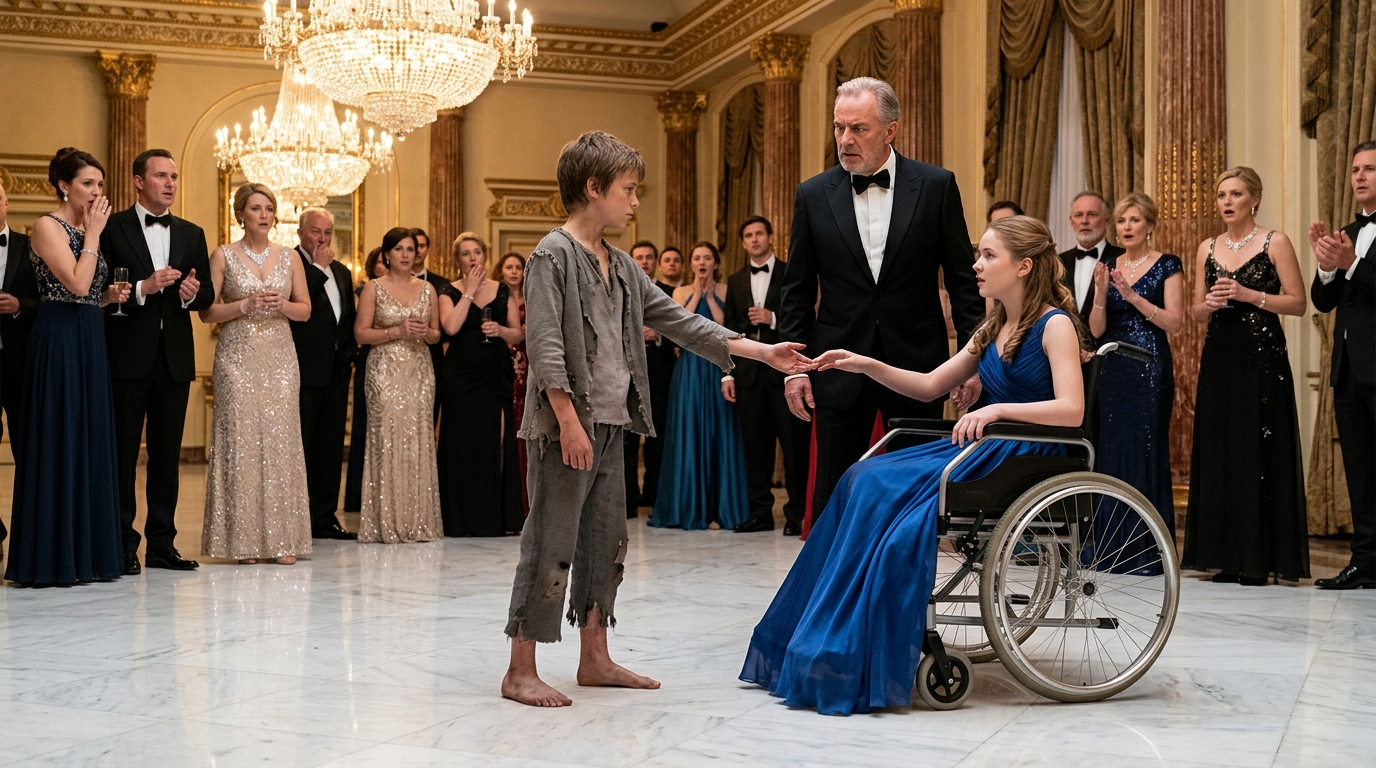
I called it the Ashford Children’s Mobility Fund. We raised money for rehabilitation programs, therapy scholarships, adaptive equipment, and research. Everyone praised my strength. Reporters wrote about my devotion. Donors toasted Clara’s courage while she sat at the center of the ballroom in a blue gown, hands folded on the arms of her wheelchair, looking like something fragile they could admire without understanding.
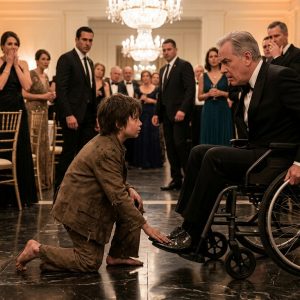
Then the boy walked in barefoot.
At first, no one reacted.
That was how absurd he looked in that room.
A barefoot child in gray rags did not belong beneath chandeliers. His dirty feet looked almost violent against the marble. His hair was tangled. His face was thin. His shirt hung from one shoulder.
But he did not move like a child begging for scraps.
He moved like someone who had finally reached the right place after being chased through every wrong one.
He walked straight toward Clara.
The guests noticed then.
A hush spread.
My sister Vivian, standing near the donor table, stiffened first.
Security took one step forward.
I lifted my hand sharply.
They stopped.
I moved in front of Clara.
The boy stopped three feet away from us.
He looked past me.
Not rudely.
Completely.
As if I were only furniture between him and the person he had come to find.
“May I have this dance?” he asked.
A few people laughed.
Softly.
Cruelly.
The kind of laughter people use when they want to prove they are not uncomfortable.
I stared at him.
“Do you even understand who she is?”
The boy did not look at me.
“I know she wants to dance.”
Behind me, Clara’s fingers tightened on the wheelchair arms.
I heard it.
The faint scrape of her nails against polished wood.
My daughter had not reacted to music, therapy, doctors, prayer, or pleading in two years.
But she reacted to him.
The room felt suddenly colder.
Vivian appeared beside me.
“Nathaniel,” she said quietly, “let security handle this.”
I ignored her.
The boy extended his hand toward Clara.
The gesture was small.
Open.
Certain.
I stepped closer.
“Why should I allow you near her?”
He finally looked at me.
His eyes were dark and older than his face.
“Because I can help her stand.”
A woman in the crowd gasped.
Vivian’s hand closed around my sleeve.
“Enough.”
But Clara leaned forward.
Just an inch.
Just enough to make every person in the room hold their breath.
“What did you say?” I asked.
The boy turned back to my daughter.
“Dance with me.”
Clara’s lips parted.
The boy lowered his voice.
“Stand up.”
Vivian whispered, “Get him out.”
But before security could move, the boy said one more thing.
A name.
Not Clara.
Not Miss Ashford.
A name I had not heard since the night my wife died.
“Bluebird.”
And my daughter began to cry.
The Name No Stranger Should Know
Bluebird was not a public nickname.
It was not printed in birthday cards or embroidered on blankets. It was not something staff used, not something relatives knew, not something that belonged to the world outside our family.
Evelyn had called Clara that when she was small.
My little bluebird.
Because Clara used to hum before she spoke.
Because she sang to herself in the garden.
Because she once told her mother that birds did not fly because they were strong, but because they trusted the air.
After Evelyn died, the nickname disappeared.
I never used it again.
It hurt too much.
Yet here stood a barefoot boy in rags, saying it in the middle of my ballroom as if he had carried it through snow, hunger, and God knew what else just to place it back in my daughter’s hands.
Clara was shaking now.
Her eyes were fixed on him.
Not confused.
Terrified.
Recognizing.
“Who are you?” I asked.
The boy reached into his pocket.
Vivian stepped backward.
That was the first time I saw fear on her face.
Not discomfort.
Not embarrassment.
Fear.
The boy pulled out a tiny brass key tied to a blue thread.
Clara made a sound so small it barely escaped her throat.
The key was old, darkened at the edges, worn smooth from being held too often. The thread tied around it was faded but unmistakable.
Blue silk.
The same silk Evelyn had once used to tie Clara’s hair before piano recitals.
The boy held it toward my daughter.
“She said you would know this.”
I did not take it.
Clara did.
Her hand trembled so violently I thought she might drop it.
But the moment the key touched her palm, something changed in her face.
A door opening inside a locked room.
She whispered, “Milo?”
The boy nodded.
The ballroom seemed to tilt.
I turned to Vivian.
Her face had gone pale.
“Milo?” I repeated.
Vivian recovered quickly, as she always did.
“Nathaniel, this is manipulation. Someone has clearly coached him.”
The boy looked at her then.
For the first time, anger entered his expression.
“She told me you would say that.”
“Who?” I demanded.
The boy looked back at Clara.
“Her mother.”
The word mother hit the room like a thrown glass.
Evelyn had been dead two years.
I had buried her.
I had watched the coffin lowered into the family plot with Clara beside me in that wheelchair, silent as stone. Vivian had stood on my other side, one hand on my shoulder, whispering that we had to move forward for the child.
Now the child in rags was telling me my dead wife had sent him.
I took a step closer.
“Where did you get that key?”
Milo glanced toward the side doors.
That was when I understood he was not only afraid of us.
He was afraid of someone following him.
“She gave it to Agnes,” he said.
My throat tightened.
Agnes had been our housekeeper for thirty years.
She died six months after Evelyn.
A stroke, Vivian said.
Sudden.
Peaceful.
Convenient.
“What did Agnes do with it?”
“She hid it until she found me.”
Vivian’s voice sharpened.
“This is nonsense.”
Clara looked at her aunt.
For two years, my daughter had barely met anyone’s eyes.
Now she stared at Vivian as if seeing her clearly for the first time.
“Aunt Vivian,” Clara whispered, “why does he have Mom’s key?”
Vivian did not answer.
The crowd noticed.
People who had come for champagne and sympathy were now watching a family fracture beneath chandeliers.
I turned to security.
“Clear the room.”
Vivian grabbed my arm.
“You cannot turn a public gala into a circus because of a street child.”
I looked down at her hand until she removed it.
“It seems the circus began before he arrived.”
The room emptied slowly, reluctantly. Wealthy people dislike being removed from scandal they helped fund. Phones were lowered only after my security chief warned that anyone recording my daughter would leave without their device.
Within minutes, only six people remained.
Clara.
Milo.
Vivian.
My security chief, Daniel Pike.
Dr. Howard Bell, Clara’s longtime specialist.
And me.
Dr. Bell stood near the piano, sweating through his collar.
I noticed that too late.
Milo walked closer to Clara.
“Can I show him?” he asked her.
Clara looked down at the brass key.
Then nodded.
Milo turned toward the back of the ballroom.
“There’s a door behind the old curtain.”
I frowned.
“What door?”
He pointed toward the west wall, where velvet drapery covered what I had always assumed was decorative paneling.
Vivian’s voice dropped.
“Nathaniel, stop.”
Not angry now.
Pleading.
I looked at Daniel Pike.
“Open it.”
Daniel pulled the curtain aside.
Behind it was a narrow wooden door I had never seen before.
The brass key in Clara’s hand began to shake.
And from the wheelchair, my daughter whispered,
“That’s where Mom told us to hide.”
The Door Behind the Curtain
The key fit.
That was the worst part at first.
Not the hidden door.
Not Vivian’s silence.
Not Dr. Bell’s face turning the color of old paper.
The key fit.
It slid into the lock as if it had been waiting for my daughter’s hand for two years.
Clara turned it.
The click sounded too loud.
Daniel opened the door.
A narrow passage waited behind it, smelling of dust, cold wood, and the stale air of old secrets.
I had lived in Ashford House nearly all my life.
I knew every library, every guest room, every cellar, every useless formal space my ancestors built to impress people they despised.
I did not know this passage existed.
Vivian did.
I saw it in her face.
Milo took Clara’s hand.
I nearly stopped him.
Then Clara said, “Please.”
One word.
Quiet.
Alive.
I moved behind her wheelchair and pushed her into the passage.
Daniel followed with a flashlight.
Vivian came too, though no one invited her. Dr. Bell remained in the ballroom until I turned and said his name. He flinched, then followed.
The passage sloped downward, then curved left beneath the old music room.
At the end stood a small storage chamber with stone walls and a low ceiling. Daniel’s flashlight swept over sheet-covered furniture, wooden crates, and a child-sized rocking horse with one broken eye.
Then the light landed on a trunk.
Blue.
Evelyn’s blue.
Clara began breathing too fast.
Milo squeezed her hand.
“She said the song was inside.”
“What song?” I asked.
Clara whispered, “The one Mom played that night.”
I knelt before the trunk.
Locked.
Clara still held the key.
I did not ask for it.
She leaned forward and placed it in my hand.
Her fingers were ice cold.
The trunk opened with a groan.
Inside lay a white dress folded carefully in tissue paper.
A packet of letters.
A small music box.
And a leather-bound ledger.
Vivian made a soft sound behind me.
I lifted the music box first.
It was painted with tiny bluebirds along the lid.
Clara covered her mouth.
“I remember that.”
Milo said, “She told me you would.”
I opened it.
For a moment, nothing happened.
Then the melody began.
Thin.
Metallic.
Haunting.
Clara’s eyes widened.
Her feet shifted on the wheelchair footrests.
Both of them.
Dr. Bell stepped forward too quickly.
“That’s enough stimulus for today.”
Daniel blocked him.
“No, doctor.”
The music continued.
A lullaby.
Soft, uneven, familiar in a way that made the hair rise along my arms.
Evelyn had played it for Clara when she was sick.
When she was afraid of storms.
When she cried after falling from her first pony.
Then the melody changed.
Three notes rose.
A pause.
One note fell.
Clara cried out.
Her hands gripped the chair.
“I heard it,” she whispered.
Milo knelt before her.
“Tell him.”
She shook her head violently.
“I can’t.”
“You can.”
Vivian’s voice cut through the chamber.
“She is fragile. You are torturing her.”
Milo turned on her.
“No. You did.”
The words landed like a strike.
Vivian stepped back.
Clara’s breathing came in broken pieces.
I knelt beside her.
“Bluebird,” I said, using the name for the first time in two years. “Look at me.”
Her eyes found mine.
Terror lived there.
Old terror.
Buried terror.
“I won’t be angry,” I said. “Not at you.”
Her lower lip shook.
“Mom wasn’t alone when she fell.”
The chamber went silent.
Dr. Bell closed his eyes.
Vivian did not move.
I felt my heart become something hard and sharp.
“Who was with her?”
Clara looked toward Vivian.
My sister took one step backward.
“It was an accident,” Vivian said.
No one had accused her yet.
That was how I knew.
Milo reached into the blue trunk and pulled out the leather ledger.
“She found this,” he said. “That’s why they took me.”
I looked at him.
“Took you?”
His voice lowered.
“I was in the house that night too.”
My mind fought the sentence.
A barefoot boy in my ballroom.
My wife’s key.
My daughter’s nickname.
A hidden trunk.
A ledger.
A child I had never known existed.
I opened the ledger.
The first page carried the Ashford Foundation seal.
Beneath it were names of children.
Birth dates.
Placement numbers.
Payment columns.
And one name circled in Evelyn’s handwriting.
Milo Bell.
Dr. Bell whispered, “Nathaniel, I can explain.”
Then Clara leaned forward in her wheelchair, gripped the arms, and tried to stand.
The Ledger of Lost Children
She did not rise fully.
Not then.
Her knees trembled.
Her body pitched forward.
I caught her before she fell.
But for one impossible second, Clara’s weight was in her legs.
Her feet pressed against the stone floor.
Real.
Present.
Fighting.
Then fear dragged her back into the chair.
She sobbed into my jacket, shaking so hard I thought she might break.
I held her and looked over her shoulder at Vivian, Dr. Bell, and the ledger that had just turned my philanthropy into a crime scene.
The Ashford Foundation had begun with my father.
Scholarships.
Medical grants.
Homes for abandoned children.
Publicly, it was one of the cleanest names in the country.
Privately, according to Evelyn’s notes in the margins, certain children had been moved through sealed placements to wealthy families who wanted no waiting lists, no questions, no birth mothers returning later with claims.
Some children were renamed.
Some were hidden.
Some were marked deceased in one system and adopted in another.
Milo Bell was listed as transferred at age four.
No next of kin.
Medical exception.
Restricted inquiry.
Dr. Bell’s signature appeared beside the transfer.
So did Vivian’s.
I looked at Milo.
“How did Evelyn know you?”
His throat moved.
“She found me in the east cottage.”
“The cottage has been empty for years.”
“No,” he said. “It wasn’t.”
I turned to Vivian.
Her face was hard now.
Not afraid anymore.
Angry.
That frightened me more.
“You kept children on my property?”
Vivian’s mouth tightened.
“You funded a program you never bothered to understand.”
The sentence hit like a slap because part of it was true.
I had signed documents.
Attended ribbon cuttings.
Smiled beside children whose names I never learned.
I had trusted Vivian because she handled details.
Because grief after Evelyn’s death made me want fewer doors to open.
But before Evelyn died, she had been opening them.
One by one.
Milo continued.
“She came to the cottage at night. She asked my name. She said I wasn’t supposed to be there. She brought food. Books.” He looked at Clara. “She brought Clara once.”
Clara’s eyes squeezed shut.
Memory moved across her face like pain.
“We played in the music room,” she whispered. “Mom said Milo needed a friend.”
I looked at Dr. Bell.
“Why was he there?”
The doctor’s hands trembled.
“He was a temporary placement.”
“Under whose authority?”
Silence.
I stepped toward him.
“Under whose authority?”
Vivian answered instead.
“Mine.”
The chamber seemed to shrink around us.
“You?”
“The foundation needed discretion. Some children were safer without public records.”
“Safer?” I said.
Milo laughed once.
A bitter, ugly sound no child should know how to make.
Vivian ignored him.
“You think every mother deserves a second chance? Every addict? Every violent man? We placed children where they could have lives.”
“You sold them.”
Her eyes flashed.
“I protected the foundation.”
There it was.
The answer behind every monstrous decision powerful people make.
Protection.
Legacy.
Order.
Words clean enough to cover blood if spoken with confidence.
I lifted the ledger.
“Evelyn found this.”
Vivian said nothing.
“She confronted you.”
Still nothing.
Clara began rocking slightly in her chair.
“Milo was hiding behind the curtain,” she whispered. “Mom said she was going to tell Dad.”
Milo nodded.
“Your aunt said if she did, everything would collapse.”
I looked at Clara.
“What happened on the stairs?”
My daughter began crying harder.
Dr. Bell spoke quickly.
“Repressed memories are unreliable. She has been through tremendous trauma—”
Daniel Pike grabbed him by the collar and shoved him against the stone wall.
I did not stop him.
Clara’s voice came out thin.
“Mom tried to take us through the passage. Me and Milo. She said we had to get to Dad before the gala ended.”
“What gala?”
Vivian’s lips parted.
The answer came before anyone spoke.
The night Evelyn died had been another foundation gala.
I had been in the ballroom raising money while my wife was beneath the house trying to expose the charity itself.
Clara stared at Vivian.
“You grabbed Mom’s arm.”
Vivian closed her eyes.
Milo whispered, “She fell.”
Clara shook her head.
“No.”
The whole room went still.
Clara looked at me.
“She was pushed.”
Vivian’s eyes opened.
Flat.
Cold.
“You were ten years old.”
Clara flinched.
I stepped between them.
“She was my daughter.”
“She was hysterical,” Vivian snapped. “Evelyn had filled her head with nonsense. She was dragging children through hidden corridors like a madwoman.”
Milo’s face went white with rage.
“She was saving us.”
Vivian turned on him.
“You were a stolen file with legs.”
I saw Daniel’s hand tighten on Dr. Bell’s collar.
I saw Clara’s foot shift again.
I saw Milo stand taller despite shaking.
And I saw, finally, the exact shape of my blindness.
Vivian had not only hidden a network.
She had weaponized my daughter’s trauma to keep it buried.
Dr. Bell adjusted his glasses with trembling fingers.
“Nathaniel, listen to me. Clara’s paralysis was not caused by injury. It was psychological. Vivian insisted that if we allowed the memory to surface too soon, it might destroy her.”
“So you helped bury it.”
His mouth opened.
Closed.
That was all the confession I needed.
Daniel pulled out his phone.
“Sir?”
I looked at him.
“Call federal authorities. Not local. Not foundation counsel. Federal.”
Vivian laughed softly.
“You think I don’t know people there?”
Milo reached back into the trunk.
“There’s more.”
He pulled out a small black recorder.
Old.
Scratched.
Wrapped in blue silk.
Clara stared at it.
“She had that in her hand,” she whispered.
Milo pressed play.
For two seconds, there was only static.
Then my wife’s voice filled the chamber.
Breathless.
Terrified.
Alive.
“Nathaniel, if you hear this, Vivian is not protecting the children. She is moving them. Bell is signing the transfers. I found the ledger. I found Milo. There are dozens more. If anything happens to me, believe Clara. Believe the boy. And for God’s sake, open every door in this house.”
Then another voice.
Vivian’s.
Sharp.
Close.
“You should have stayed grateful, Evelyn.”
A struggle.
A cry.
The recorder hit something hard.
Then Clara’s ten-year-old scream tore through the speaker.
The Dance That Opened Every Door
No one spoke after the recording ended.
There are silences that hide.
This one revealed.
Vivian stood perfectly still, her face stripped of every practiced expression she had worn for years. Not sister. Not caretaker. Not grieving aunt. Not guardian of the family name.
Just a woman who had been heard.
Dr. Bell slid down the wall after Daniel released him. His face had collapsed into something small and gray.
Milo stood beside Clara, one hand still holding hers.
My daughter was no longer crying.
That almost frightened me more.
She was staring at Vivian with the exhausted clarity of a child who had finally stopped protecting the adult who hurt her.
“You told me Dad would hate me if I remembered,” she said.
Vivian’s mouth twitched.
“I told you what was necessary to keep you alive.”
“No,” Clara whispered. “You told me what kept you safe.”
That was when Vivian ran.
Not far.
Daniel caught her before she reached the passage door.
She fought him with surprising strength, clawing at his wrist, shouting that none of us understood the scale of what Evelyn had threatened, that the foundation would fall, that hundreds of families would be ruined.
Families.
She meant buyers.
Donors.
Judges.
Doctors.
People whose reputations mattered more to her than children with real names.
Federal agents arrived before dawn.
By then, the house was no longer a mansion.
It was evidence.
They opened the blue trunk.
Then the east cottage.
Then the sealed medical office beneath the old nursery.
Then the foundation archive Vivian had hidden behind a false wall in the wine cellar.
Every door answered another question.
Every room contained another wound.
Records confirmed that more than forty children had been illegally transferred through foundation-linked placements over fourteen years. Some had gone to wealthy families desperate enough to pay. Some had been hidden in private “therapeutic homes.” Some had disappeared into sealed records that took months to untangle.
Milo was one of the missing children.
His mother had never abandoned him.
She had been told he died after a premature birth.
Dr. Bell signed both documents.
The false death record.
The transfer clearance.
Vivian profited, but money was only part of it.
Control was the other.
She believed the Ashford name belonged to her as much as it belonged to me. She had built herself into the foundation so deeply that she thought exposure would kill her before prison ever could.
Maybe she was right.
At trial, the recording convicted her before the jury officially did.
But Clara’s testimony destroyed her.
My daughter entered the courtroom in her wheelchair.
The press noticed that first.
They noticed the blue dress too.
A simpler one than the gala gown, but the same color.
Milo walked beside her in a clean gray suit that looked uncomfortable on him. He refused new shoes until Clara picked them out herself.
When the prosecutor asked Clara what she remembered, she did not rush.
She told the court about the hidden passage.
The music box.
The trunk.
The ledger.
The fight on the stairs.
Her mother’s hand letting go.
The way Vivian knelt afterward and whispered, “If you stand up, they will take the boy too.”
That was the sentence that locked Clara inside her own body.
Not the fall.
Not even the death.
The threat.
A child’s mind had decided that staying seated meant keeping Milo alive.
So she stayed seated for two years.
People in the courtroom cried when they heard that.
I did not.
I had cried already.
Now I was too busy understanding the terrible obedience of traumatized children.
Vivian was convicted on every major count.
Conspiracy.
Fraud.
Illegal child placement.
Evidence tampering.
Medical coercion.
And, finally, manslaughter in Evelyn’s death.
Dr. Bell cooperated too late to save himself.
He gave names.
Many names.
Judges.
Attorneys.
Agency directors.
Families who had asked fewer questions than money should allow.
The Ashford Foundation was dissolved.
Then rebuilt under independent oversight with survivor advocates, public records, and a legal team whose only job was reopening sealed placements.
Not charity.
Accountability.
I learned the difference late.
But I learned it.
Clara’s recovery took longer than the trial.
That is the part no headline cared to follow.
They wanted the miracle moment.
The barefoot boy.
The dance request.
The girl leaning forward.
The father stunned beneath the chandeliers.
But healing did not happen in one whisper.
It happened in therapy rooms, in nightmares, in mornings when Clara hated her legs for shaking, in afternoons when Milo sat on the floor and counted with her because doctors made her nervous.
One step.
Then none for days.
Two steps.
Then a fall.
Three steps.
Then rage.
Then laughter.
Then grief.
Then trying again.
Six months after Vivian’s sentencing, Clara asked to return to the ballroom.
I almost said no.
The room still felt haunted to me.
She insisted.
So we cleared it.
No donors.
No cameras.
No diamonds.
Only me, Milo, Daniel Pike, Marian the physical therapist, and a pianist Clara trusted because he never played too loudly.
The chandeliers were dimmed.
The marble floor shone beneath us.
Clara sat in her wheelchair at the center of the room, wearing a blue sweater and soft shoes.
Milo stood in front of her.
Clean now.
Fed now.
Still wary of rooms that looked too expensive.
He extended his hand exactly as he had that first night.
“May I have this dance?”
Clara laughed.
A real laugh.
Small, but real.
“You’re supposed to ask Dad.”
Milo looked at me.
I tried to answer and failed.
So I nodded.
Clara placed her hand in his.
Milo did not say stand up this time.
He did not need to.
Clara leaned forward, pressed both feet to the marble, and rose.
Slowly.
Shaking.
Alive.
The pianist began the music box melody.
The bluebird song.
Clara took one step.
Milo took one backward.
Another step.
Another.
Then she stopped, breathless, laughing and crying at once.
It was not graceful.
It was not perfect.
It was not the ballroom fantasy donors would have preferred.
It was better.
Because it was true.
I watched my daughter dance badly across the marble with the boy my wife had died trying to save, and I understood something I should have known long before the gala.
Hope does not always enter through the front door.
Sometimes it arrives barefoot.
Filthy.
Uninvited.
Carrying a key.
And sometimes the person everyone wants removed from the room is the only one brave enough to open what the family buried.