The Girl at the Grand Piano
The ballroom was built to make hunger feel impossible.
That was the first thing I thought when the girl sat at the piano.
Not because I was kind.
Because I was annoyed.
The Armitage Hall ballroom glittered beneath three crystal chandeliers, each one imported from Vienna, each one cleaned twice before any public event, each one throwing gold across the marble floor as if money itself had become light.
Champagne moved from hand to hand.
Women laughed behind diamonds.
Men in black tuxedos leaned into private conversations about donations, board seats, and the quiet satisfaction of being publicly generous.
It was the annual Armitage Winter Benefit.
My family’s event.
My family’s name.
My family’s stage.
And that night, every person in the room had come to be seen giving.
My name was Julian Armitage. At forty-six, I had inherited the foundation, the hotel holdings, the private arts school, and the talent for smiling through things I did not want to feel.
That last inheritance came from my mother.
She sat near the front table in a silver gown, posture perfect, face composed, watching the room the way a queen watches territory.
Then the wrong note struck.
One harsh piano key.
Loud.
Ugly.
Startling enough that every head snapped toward the stage.
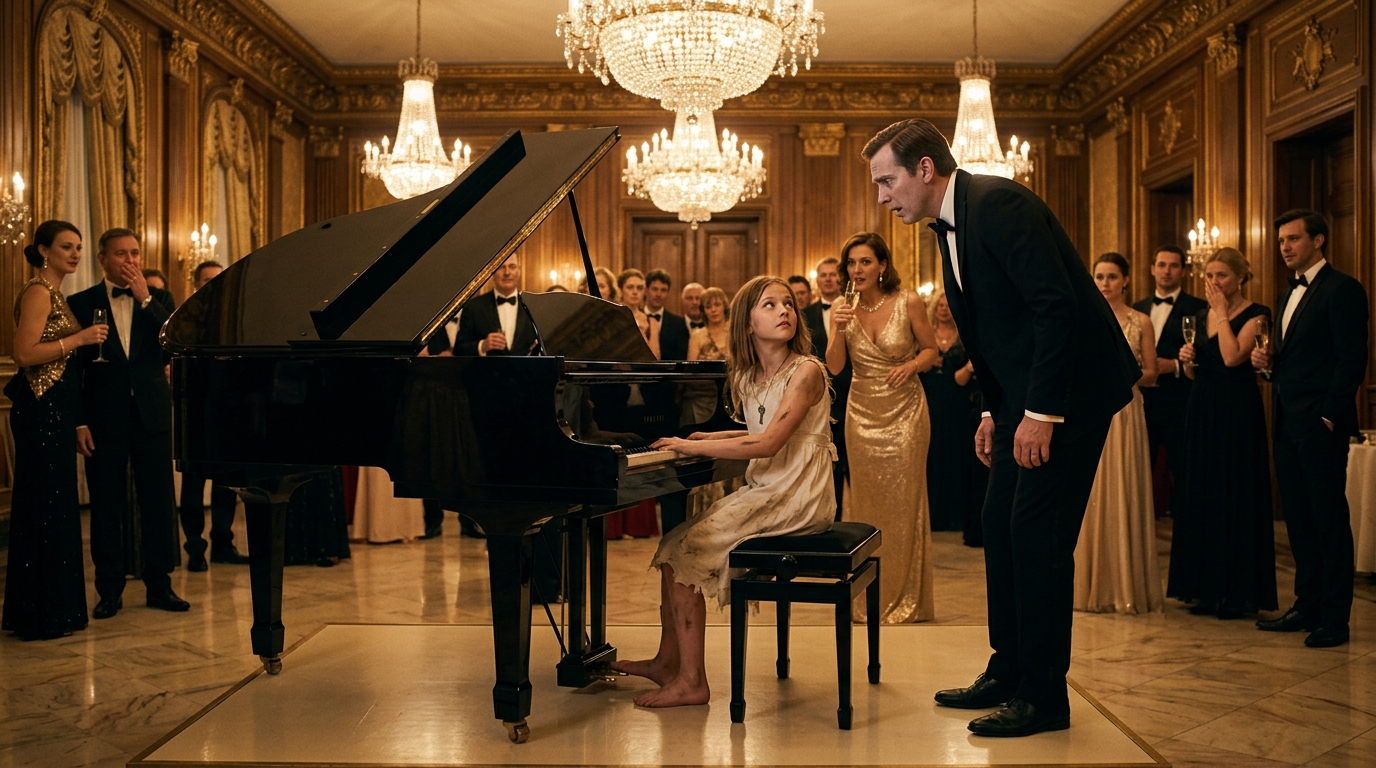
At the grand piano sat a girl.
Barefoot.
Filthy.
Starving.
She wore a tattered white dress too thin for winter, with dirt smudged along her arms and knees. Her hair fell in uneven strands around her face. Her feet looked painfully small against the polished brass pedals.
No one knew how she had entered.
No one knew whether to laugh yet.
She looked at the crowd and said, voice trembling but clear,
“Could I play for a meal?”
For half a second, the room held still.
Then laughter broke out.
Soft at first.
Then confident.
A woman near the front covered her mouth with her champagne glass. A man from the museum board turned away, grinning into his napkin. Even one of the reporters smiled, unsure whether the moment was tragic or amusing.
I stood before I thought better of it.
That was my mistake.
Or maybe that was the first honest thing I did all night.
I walked toward the piano with the measured calm of a man trained to remove discomfort without making it look like force.
“This isn’t a charity,” I said.
The laughter grew.
The words were cruel.
Worse, they were absurd.
The entire evening was a charity event.
But rich people understand coded language.
This isn’t a charity meant: not for you.
The girl’s expression dropped.
Not with surprise.
With recognition.
That was the part that stayed with me later.
She did not look shocked by humiliation. She looked as if she had simply found it where she expected it to be.
Still, she did not run.
She looked down at the keys.
Swallowed.
Lifted her trembling hands.
And played.
Only a few notes.
Soft.
Clear.
So delicate that the room stopped laughing before anyone chose to.
The melody moved through the ballroom like a hand touching an old scar.
Three rising notes.
A pause.
One descending phrase.
Then a final unresolved chord.
My body went cold.
I knew that song.
Not vaguely.
Not from some concert program.
I knew the angle of it. The breath inside it. The unfinished final note that always made the listener feel as though someone had opened a door and refused to say what waited beyond it.
Mara Bell wrote that song.
Mara Bell played it in this ballroom nineteen years earlier.
Mara Bell vanished the same winter the newspapers called her a thief, a manipulator, and a social climber who tried to blackmail one of the city’s most respected families.
My family.
Me.
I had loved her once.
Then I had believed the worst of her because believing was easier than choosing her over the empire I was born into.
The girl stopped playing.
My throat had gone dry.
“Who taught you that song?”
She looked up at me.
“My mother.”
The ballroom seemed to contract.
The laughter was gone now.
All of it.
“What is her name?” I asked.
The girl’s eyes filled with tears, but she did not lower her gaze.
Before she could answer, light caught something at her neck.
A silver key.
Small.
Old.
Hanging from a thin chain.
My breath stopped.
I knew that key.
I had given it to Mara the night before everything fell apart.
It opened the west music room.
The private room behind the stage.
The room my mother said had been sealed after Mara stole from the foundation.
I took one step closer.
The girl’s hand flew to the key.
Protective.
Terrified.
My mother stood from the front table.
“Julian,” she said softly.
Not loudly.
She did not need volume.
Everyone in our family understood command when it wore silk.
But I kept looking at the key.
Because if Mara’s daughter had it, then either Mara had survived the scandal—
Or my family had buried more than her name.
The Key Around Her Neck
“What is your mother’s name?”
The girl’s lips parted.
My mother spoke first.
“This child is clearly distressed.”
That sentence changed the temperature of the room.
Not for the guests.
For me.
I had heard my mother use that tone before.
Nineteen years ago, after Mara disappeared.
Julian, grief makes people imaginative.
Julian, that girl was not who you believed she was.
Julian, we handled the matter quietly because we love you.
Now she stepped toward the piano with the same calm face and the same poison wrapped in concern.
The girl slid off the bench and backed away.
Not from me.
From my mother.
I saw it.
So did my mother.
Her eyes hardened for half a second.
Then softened again for the audience.
“Sweetheart,” she said, “where did you get that key?”
The girl clutched it tighter.
“My mom said never give it to the silver lady.”
A murmur moved through the ballroom.
The silver lady.
My mother wore silver to every winter benefit.
She had for decades.
It became a family joke.
Suddenly, it was not funny.
I turned to the girl.
“What is your name?”
“Lena.”
Another blow.
Mara used to say if she ever had a daughter, she would name her Lena. Simple. Bright. Impossible to turn into something grand.
My voice came out rough.
“Lena what?”
She swallowed.
“Lena Bell.”
My mother’s face did not change.
That was how I knew she knew exactly who this child was.
I looked at her.
“You knew.”
She smiled faintly.
“Julian, not here.”
Not denial.
Not confusion.
Not Who is this child?
Not here.
The ballroom heard it too.
Phones began to rise.
My mother noticed.
Her smile sharpened.
She signaled security with two fingers.
Two men moved from the side wall.
Lena stepped backward into the piano bench.
I moved in front of her.
The room went silent again.
For forty-six years, I had been my mother’s obedient son in public. Even when we disagreed, I did it privately. Even when her decisions disturbed me, I called them strategy. Even when Mara begged me to believe her, I allowed my mother to turn my doubt into betrayal.
Not this time.
“Touch her,” I said to security, “and you’re fired before you reach the stage.”
The guards stopped.
My mother’s eyes flashed.
A small thing.
A crack under marble.
Lena looked up at me.
Not trusting.
Not yet.
Just surprised I had not stepped aside.
I crouched slowly so I was no longer towering over her.
“Lena,” I said, “where is your mother?”
Her face folded.
“She’s sick.”
“Where?”
She shook her head.
“My mom said if I told the wrong person, they’d move her again.”
Again.
The word landed coldly.
Move her.
Not she would leave.
Not they would hurt her.
Move her.
Like a file.
Like a patient.
Like someone controlled by people who had practiced making bodies vanish.
My mother descended the stage steps with terrifying grace.
“Julian,” she said, “this has gone far enough.”
I stood.
“No. It went far enough nineteen years ago.”
Gasps moved through the ballroom.
My mother stopped.
That sentence had broken a rule older than the chandeliers.
We did not speak of Mara Bell.
Not publicly.
Not fully.
Not in rooms where donors had once repeated the story my family fed them.
Mara the thief.
Mara the unstable pianist.
Mara the poor girl who tried to trap an Armitage son with a fake pregnancy and stolen foundation money.
Pregnancy.
The word rose inside me like something drowned coming back.
I looked at Lena.
Her age.
Her eyes.
The key.
The song.
Mara’s song.
I had not simply abandoned a woman.
I might have abandoned a child.
My child.
Before I could speak, Lena reached into the pocket of her dress and pulled out a folded piece of paper.
“My mom said to give you this if you remembered the key.”
My hand shook as I took it.
The paper was old, soft from being unfolded too often.
Mara’s handwriting slanted across the page.
Julian,
If Lena reaches you, it means she still believes you might be better than the man who let them erase me.
Do not trust your mother.
Do not call foundation counsel.
The west music room was never sealed because I stole.
It was sealed because I hid the ledger there.
And our daughter has the key.
Our daughter.
The ballroom blurred.
I heard my mother whisper my name.
This time, there was fear in it.
The Room Behind the Stage
The west music room had been part of Armitage Hall since my grandfather’s time.
As children, my sister and I called it the blue room because of the velvet drapes and painted ceiling. My mother used it for private donor meetings until the winter Mara vanished.
After that, the door was locked.
Then paneled over.
Then forgotten by everyone except those who had reason not to forget.
I walked there with Lena beside me and half the ballroom trailing behind at a cautious distance.
My mother tried to stop us twice.
The first time with concern.
The second with command.
The third time, she said, “Julian, if you open that room, you will destroy everything your father built.”
I turned.
“My father is dead.”
Her expression tightened.
“That is not an answer.”
“No,” I said. “It’s an excuse you’ve used long enough.”
The west corridor behind the stage smelled of dust, flowers, and old paint. A false panel covered the door now, but if you knew where to press, the seam still answered.
I had not touched it in nineteen years.
My fingers found the hidden latch.
The panel released.
Behind it stood a narrow blue door with a silver lock.
Lena lifted the key from her neck.
Her hands trembled.
“Mom said it only opens if you turn it twice to the left.”
Mara had always hated obvious things.
Lena inserted the key.
Turned left once.
Then again.
The lock clicked.
The door opened.
Cold air slid out.
Inside, dust covered everything.
A grand piano beneath a white sheet.
Old music stands.
A cracked mirror.
A table near the window.
And on that table, exactly where no thief would leave evidence, sat a metal document box.
My mother made a sound behind me.
Not a gasp.
Something smaller.
Older.
The sound of a lie seeing its own grave opened.
I crossed the room and lifted the box.
Locked.
Lena handed me the key again.
It fit.
Inside were ledgers, photographs, letters, medical forms, and a cassette recorder wrapped in blue silk.
On top was a photograph.
Mara, nineteen years younger, sitting at the same grand piano.
One hand resting on her stomach.
Smiling.
Beside her stood me.
I did not remember the photograph being taken.
On the back, Mara had written:
Before they made him choose.
My chest tightened until breath became work.
I opened the first ledger.
Armitage Children’s Arts Fund.
Scholarship transfers.
Emergency placements.
Medical guardianship approvals.
Donation diversions.
Names of children with new identities.
Names of mothers declared unstable.
Names of donors who paid for “private adoption sponsorships.”
Money had moved through my family’s foundation for years under the cover of music scholarships and child relief.
Not stolen by Mara.
Exposed by her.
I looked at my mother.
“You said she stole from us.”
My mother’s face had gone white, but her spine remained straight.
“She stole documents.”
“She found records.”
“She threatened the foundation.”
“She threatened you.”
The difference seemed lost on her.
Or perhaps it never mattered.
Lena stood near the piano, both hands clutching her elbows.
I turned the next page.
Then froze.
Patient intake form.
Name: Mara Bell.
Status: post-delivery psychiatric instability.
Infant: female.
Infant disposition: deceased.
Authorized by: Helena Armitage.
My mother.
I heard Lena make a tiny sound.
She had seen it too.
Infant disposition: deceased.
The paper said my daughter had died.
My daughter was standing beside me.
“What did you do?” I asked.
My voice no longer sounded like mine.
My mother looked at Lena.
For one second, there was no performance left in her.
Only contempt.
“She was a complication.”
The room became very still.
“A baby,” I said.
“A claim,” my mother replied. “A permanent claim on you. On the family. On the foundation. On everything Mara Bell intended to ruin.”
Lena stepped behind me.
I could feel her shaking.
The cassette recorder sat in the box.
I picked it up.
My mother’s eyes widened.
“Julian.”
I pressed play.
Static.
Then Mara’s voice filled the room.
Young.
Terrified.
Alive in sound.
“Julian, if you hear this, I tried to tell you. Your mother knows about the placements. Your father knew before he died. Helena is moving the girls through Westhaven under arts sponsorship names. Dr. Bell signed my confinement papers. They told me our baby died, but I heard her cry. I heard her, Julian.”
A sob broke through the recording.
Then another voice.
My mother’s.
Cold.
Close.
“You should have taken the money and left when we offered.”
Mara screamed.
The tape cut.
No one moved.
Then Lena whispered,
“My mom said I cried loud enough for someone to save me.”
My mother closed her eyes.
And behind us, an old man’s voice said,
“She did.”
The Man Who Heard the Baby Cry
The old man in the doorway was Edmund Vale.
For forty years, he had tuned the pianos at Armitage Hall.
He was small, bent at the shoulders, and half blind in one eye. I remembered him moving quietly through rooms with a leather tool bag and a pencil tucked behind his ear.
I had not seen him in years.
My mother clearly had.
Her face hardened.
“You.”
Edmund stepped into the music room.
His hands shook, but his voice did not.
“I wondered if the girl would find the key.”
Lena stared at him.
“You knew my mom?”
Edmund’s face softened.
“I knew both of you.”
My throat tightened.
“What do you mean?”
He looked at me with old shame.
“The night Mara gave birth, they brought her here first. Not to a hospital. Here. Dr. Bell came through the service entrance. Your mother said there could be no records until decisions were made.”
Decisions.
My stomach turned.
Edmund continued.
“I was tuning the ballroom piano after the gala. I heard the baby cry from behind the panel.”
Lena’s hand found mine.
I held it.
Hard.
“What happened?”
“They told Mara the child was stillborn. Your mother ordered the baby moved to Westhaven under another name. I followed the nurse as far as the service hall. Agnes stopped me.”
“Agnes?”
“My wife,” he said. “She worked in the laundry. She took the baby before they reached the car.”
My mother’s voice cut through the room.
“She stole foundation property.”
Foundation property.
The phrase did what the ledger, the tape, and the forged death form had not.
It stripped the last human mask from her face.
Edmund looked at Lena.
“Agnes hid you for three days. Then she found Mara’s cousin, a girl barely old enough to care for herself but brave enough to run. She took you out of the city. Mara found you years later.”
Lena’s eyes filled.
“My Aunt Rosa.”
Edmund nodded.
“She died protecting you.”
Lena began to cry silently.
My mother turned toward the door.
Security blocked her.
Not my men.
Federal agents.
I did not know when they had arrived.
Then I saw the woman behind them.
Mara.
Older.
Thin.
Hair streaked with gray.
One hand gripping a cane.
The other pressed to the doorframe as if standing required every piece of will left in her body.
For a moment, the room forgot to breathe.
Lena whispered, “Mom.”
She ran.
Mara opened one arm and nearly fell when Lena collided with her.
I stood frozen.
Nineteen years vanished and remained at once.
Mara looked at me over our daughter’s shoulder.
No tenderness.
Not yet.
No forgiveness.
Only exhaustion and the terrible fact of survival.
“You opened it,” she said.
“I should have opened it years ago.”
“Yes,” she replied.
The truth landed cleanly.
No cruelty.
No comfort.
Mara had earned the right to give me neither.
My mother stared at her as if the dead had learned bad manners.
“How are you here?”
Mara smiled faintly.
“Edmund called me when Lena entered the hall.”
Edmund lifted his chin.
“I called Agent Voss too.”
One of the federal agents stepped forward.
Rachel Voss.
Organized financial crimes and child welfare trafficking division.
She looked at my mother.
“Helena Armitage, you are being detained pending investigation into unlawful confinement, falsified medical records, child trafficking through fraudulent foundation placements, and obstruction.”
My mother did not flinch.
“This foundation has saved thousands of children.”
Mara’s voice cut in.
“And sold hundreds.”
The words hung in the room.
No one contradicted her.
Because the ledger sat open.
Because the tape existed.
Because Lena stood alive with a death form in the box.
Because the silver key had opened more than a room.
It had opened the machinery beneath my family’s charity.
Voss looked at me.
“Mr. Armitage, we’ll need your cooperation.”
I looked at Mara.
Then Lena.
Then the woman who raised me.
For the first time, the choice my mother had staged nineteen years earlier stood before me again.
Family name.
Or truth.
This time, I did not hesitate.
“You’ll have it.”
My mother laughed once.
Soft.
Bitter.
“You always were sentimental.”
“No,” I said. “I was cowardly.”
Her smile faded.
“I’m done confusing the two.”
The Melody That Returned
The investigation took down more than my mother.
That is what people remember now, though they rarely say it in the same breath as her name.
They prefer one villain.
One arrest.
One satisfying face for the evil.
But the ledgers from the west music room were not the work of one woman alone.
There were doctors.
Lawyers.
Judges.
Agency directors.
Donors who paid “sponsorship fees” and received children through sealed emergency placements.
Board members who saw irregular transfers and decided not to see them clearly.
Men like me, who signed reports without reading because the summaries sounded philanthropic enough.
That was the hardest truth.
I had not built the machine.
But I had inherited it, benefited from it, toasted over it, defended it, and looked away when its victims did not wear the right clothes.
The press called it the Armitage Hall Scandal.
Mara called it what it was.
A market.
Children moved through arts scholarships, recovery homes, private clinics, and adoption shortcuts. Mothers declared unfit. Infants marked deceased. Girls placed with families whose donations arrived suspiciously close to transfer dates.
The west music room became evidence.
Then a memorial.
Then, eventually, a public archive.
Not because I wanted my family’s shame displayed.
Because Mara insisted.
“Locked rooms are where your people hide crimes,” she said. “Open rooms make them work harder.”
She was right.
Lena came to live with Mara in a safe apartment near the courthouse first.
Not with me.
I offered.
Mara refused.
“You do not get to skip from ignorance to fatherhood in one gesture,” she said.
Again, she was right.
So I began smaller.
Groceries.
Medical bills paid through a fund Mara controlled.
School enrollment.
Therapy.
Court appearances.
Sitting outside rooms I was not invited into.
Waiting without making waiting look noble.
Lena did not call me Dad.
She called me Julian.
Then Mr. Julian when she was angry.
Then nothing for a long while after she learned exactly how long I had believed her mother was a liar.
Children forgive differently.
Sometimes they do not.
Adults should learn to survive that.
At my mother’s trial, the tape played first.
Mara’s voice.
The baby crying.
My mother’s threat.
Then Edmund testified.
Then Mara.
Then Lena, briefly, with Voss beside her and one hand wrapped around the silver key.
The prosecutor asked why she went to the piano that night.
Lena looked at the jury.
“Because hungry children are invisible unless they make noise.”
The courtroom went silent.
“What noise did you make?”
She lifted her chin.
“My mother’s song.”
My mother was convicted on every major count.
She never apologized.
Not to Mara.
Not to Lena.
Not to me.
The last thing she said before sentencing was that history would understand her.
Mara leaned toward me and whispered, “History is just gossip with better furniture.”
I laughed.
Quietly.
For the first time in years, something in the room felt alive.
After the trial, Armitage Hall closed for six months.
When it reopened, there was no winter benefit.
No champagne.
No white-gloved donors posing beneath chandeliers.
Instead, we held a public hearing for families searching for children lost through foundation placements. Lawyers sat where society women once laughed. Records clerks worked at tables that used to hold floral arrangements. The grand piano stayed uncovered.
Lena asked to play.
Mara said no at first.
Then yes.
Only if Lena wanted it for herself.
Lena wore shoes this time.
Plain black ones she chose herself.
She sat at the grand piano in a clean blue dress, the silver key still around her neck.
The room was full, but not with the old crowd.
Mothers.
Fathers.
Adult adoptees.
Survivors.
Investigators.
People who had spent years being told their grief was confusion.
Lena placed her hands on the keys.
For a moment, I saw the starving child from the gala.
Then she began to play.
The same melody.
But not the same.
The opening was Mara’s.
Soft.
Haunting.
Unresolved.
Then Lena changed the ending.
She added three bright notes that rose instead of fell.
A question becoming an answer.
A door opening and staying open.
Mara cried.
I did too.
No one laughed this time.
When Lena finished, she stood and looked at the room.
“My mom said this song used to be proof,” she said. “Now I want it to be a map.”
That became the name of the archive.
The Map Room.
The west music room was restored, but not to its old beauty. We left one wall unfinished, showing the outline of the hidden door. Beneath glass, the silver key rests beside copies of the first ledger, Edmund’s statement, and the forged document declaring Lena dead.
People ask why I would keep my family’s shame visible.
Because shame hidden becomes inheritance.
Shame seen clearly can become warning.
Months later, Lena invited me to dinner.
A small thing.
A huge thing.
Mara cooked badly. Lena burned the bread. I brought dessert because I was told it was the safest assignment.
After dinner, Lena gave me a folded paper.
Inside was a drawing of a grand piano.
Three people stood beside it.
A woman with a cane.
A girl with a key.
A man in a black suit standing slightly apart.
Not erased.
Not centered.
There.
At the bottom, she had written:
Still deciding.
I kept it.
It is on my desk now, above every foundation report I read myself.
Every word.
Every number.
Every name.
Sometimes I still hear the laughter from that night.
The laughter after she asked to play for a meal.
Mine included.
I do not soften that memory.
It deserves its teeth.
Because the girl at the piano did not come to entertain us.
She came hungry.
She came barefoot.
She came carrying a key to a room full of crimes.
And she played the one song powerful people had failed to silence.
Not beautifully enough to be forgiven.
Bravely enough to be believed.