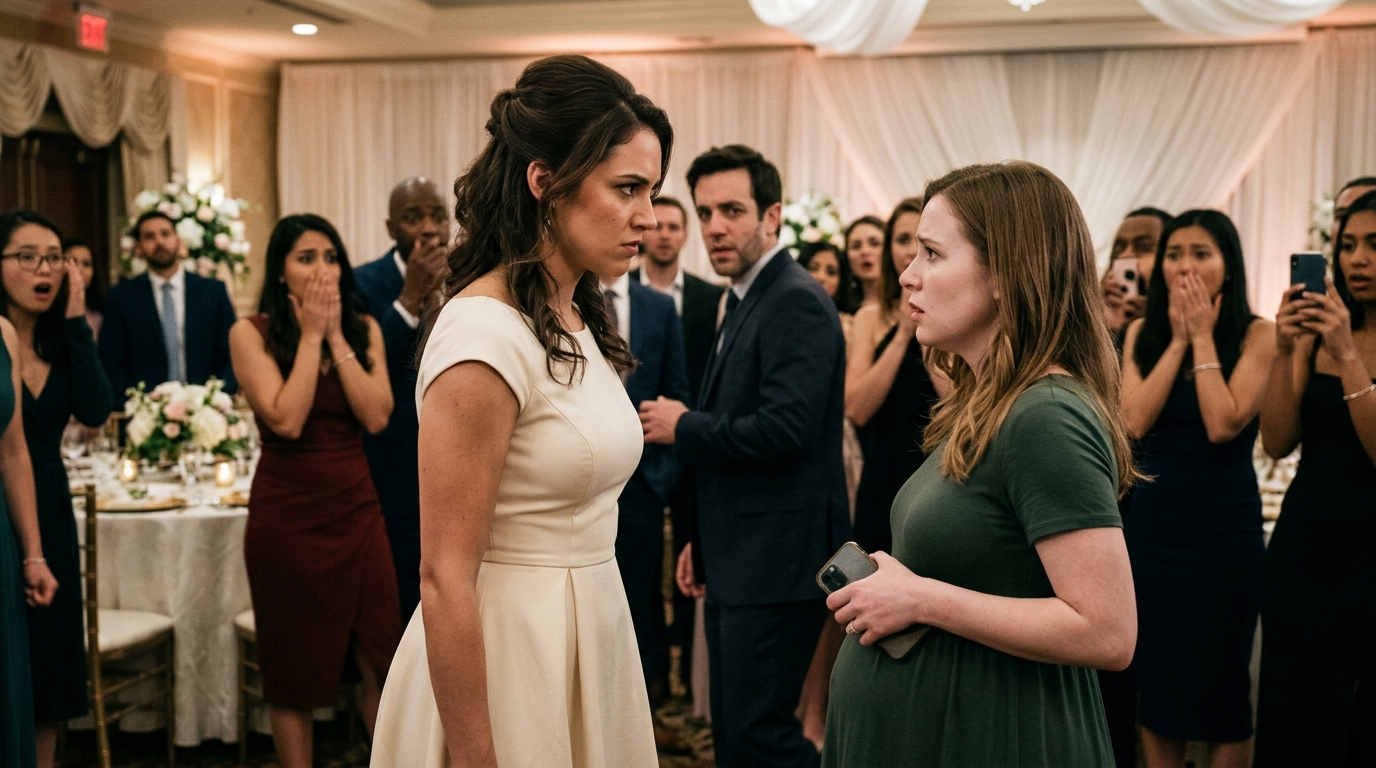
The Woman at the Entrance
“HONEY!”
The voice cut through the celebration like a glass dropped onto marble.
Too loud.
Too sudden.
Too wrong.
Laughter stopped first.
Then the music faltered.
Then the conversations died one by one, until the entire ballroom was staring toward the entrance.
At the doorway stood a pregnant woman.
She did not rush in.
She did not scream again.
She simply stood there, one hand resting on the curve of her belly, her dark coat open, rain still glistening on her sleeves. Her hair was smooth despite the storm outside. Her face was calm. Too calm for someone who had supposedly arrived by accident.
Her eyes moved across the room slowly, passing over the white flowers, the champagne glasses, the blue-and-gold balloons, the photographer near the dessert table, the violinist lowering her bow, and finally—
Sophia.
Sophia Bennett stood at the center of the ballroom in a pale ivory dress, one hand instinctively moving to her own stomach.
She was five months pregnant.
The party was supposed to be a celebration.
Not a wedding.
Not exactly.
Ryan had called it “a family blessing dinner,” a way to gather everyone before the baby came. There had been speeches. Toasts. A framed ultrasound photo on the gift table. A small cake with gold lettering that said:
Welcome, Baby Hart.
Ryan Hart stood beside Sophia, smiling only seconds earlier as his mother dabbed at her eyes and said how proud she was to finally see him build a family.
Now Ryan’s smile had vanished.
The woman at the entrance took one step forward.
“You didn’t tell me about this.”
Her tone did not rise.
It didn’t need to.
Every word landed cleanly in the silence.
Sophia turned slowly toward Ryan.
Ryan stepped forward, his expression shifting too quickly from confusion to anger.
“I don’t know you.”
Too quick.
Too certain.
Too rehearsed.
Sophia felt the first crack open inside her chest.
The woman at the entrance did not flinch.
She walked farther into the room.
One step.
Then another.
Slow.
Measured.
Like she knew every eye belonged to her now.
“I’m his wife.”
The words detonated.
Gasps burst from the guests.
Someone whispered, “Oh my God.”
Hands flew to mouths.
Phones rose from tables.
Ryan’s mother, Evelyn Hart, froze beside the gift display, one hand clutching her pearls.
Sophia stared at the woman.
Then at Ryan.
Then back.
The pregnant stranger lifted her chin.
“We’ve been married three years.”
The silence that followed felt heavier than the accusation itself.
Ryan shook his head.
Panic climbed into his voice despite his attempt to bury it.
“That’s not true.”
But it wavered.
Sophia heard it.
So did half the room.
The woman reached into her coat pocket and produced her phone.
She tilted it outward.
Close enough for the front guests to see.
A photo appeared on the screen.
Ryan.
Younger by a few years.
Standing beside her.
His arm around her waist.
Both of them smiling in front of what looked like a courthouse.
The crowd leaned in.
Breath held.
The woman lowered her phone and placed one hand over her belly.
“And I’m carrying his child.”
No one moved.
No one even seemed to breathe.
Sophia felt every eye turn to her.
She could feel the sympathy already forming.
The pity.
The humiliation.
The silent question:
Did she know?
She looked at Ryan, searching his face, begging for something clear. Outrage. Shock. Hurt. Anything that looked real enough to hold.
But Ryan did not look at her.
He looked at the woman.
And in that one small failure, Sophia found her answer.
Not the whole answer.
But enough.
The woman took another step closer.
Her face remained composed, but there was something underneath it now.
Expectation.
She expected Sophia to collapse.
Expected tears.
Expected a scene.
Expected the pregnant fiancée to crumble in front of everyone and let the story belong to her.
Sophia did feel like crumbling.
But something else rose first.
A memory.
A hospital bracelet.
A strange phone call three weeks ago.
A name written on a document Ryan had sworn meant nothing.
Sophia inhaled slowly.
Then she stepped toward the woman.
Not fast.
Not dramatic.
In control.
Changed now.
“Then answer one thing.”
Her voice was steady.
Too steady.
The ballroom froze again.
The stranger’s eyes narrowed slightly.
Sophia looked directly at her.
“What hospital did you give birth in… last year?”
The words landed like a knife placed gently on a table.
The woman’s face fell.
Not slowly.
Instantly.
Color drained from her cheeks.
Her confidence disappeared so completely that the entire room felt the shift.
Ryan looked at Sophia then.
Really looked.
Fear flickered across his face.
And in that moment, everyone understood the same thing.
Something about the woman’s story did not add up.
And Sophia knew it.
Video: A Pregnant Woman Claimed She Was His Wife—Then Sophia Asked One Question That Exposed the Lie
The First Lie Was Not the Biggest One
The woman’s lips parted.
No sound came out.
Sophia waited.
The ballroom remained silent around them, but it no longer felt like the silence of shock.
It felt like a courtroom.
The woman recovered just enough to force a laugh.
“What kind of question is that?”
“The kind you should be able to answer.”
Sophia did not raise her voice.
That made it worse.
The woman’s eyes flicked toward Ryan.
Only for half a second.
But Sophia saw it.
So did Ryan’s older brother, Nathan, who had been standing near the bar with his wife and had stopped smiling the moment the woman walked in.
Sophia took another step forward.
“You said you’re carrying his child.”
“I am.”
“You said you’re his wife.”
“I am.”
“You said you’ve been married three years.”
The woman’s jaw tightened.
“Yes.”
Sophia nodded slowly.
“Then tell everyone where you gave birth last year.”
A ripple passed through the guests.
The stranger placed one hand on her belly protectively.
“I don’t have to answer your questions.”
“No,” Sophia said. “But you came here to make me answer yours.”
Ryan finally moved.
“Sophia, stop.”
That was the wrong thing to say.
Every head turned toward him.
Sophia’s face remained calm, but her eyes sharpened.
“Why?”
Ryan swallowed.
“This is stressful. You’re pregnant. We should go somewhere private.”
The woman seized on that.
“Yes,” she said quickly. “This should be private.”
Sophia looked between them.
For one terrible moment, she almost laughed.
They had both chosen the same word.
Private.
The word people use when public lies stop working.
Sophia turned to the guests.
“No. She entered this room publicly. She called him ‘honey’ publicly. She announced a marriage and a pregnancy publicly. So she can answer publicly.”
The stranger’s composure cracked.
“My baby has nothing to do with you.”
“Your baby?” Sophia asked.
A tiny pause followed.
Too tiny for most.
But Sophia heard it.
“You’re wearing a prosthetic belly.”
The room erupted.
The woman stumbled back as if slapped.
Ryan’s mother gasped.
Ryan’s face went gray.
The stranger’s hand flew instinctively to her stomach.
Sophia continued, every word measured.
“And last year, you gave birth to a daughter at Mercy General under the name Claire Donovan.”
The woman stopped breathing.
Sophia turned toward Ryan.
“Isn’t that what you told me?”
Ryan’s mouth opened.
Nothing came.
The crowd shifted again.
This was no longer a simple scandal.
It was becoming something stranger.
Darker.
Sophia looked back at the woman.
“But the baby wasn’t Ryan’s. And your name isn’t Claire Donovan.”
The woman whispered, “You don’t know anything.”
Sophia’s eyes glistened now, but her voice did not break.
“I know your real name is Mara Voss.”
At the sound of that name, Ryan’s mother dropped her champagne glass.
It shattered beside the gift table.
Everyone turned.
Evelyn Hart stood frozen, one hand over her mouth, face drained of color.
Sophia looked at her.
“So you do know her.”
Evelyn shook her head too quickly.
“No.”
Nathan, Ryan’s brother, stepped forward.
“Mom?”
Evelyn did not answer.
Mara’s expression changed from panic into desperation.
She looked at Ryan.
“You said she wouldn’t know.”
The sentence left her mouth before she could stop it.
And that was the moment Ryan Hart’s life began to collapse in front of everyone he had invited to celebrate it.
The Celebration Sophia Almost Canceled
Three weeks earlier, Sophia had almost called off the party.
Not because she suspected Ryan of having another wife.
Not at first.
The doubt began smaller.
A text message.
That was how most disasters entered modern lives now.
Not through letters sealed in drawers.
Not through mysterious footsteps in hallways.
Through a screen lighting up at the wrong moment.
Ryan had left his phone on the kitchen island while taking a shower. Sophia was cutting strawberries for breakfast when the screen flashed.
Unknown Number:
If she signs before the party, I’m done. After that, I want the rest.
Sophia froze.
The message disappeared when the phone locked again.
She stood there with a knife in her hand, listening to water running down the hall, telling herself not to imagine betrayal where there might be only business.
Ryan worked in private equity.
He received strange messages sometimes.
Short.
Urgent.
Cryptic.
Still, something about the phrase made her stomach tighten.
If she signs.
Sophia had been asked to sign paperwork that week.
Ryan said it was for the baby.
A financial planning package.
Trust arrangements.
Insurance.
Property protections.
Normal things for a couple about to become parents, he said.
She had believed him because she wanted their family to begin without suspicion.
But after the message, she took the documents to her friend Amara, a family attorney.
Amara read them in silence.
Then again.
Then she looked up and said, “Sophia, do not sign this.”
Sophia’s blood went cold.
“Why?”
“This isn’t just baby planning. This gives Ryan broad temporary authority over your investment accounts if a doctor certifies you’re medically incapacitated.”
Sophia touched her stomach.
“Medically incapacitated?”
Amara’s face darkened.
“There’s also language about prenatal complications, emergency guardianship of the child, and trust asset movement.”
“I don’t understand.”
Amara lowered the pages.
“It means if something happens during pregnancy or delivery, he could move faster than your family to control your money and make decisions about the baby.”
Sophia felt the room tilt.
Ryan knew she had inherited her father’s share of Bennett Foods the year before.
Not controlling interest.
But enough.
Enough that investors, relatives, and ambitious men suddenly found her more interesting than they had before.
Sophia had thought Ryan loved her before any of that mattered.
Maybe he had.
Maybe he hadn’t.
Once doubt begins, it does not ask permission before revisiting every memory.
The anniversary dinner where he asked about her trust.
The way he gently suggested she distance herself from her older sister, Camille, because Camille was “too controlling.”
The sudden push to move into his family’s estate after the baby came.
The doctor he wanted her to switch to.
The way his mother, Evelyn, kept saying, “A Hart baby should be protected by Hart decisions.”
Sophia did not confront him.
Not immediately.
Amara advised patience.
“People like this reveal themselves when they think you are still unaware.”
So Sophia waited.
She copied messages when she could.
She delayed signing.
She claimed pregnancy fatigue.
She smiled through dinners.
Then, five days before the party, Amara called her late at night.
“I found something strange.”
Sophia sat up in bed.
Ryan was asleep beside her.
“What?”
“The phone number that texted him is linked to a woman named Mara Voss. But she also used the name Claire Donovan last year.”
Sophia looked at Ryan’s sleeping face in the dark.
“What does that mean?”
“It means she gave birth at Mercy General twelve months ago.”
Sophia’s hand tightened around the phone.
“To Ryan’s baby?”
“No. That’s the strange part. The father listed was a man named Elliot Pierce. But two weeks later, Mara filed a private paternity dispute against another man and withdrew it after receiving a settlement.”
Sophia closed her eyes.
“A scam?”
“Maybe. Or something worse.”
Then Amara said the sentence that had kept Sophia awake every night since:
“She may have done this before.”
Mara Voss Had a Script
Mara’s story was not original.
That was what made it dangerous.
Original lies are easier to spot. They have rough edges. They change too much. They rely on improvisation.
Mara had a script.
She appeared at moments designed to cause maximum damage.
Engagements.
Family dinners.
Business launches.
Baby showers.
Weddings.
She arrived calm but emotional, claiming marriage, pregnancy, betrayal, abandonment. She came with photos that looked real enough. Documents that appeared official enough. Tears that convinced people who wanted spectacle more than truth.
Most victims paid.
Not always because they believed her.
Often because they wanted silence.
A wealthy man accused of secret marriage does not need the accusation to be true for the damage to begin.
Mara had built a life on that gray space between truth and proof.
But Sophia’s case was different.
Because Ryan knew Mara.
That was what Amara discovered two days before the party.
Ryan Hart had represented Mara three years earlier in a private settlement involving a businessman accused of abandoning her. Ryan had been the junior attorney on the case before leaving law for finance. He knew her methods. He knew her history.
And yet Mara’s number was in his phone.
And yet she was asking for money.
And yet Ryan was rushing Sophia to sign legal authority before the celebration.
Sophia understood then.
Mara was not coming to expose Ryan.
She was coming to help him.
The plan had become visible only in pieces, but once assembled, it was elegant in a cruel way.
Mara would crash the celebration.
She would claim to be Ryan’s wife and pregnant with his child.
Sophia, humiliated and emotionally devastated, would break down publicly.
Ryan would appear shocked, then wounded, then protective.
His family would urge Sophia not to make decisions while “unstable.”
The paperwork would suddenly become necessary.
To protect the baby.
To protect assets.
To protect her from stress.
If Sophia refused, Ryan could argue she was erratic.
If she signed, he gained access.
If the scandal damaged her reputation, he became the calm partner guiding her through crisis.
It was not about Mara replacing Sophia.
It was about making Sophia look too emotionally fragile to control what was hers.
That was why Sophia did not cancel the party.
She changed the guest list.
She invited her attorney.
Her sister Camille.
Two board members from Bennett Foods.
Her private doctor, Dr. Leona Hayes.
And quietly, at Amara’s insistence, a retired investigator named Victor Crane who specialized in fraud and identity cases.
Ryan noticed none of it.
Because Ryan was too busy believing he was in control.
Now, standing in the ballroom as Mara’s face drained of confidence, Sophia finally saw the plan unravel.
Mara tried to recover.
“I don’t know what she’s talking about.”
Sophia held out her hand.
“Then show us the marriage certificate.”
Mara’s mouth tightened.
Ryan said sharply, “Sophia, enough.”
“No,” Camille said.
Sophia’s older sister stepped forward from the front table. She had been silent until then, watching with the stillness of someone waiting for the correct moment to strike.
Camille Bennett was not gentle like Sophia.
She had inherited their father’s temper and their mother’s precision.
“Let her show the certificate,” Camille said.
Ryan glared.
“This is family business.”
Camille smiled coldly.
“Wonderful. I’m family.”
A few guests murmured approval.
Mara looked toward the doors.
Victor Crane had quietly moved near the entrance.
Not blocking her obviously.
Just existing where escape wanted to be.
Sophia looked at Mara.
“You came here with proof. Show it.”
Mara’s hand trembled as she unlocked her phone again.
The photo appeared.
Ryan and Mara at a courthouse.
Mara enlarged it.
“There,” she said. “You can see for yourself.”
Sophia turned toward the large screen behind the dessert table, where Ryan had planned to show baby photos and family videos later that evening.
“Put it up.”
Mara froze.
“What?”
“If it’s proof, let everyone see.”
Ryan’s voice dropped.
“Do not do that.”
Sophia looked at him.
“Why not?”
He said nothing.
Camille took Mara’s phone before the woman could react, passed it to Amara, and within seconds the photo appeared on the ballroom screen.
Two hundred people stared.
At first, it looked convincing.
Ryan and Mara.
Courthouse steps.
Smiling.
Then Victor Crane spoke from the back of the room.
“That courthouse was demolished four years ago.”
The room went still.
Victor walked forward slowly.
“That photo is dated eighteen months ago.”
Mara’s mouth opened.
Victor nodded toward the screen.
“The building behind them did not exist then.”
Sophia turned to Ryan.
His face had gone pale.
Mara whispered, “Ryan…”
Camille’s eyes sharpened.
“So he gave you the wrong image.”
That sentence changed everything.
Because it did not accuse Mara alone.
It connected him.
Ryan Hart Finally Lost the Room
Ryan had always been good in rooms.
That was what Sophia remembered most painfully.
At dinners, he knew when to speak and when to listen. At board events, he could charm suspicious investors by making them feel like mentors. With Sophia’s friends, he was humble enough to seem safe. With her family, he was attentive enough to seem permanent.
But that night, the room turned faster than he could adapt.
Mara was no longer the threat.
She was the crack.
And through that crack, everyone began seeing him.
Ryan raised both hands.
“This has gone too far.”
Sophia almost admired the choice.
Not denial now.
Authority.
He was trying to reframe the scene as chaos that needed his control.
“She is upsetting my fiancée,” he said.
“I’m fine,” Sophia answered.
“You’re not.”
The words came too quickly.
Sophia stared at him.
Ryan softened his voice.
“You’ve been under stress. The pregnancy, the company, your father’s death. You’re not thinking clearly.”
A cold wave moved through Sophia.
There it was.
The line.
The one the paperwork had been waiting for.
Amara stepped forward.
“Mr. Hart, are you suggesting Sophia Bennett is mentally or medically unfit to make decisions?”
Ryan looked at her.
Only then did he realize who she was.
“Amara.”
“Yes,” she said. “Her attorney.”
His jaw tightened.
“I’m concerned about her.”
Dr. Leona Hayes stood from another table.
“As her physician, I can confirm Sophia is medically stable and fully capable.”
Ryan’s mother stood abruptly.
“This is ridiculous. My son is being ambushed.”
Camille turned toward Evelyn.
“No, Mrs. Hart. Your son is being caught.”
Evelyn’s face changed.
Something old and bitter moved through her expression.
“You Bennetts always think money makes you untouchable.”
Sophia looked at her.
“And you Harts always think marriage makes women transferable.”
Evelyn flinched.
The guests felt it then.
This was not only Ryan’s plan.
Evelyn knew.
Maybe not every detail.
But enough.
Nathan, Ryan’s brother, spoke for the first time.
“Mom.”
Evelyn did not look at him.
Nathan stepped closer.
“What did you know?”
“Stay out of this.”
His face hardened.
“No. What did you know?”
Ryan snapped, “Nathan, shut up.”
The command confirmed what the room had already begun to suspect.
Nathan looked at Sophia, then at Mara, then at his brother.
“Is this about Dad’s debt?”
Evelyn inhaled sharply.
Ryan’s eyes turned lethal.
Sophia felt another piece drop into place.
“What debt?”
Nathan’s mouth tightened.
Ryan moved toward him.
“Nathan.”
But Nathan was done.
“Our father didn’t leave us wealth,” he said quietly. “He left liabilities. Ryan has been covering them. Or pretending to.”
Evelyn hissed, “You have no right.”
Nathan ignored her.
He looked at Sophia.
“I thought he was marrying you because he loved you.”
The sentence hurt more than Sophia expected.
Because it implied there had been doubts even before tonight.
Ryan’s face twisted.
“You think you’re better than me?”
Sophia did not answer.
He stepped toward her.
“You think your father’s company makes you smarter? You think because everyone smiles when you enter rooms, you understand what it takes to survive?”
Camille moved instantly between them.
“So this was survival?”
Ryan pointed toward Sophia’s stomach.
“That baby is my future too.”
Sophia’s voice turned quiet.
“No. This baby is our child. Not your access card.”
Mara began crying then.
Not dramatically.
Not because of Sophia.
Because she finally understood Ryan might sacrifice her first.
“I want my money,” she said.
The room turned toward her.
Ryan’s face went dark.
Mara’s voice shook.
“You promised the rest after she signed.”
Gasps exploded through the ballroom.
Ryan closed his eyes.
Too late.
Victor Crane lifted his phone.
“That was clear enough.”
Ryan looked at him.
Victor smiled faintly.
“I’ve been recording since she entered.”
The Real Wife Ryan Never Mentioned
Police were not called immediately.
That surprised the guests.
But Camille Bennett had learned from her father that public scenes are not always the place to finish private traps. First, you secure evidence. Then witnesses. Then documents. Then you call the people who cannot be dismissed as hysterical.
Amara made the call.
Victor Crane secured Mara’s phone before she could delete messages.
Mara, realizing she had lost control of her own performance, began talking fast.
She said Ryan contacted her six weeks earlier.
He said he needed a “controlled scandal.”
He said Sophia was too careful with financial documents.
He said if Mara could humiliate Sophia publicly and create enough doubt about Ryan’s past, he could pressure Sophia into signing emergency authority documents to stabilize their “family crisis.”
Mara was supposed to be paid in two installments.
Half before.
Half after Sophia signed.
Mara claimed she did not know Sophia was pregnant.
No one believed that.
Then Mara said something that changed the room yet again.
“He said it worked once before.”
Sophia’s blood chilled.
“What worked before?”
Mara looked toward Ryan.
He stared back with pure hatred.
Mara swallowed.
“With someone named Rachel.”
The name struck Nathan first.
His face drained.
“Ryan…”
Sophia turned to him.
“Who is Rachel?”
Nathan looked as if he might be sick.
“My brother’s ex-wife.”
The room erupted again.
Sophia stared at Ryan.
“Ex-wife?”
Ryan said nothing.
Mara gave a hollow laugh.
“So there was a wife.”
Sophia’s hand went to the back of a chair.
Not because she felt weak.
Because the floor seemed too far away.
“You told me you were never married.”
Ryan’s face hardened.
“It was annulled.”
Nathan shook his head.
“No, it wasn’t.”
Evelyn whispered, “Enough.”
Nathan looked at her with disgust.
“No, Mom. It has been enough for years.”
Then he told the story.
Rachel Moore had married Ryan when he was twenty-six. She came from a modest family but had inherited a small apartment building from her grandmother. Within a year, Ryan had convinced her to refinance it for a business opportunity. When the business failed, Rachel discovered the money had not gone where he claimed.
She filed for divorce.
Then came the scandal.
A woman appeared at a restaurant claiming Ryan had fathered her child and that Rachel had known. Rachel broke down publicly. Ryan and Evelyn used that breakdown to pressure her into settlement. Rachel lost the building. Ryan walked away clean.
“Who was the woman?” Camille asked.
Nathan’s eyes moved to Mara.
Mara raised both hands.
“It wasn’t me.”
Victor Crane checked something on his tablet.
“No,” he said. “But the method matches.”
Sophia looked at Ryan.
“Where is Rachel now?”
Ryan’s expression became unreadable.
Nathan answered instead.
“She disappeared from public life. Last I heard, she was working at a shelter outside Portland.”
Sophia’s throat tightened.
There it was.
The past.
Not buried.
Repeated.
She looked down at her stomach and felt the baby move lightly beneath her hand.
A small flutter.
A reminder.
This was not only about betrayal anymore.
It was about stopping a pattern before her child was born into it.
Sophia’s Father Had Left Her More Than Money
The police arrived thirty minutes later.
By then, the ballroom had transformed completely.
No one was pretending it was a celebration anymore.
The blue-and-gold balloons looked absurd above the rows of silent guests. The cake sat untouched. The framed ultrasound on the gift table seemed suddenly less like decoration and more like evidence of what Ryan had nearly used.
Officers took statements.
Amara handed over copies of the legal documents Ryan had urged Sophia to sign.
Victor provided recordings.
Mara provided messages.
Nathan gave the name Rachel Moore.
Evelyn refused to speak without an attorney.
Ryan said only one thing as officers escorted him from the ballroom for questioning.
“You’ll regret this.”
Sophia looked at him.
“No,” she said. “I almost did.”
That was all.
When he was gone, the room did not explode into chatter.
People were too ashamed.
Some because they had believed Mara.
Some because they had doubted Sophia.
Some because they had enjoyed the scandal for the first few seconds before remembering there were real lives inside it.
Sophia’s sister Camille came to her side.
“Are you okay?”
Sophia almost said yes.
Then she shook her head.
“No.”
Camille wrapped an arm around her.
“Good. Don’t lie to make other people comfortable.”
Sophia laughed once through sudden tears.
Their father used to say that.
The thought nearly broke her.
Henry Bennett had died eighteen months earlier, leaving his daughters not only assets but instructions. Sophia had once thought his caution excessive. Multiple trusts. Independent medical advocates. Legal protections. Asset controls. Emergency guardianship restrictions. He had insisted his daughters understand every document before signing anything.
“Money attracts helpers,” he once told Sophia. “Some are real. Most are waiting to become owners.”
She had rolled her eyes then.
Now she understood.
Her father’s protections had slowed Ryan down.
That delay had saved her.
In the days that followed, the story became public.
Not through gossip first, though gossip came fast.
Through legal filings.
Ryan Hart was investigated for attempted fraud, conspiracy, coercive control, and financial exploitation. Mara Voss was charged with fraud and later cooperated. Evelyn Hart became part of the investigation after messages showed she had encouraged Ryan to frame Sophia as emotionally unstable.
But the name that drew the most attention was Rachel Moore.
Reporters found her.
So did Sophia.
She did not visit immediately. She wrote first.
A letter.
Not from a rich woman seeking absolution.
Not from the almost-next victim asking for emotional labor.
Just truth.
My name is Sophia Bennett. I was engaged to Ryan Hart. I believe he tried to do to me what he did to you. I am sorry no one listened the first time. I will listen now if you ever want to speak.
Rachel called three days later.
Her voice was quiet.
“I wondered when he’d try again.”
Sophia closed her eyes.
“I’m sorry.”
“Don’t be. Just don’t let him call it love in court.”
Rachel testified months later.
So did Sophia.
So did Nathan.
So did Mara.
Ryan’s defense tried to paint him as a desperate man pressured by debt, manipulated by Mara, misunderstood by Sophia, and emotionally burdened by impending fatherhood.
It failed.
Because desperate men do not accidentally draft medical authority documents.
Misunderstood men do not hire fake pregnant women.
Loving men do not rehearse instability narratives before their child is even born.
The Baby Shower That Became a Warning
Sophia gave birth four months after the ballroom confrontation.
A daughter.
Grace Bennett Hart.
Sophia debated the surname for weeks.
In the end, she did not use Hart.
Grace Bennett was born just before dawn during a spring rainstorm. Camille was in the delivery room. So was Dr. Hayes. Ryan was not informed until after the birth, through attorneys, as required.
Sophia held her daughter against her chest and cried for a long time.
Not because she was afraid.
Because she had almost given this child a future shaped by a man who saw them both as leverage.
Grace opened her tiny mouth and yawned.
Sophia laughed through tears.
“You have no idea what you escaped,” she whispered.
But then she corrected herself.
No.
Grace had not escaped because she was lucky.
She had escaped because women spoke.
Amara.
Camille.
Rachel.
Even Mara, eventually, though not nobly.
And Sophia herself.
That mattered.
Years later, people would still talk about the night a pregnant woman crashed Sophia’s celebration and claimed to be Ryan’s wife. Online clips would cut the moment into dramatic fragments: Mara entering, Ryan denying, Sophia asking the hospital question, the fake photo exposed, the room turning.
But Sophia rarely watched those clips.
They made it look like the power shifted in one perfect moment.
It hadn’t.
The power shifted in private first.
When she took the paperwork to Amara.
When she stopped explaining away Ryan’s pressure.
When she invited people who would believe evidence over performance.
When she refused to mistake humiliation for truth.
The public moment only revealed what had already begun.
A year after Grace was born, Sophia held another event in the same ballroom.
Not a baby shower.
Not a celebration of romance.
A foundation launch.
The Bennett Safe Decisions Fund provided legal reviews, emergency financial counseling, and medical advocacy for pregnant women facing coercive partners, financial manipulation, or pressure to sign away rights during vulnerable moments.
Rachel Moore attended.
She stood quietly near the back at first, then cried when Sophia mentioned her by name—not as a victim, but as the woman whose ignored story helped save another.
Mara did not attend.
She was serving a sentence by then.
Ryan’s case had ended in conviction on several fraud-related charges. The coercive-control elements were harder to prosecute fully, but the evidence entered the record. His reputation, career, and access to Sophia’s life were gone.
Evelyn Hart moved away from the city.
Nathan remained.
He sent gifts for Grace’s first birthday and asked Sophia once, carefully, if she hated him for not speaking sooner.
Sophia answered honestly.
“I hated that you waited.”
He nodded.
“I do too.”
Over time, that was enough to begin a different kind of accountability.
At the foundation event, Sophia stood at the podium where Mara had first turned the room silent.
Grace was asleep backstage with Camille.
Sophia looked out at the guests.
Some had been there that night.
Some had not.
All of them listened.
“A woman walked into this room and told a lie,” Sophia said. “But the lie only worked because it was designed to trigger something real: shame, fear, public judgment, and the pressure on women to collapse politely when men betray them.”
The room remained still.
“She was not Ryan’s wife. She was not carrying his child. But she exposed something anyway. She exposed how ready people were to believe I was the victim of a scandal before asking if I was the target of a plan.”
Sophia paused.
Her hand rested briefly over the place where she had once felt Grace move beneath her dress.
“So when I asked her what hospital she gave birth in last year, I was not being clever. I was refusing to play the role written for me.”
She looked toward Rachel.
“Every woman deserves time to ask one more question before signing, surrendering, forgiving, or doubting herself.”
The applause came slowly.
Then strongly.
Sophia stepped away from the podium with tears in her eyes, but she did not hide them.
She no longer believed steadiness required pretending not to hurt.
Later that evening, after the guests left, Sophia stood alone near the entrance where Mara had first appeared.
The ballroom was quiet now.
No music.
No gasps.
No phones raised.
Just empty tables, soft light, and the faint echo of the night everything almost broke.
Camille came up beside her.
“You okay?”
Sophia smiled faintly.
“Getting there.”
Camille looked toward the doorway.
“I still can’t believe she yelled ‘Honey.’”
Sophia laughed.
This time, it did not hurt.
“Terrible entrance.”
“Effective, though.”
Sophia nodded.
“Yes.”
For a moment, both sisters stood in silence.
Then Sophia said, “I thought that night was the end of my family.”
Camille looked backstage, where Grace slept.
“It was the beginning of the right one.”
Sophia touched the small gold bracelet on her wrist—her father’s last gift, engraved with the words he had repeated all her life:
Read before you sign.
She smiled.
Ryan had believed a public lie could make her weak.
Mara had believed pregnancy, real or fake, could be used as a weapon.
Evelyn had believed family meant control.
They were all wrong.
Because Sophia did not survive that night by being untouched by pain.
She survived it by asking the question no one expected.
And sometimes that is all truth needs.
One precise question.
One pause.
One liar going pale.
One room realizing the story they were given was not the story they were in.