The Man on the Marble Stairs
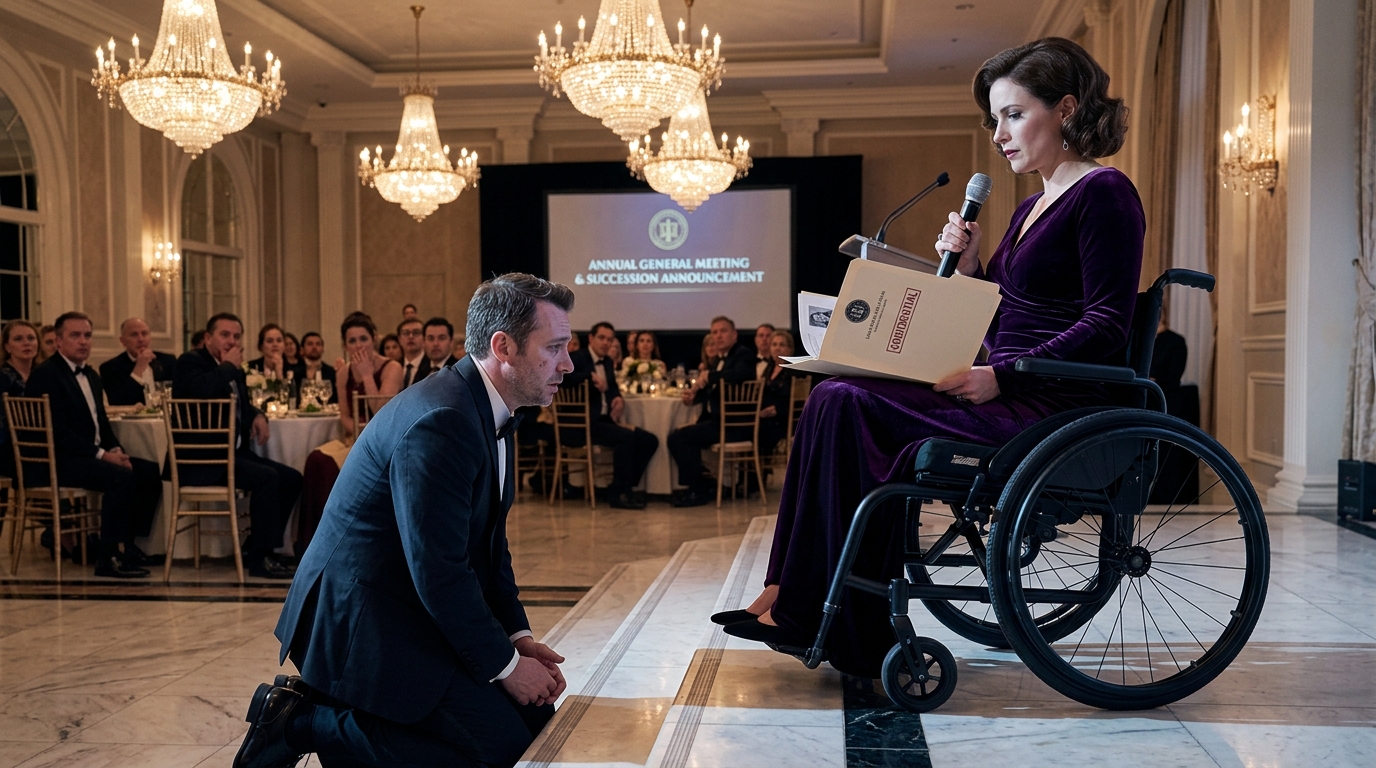
I remember the sound of his knees hitting the marble.
Not the applause.
Not the violin quartet playing near the west balcony.
Not the low murmur of old-money families pretending they had not come to watch a public execution disguised as a charity gala.
It was his knees.
A dull, humiliating crack against the polished staircase beneath the main stage.
For years, I had imagined that sound.
I had imagined him begging in some private room, away from the cameras, away from the donors, away from the same people who once lowered their eyes when I rolled past them in my wheelchair.
But reality was colder.
Cleaner.
More elegant.
And far more satisfying.
Sebastian Vale knelt below me in a black tuxedo tailored by a man who probably knew his measurements better than his soul. His silver cufflinks caught the chandelier light. His hair was perfect. His face was not.
His face was beginning to understand.
The ballroom at Hawthorne House had gone unnaturally quiet. Two hundred investors, trustees, heirs, judges, socialites, and family friends sat frozen beneath the vaulted ceiling. Crystal chandeliers hung above them like glittering witnesses.
I sat above him on the raised platform in my wheelchair, wearing a deep purple gown that fell over my legs like a royal secret. One hand rested on the microphone. The other gripped the armrest, not because I was afraid, but because I wanted to feel steady when the moment finally arrived.
“Clara,” Sebastian whispered. “Please.”
He had said my name like that once before.
Years ago.
In a private hospital room after the accident.
Back then, his voice had trembled with pity.
Tonight, it trembled with fear.
That difference mattered.
I looked down at him.
The man who once told me he needed “someone simpler.”
The man who once held my hand, kissed my knuckles, and explained that the future he was building required a woman who could stand beside him at galas, cross rooms without assistance, dance beneath chandeliers, and make powerful men comfortable.
A woman who did not remind them that bodies break.
A woman who did not carry visible proof that life could turn brutal without warning.
A woman who was not me.
“You told them I disappeared,” I said into the microphone.
My voice moved through the ballroom with frightening calm.
Sebastian flinched.
The audience did too.
No one liked direct language in rooms like this. They preferred betrayals wrapped in phrases like transition, restructuring, unfortunate timing, family privacy.
But I had not come back for polite language.
I had come back for the truth.
“You told them I was recovering abroad,” I continued. “Then you told them I had withdrawn from public life. Then you told them I had signed away my voting interest in Hawthorne Global because I was too damaged to lead.”
A faint gasp came from the second row.
Sebastian’s mother, Vivian Vale, lifted one hand to her pearls.
Vivian had perfected the expression of wounded innocence over seventy years of practicing cruelty in silk.
Sebastian raised both hands slightly, palms open, like a man approaching a frightened animal.
“Clara,” he said again, softer. “This isn’t the place.”
That almost made me smile.
Not because it was funny.
Because for years, men like him had decided which rooms I belonged in.
Hospital rooms.
Guest rooms.
Back rooms.
Side entrances.
Quiet exits.
Never the main stage.
Never the voting floor.
Never above him.
“This is exactly the place,” I said.
Then I lifted the folder from my lap.
Black leather.
Gold seal.
Confidential succession documents.
Sebastian saw the emblem before anyone else did.
I watched recognition move across his face like blood leaving a wound.
First confusion.
Then disbelief.
Then panic.
Those documents were supposed to be locked in his attorney’s office.
He knew that.
I knew that.
And now every important person in the room knew he knew.
“You were ashamed of me,” I said. “So I brought proof of what you did while you thought I was gone.”
His lips parted.
No sound came out.
For the first time since I had known him, Sebastian Vale had nothing beautiful to say.
I opened the folder.
And the first page did not show his fraud.
It showed his wife.
The Woman No One Was Supposed to Know About
Her name was Elise Marrow.
At least, that was the name on the Nevada marriage license.
The date printed beneath it was four months after my accident.
Four months after I woke up in a hospital bed unable to feel my legs.
Four months after Sebastian cried beside me and promised nothing would change.
The ballroom did not understand the page at first.
Rooms like that do not process scandal all at once. They resist it. They blink at it. They wait for someone in authority to tell them what interpretation is acceptable.
So I helped them.
“This is a certified copy of a marriage license,” I said. “Filed in Clark County, Nevada, under the names Sebastian James Vale and Elise Marrow.”
The silence deepened.
Not empty.
Hungry.
Sebastian stood too quickly, then remembered he had been kneeling, then half-stumbled on the first stair.
“Elise was a private matter,” he said.
A foolish sentence.
A desperate sentence.
A sentence that made every attorney in the room sit forward.
I turned the page.
A photograph appeared on the screen behind me, projected from the folder’s digital copy. Sebastian in a dark suit. Elise in a cream dress. A chapel with fake ivy and dim gold lights. His hand on her waist.
The woman beside him was young.
Elegant.
Standing.
Of course.
The audience shifted.
Someone whispered, “My God.”
Sebastian looked toward the projection booth.
Too late.
The man operating the slides had been mine for six months.
So had the caterer.
So had the security chief.
So had three board members Sebastian still believed he controlled.
That was the thing about being underestimated.
People spoke freely around you.
They assumed silence meant defeat.
They mistook absence for weakness.
They never considered that I had spent five years learning how power actually moved when no one thought I was in the room.
“Elise Marrow was not just your hidden wife,” I said. “She was your proxy.”
Sebastian’s face tightened.
There it was.
The real wound.
Not shame.
Exposure.
I lifted another page.
“This is the document that appointed her managing director of Sable Ridge Holdings, the shell company that quietly acquired voting shares from elderly Hawthorne relatives after you told them I had suffered cognitive decline.”
Vivian stood.
“Enough.”
One word.
Sharp.
Commanding.
The same tone she had used years ago when nurses entered my hospital room and she wanted them gone before they heard too much.
I turned toward her.
“Sit down, Vivian.”
The ballroom inhaled.
No one spoke to Vivian Vale like that.
Not employees.
Not relatives.
Not judges who owed her favors.
Certainly not the woman she once described as “medically unfortunate.”
Her mouth opened.
Then closed.
Because the screen changed again.
This time, it showed a handwritten letter.
Her handwriting.
Her stationery.
Her signature.
Vivian sank slowly back into her chair.
Sebastian looked at his mother.
That was when I knew.
He had not known about that letter.
Good.
I had saved something for both of them.
The letter was dated two weeks after my accident. It was addressed to Dr. Richard Mallory, the private neurologist Sebastian’s family insisted I see after I was discharged.
The first line appeared in full on the screen.
We need Clara declared unfit before the quarterly board review.
The room shifted from scandal to danger.
I could feel it happen.
Scandal entertains wealthy people.
Danger threatens them.
And this danger was legal.
Financial.
Criminal.
Sebastian slowly turned back toward me.
His face was no longer pale.
It was gray.
“Where did you get that?” he whispered.
Not “That isn’t real.”
Not “You’re lying.”
Where did you get that?
The perfect confession.
I leaned closer to the microphone.
“From the woman you paid to destroy the originals.”
A door opened at the back of the ballroom.
Everyone turned.
A small woman in a black server’s uniform stepped inside, holding a sealed archival box against her chest.
Sebastian saw her.
And whatever strength he had left disappeared.
Because the woman walking toward the stage was supposed to have died three years ago.
The Archivist Who Came Back From the Dead
Her name was Nora Bell.
To Sebastian’s family, she had been nobody.
A records clerk.
A quiet woman with gray hair, orthopedic shoes, and a habit of lowering her voice when important people entered the archive room.
To me, she had become the first person who ever told me the truth without asking what it would cost her.
I met Nora eight months after the accident.
By then, the world believed I was recovering in Switzerland. In reality, I was living in a converted guest cottage on the edge of a storm-battered lake in Maine, under a trust-owned name Sebastian never bothered to trace because he thought I was too broken to manage paperwork.
He had underestimated grief.
He had underestimated rage.
Most of all, he had underestimated boredom.
Pain leaves you with time.
Endless time.
Time to read.
Time to listen.
Time to compare signatures.
Time to notice that the board resolution removing me from operational authority used a version of my signature I had not used since college.
That was how Nora found me.
Not in person at first.
A package arrived with no return address.
Inside was a copy of the forged resolution and a yellow sticky note.
Mrs. Whitmore, if you did not sign this, call me from a phone that is not yours.
Mrs. Whitmore.
My married name.
The name Sebastian had tried to bury.
I called her from a gas station pay phone twenty minutes away.
She answered on the first ring.
“I was hoping you were alive,” she said.
No greeting.
No small talk.
Just that.
I remember gripping the receiver so hard my palm hurt.
“Why?”
“Because dead women don’t usually correct punctuation.”
That was how I learned someone had been forging more than my signature.
They had forged emails.
Medical authorizations.
Share transfers.
Private letters to distant relatives explaining that I wanted peace, solitude, and no visitors.
They had not removed me from the world all at once.
They had edited me out piece by piece.
Nora spent thirty-two years in the Hawthorne archives. She knew where every deed slept, where every codicil hid, which file cabinets stuck in humidity, which trustees drank too much and forgot to shred drafts.
She had watched Sebastian’s family rewrite truth for decades.
But my case had scared her.
Not because it was cruel.
Because it was organized.
Then, three years ago, Nora vanished.
Her car was found near a bridge outside Albany. Her apartment was cleared. Her niece identified a scarf recovered from the riverbank.
Sebastian’s people called it tragic.
Vivian sent flowers.
I attended no memorial because I already knew Nora was alive.
I was the one who moved her.
Tonight, she walked down the center aisle with the archival box in her arms, and the room looked at her the way people look at ghosts when they suddenly realize ghosts can testify.
Sebastian backed away from the stairs.
“No,” he said.
One word.
Small.
Useless.
Nora reached the platform. Security helped her up the side ramp. She placed the archival box on the table beside me, then turned toward the audience.
“I kept copies,” she said.
Her voice was not dramatic.
That made it worse.
“I kept copies because Mr. Vale asked me to destroy the originals.”
Sebastian lunged one step forward.
Two security guards moved instantly.
He stopped.
Not because he wanted to.
Because he understood the optics.
There were cameras now.
Not social media phones.
News cameras.
Legal cameras.
Board cameras.
I watched him calculate and find no exit.
Nora opened the box.
Inside were medical memos, board minutes, notarized statements, bank transfers, and one small velvet pouch.
I had not planned to show the pouch so soon.
But then Vivian stood again.
Her voice shook this time.
“You vindictive little cripple.”
The ballroom went so still I heard someone drop a fork.
Sebastian closed his eyes.
Even he knew she had just stepped on the final wire.
I looked at Vivian for a long moment.
Then I nodded to Nora.
She opened the velvet pouch and removed a ring.
Not mine.
Not Elise’s.
An old Hawthorne signet ring, gold worn thin at the edges.
Vivian stopped breathing.
Because she knew exactly whose ring it was.
So did I.
It had belonged to my father.
The man Vivian claimed had signed away his final voting shares to her family two nights before he died.
I held the ring up beneath the chandelier light.
Inside the band was a hidden compartment.
And inside that compartment was a folded strip of microfilm.
Sebastian stared at it, confused.
Vivian did not.
Vivian looked as though the floor had opened beneath her.
Because this betrayal had not started with my accident.
It had started with my father’s death.
The Signature That Should Have Been Impossible
My father died on a Thursday.
That was what the official records said.
Massive cardiac event.
No suspicious circumstances.
Private burial.
Closed family service.
I was twenty-seven then, still foolish enough to believe old families were cruel only in the emotional sense. Cold dinners. Sharp comments. Conditional affection. The usual weapons of the rich.
I did not yet understand that inheritance could make murder look administrative.
The microfilm was converted live on the projector screen.
For a few seconds, there was only grain.
Static.
Blurred lines.
Then the image sharpened.
A hospital room.
My father in bed.
Vivian beside him.
A lawyer standing near the window.
Sebastian’s father, already dead now, leaning over the mattress with a pen.
The timestamp glowed in the corner.
10:42 p.m.
The date was two days after my father’s official death.
A sound moved through the ballroom.
Not a gasp.
Something lower.
More primal.
Because everyone understood the impossibility before I explained it.
Dead men do not sign voting transfers.
Dead men do not initial codicils.
Dead men do not appear on hospital security footage forty-eight hours after their recorded time of death unless someone changed the record.
Vivian gripped her pearls so hard I thought the strand might break.
Sebastian looked at her like a child seeing his mother’s face clearly for the first time.
I almost pitied him.
Almost.
Then I remembered the hospital room.
His mouth near my hand.
His soft apology.
His beautiful betrayal.
I kept going.
“My father discovered the Vale family had been using shell companies to drain Hawthorne assets for years,” I said. “He planned to remove them from the board. He planned to give controlling authority to me.”
The footage changed.
Now my father’s hand was visible.
Weak.
Trembling.
But not holding the pen.
Sebastian’s father held it for him.
Vivian guided his fingers.
The lawyer watched.
No one spoke in the ballroom.
No one wanted to breathe too loudly around evidence like that.
“That signature transferred forty-one percent of the Hawthorne voting bloc,” I said. “It was used to place Vivian Vale in temporary control. Later, those shares were supposed to pass to Sebastian after he married me.”
I turned toward him.
“That was the point, wasn’t it?”
Sebastian’s eyes were wet now.
Whether from fear or shame, I did not care.
“You were supposed to marry the daughter, absorb the shares, and keep me decorative.”
He shook his head.
“I loved you.”
There it was.
The oldest defense of selfish men.
I loved you.
As if love could explain theft.
As if love could excuse abandonment.
As if love, once spoken, became a solvent strong enough to dissolve evidence.
“No,” I said. “You loved what marrying me gave you.”
He looked wounded.
That offended me more than his betrayal.
The nerve of him.
To bleed publicly because the knife was finally pointed in the other direction.
I took the final document from the folder.
This one had been the hardest to obtain.
Not because it was well hidden.
Because part of me had not wanted it to exist.
The screen changed again.
A trust amendment.
Signed by Sebastian.
Witnessed by Elise Marrow.
Filed under Sable Ridge Holdings.
Its purpose was simple.
Brutal.
If I were declared medically incompetent before the annual succession vote, my remaining shares would be transferred into a conservatorship controlled by my legal spouse.
Sebastian.
But if Sebastian remarried quietly and moved those spousal rights through a Nevada marital asset structure, Elise could receive them if anything happened to him.
The room understood slowly.
Then all at once.
Sebastian had not merely abandoned me.
He had kept me legally useful.
A disabled wife on paper.
A hidden wife in practice.
A fortune suspended between them.
And one final medical declaration away from being erased completely.
I looked at the front row.
At the board chair.
At the attorneys.
At the federal investigator sitting quietly behind a woman in emerald silk.
Yes.
I had invited him too.
“Dr. Mallory was scheduled to file my final incompetency certification tomorrow morning,” I said.
Sebastian closed his eyes.
Vivian whispered something that sounded like a prayer.
I smiled for the first time that evening.
“Unfortunately for all of you, he signed a cooperation agreement yesterday.”
The side doors opened.
Two federal agents entered the ballroom.
Not rushing.
They did not need to rush.
Authority does not sprint in rooms where guilt is already seated.
Sebastian turned toward the exits.
Vivian gripped the table.
Elise Marrow, hidden among the guests in a silver dress, stood too quickly.
That was how everyone found her.
And when she ran, she carried the one thing I had been waiting all night to see.
The Vote That Ended Everything
Elise made it twelve steps.
A woman can move quickly in heels when she is running from prison, but not quickly enough through a ballroom full of people who suddenly understand they have been seated inside a crime scene.
She pushed past a senator’s wife.
Knocked over a champagne flute.
Slipped near the east aisle.
The silver clutch flew from her hand and skidded across the marble floor, stopping at the base of my platform.
It opened.
A flash drive slid out.
Small.
Black.
Almost laughably ordinary.
That was the thing about empires.
They always looked massive from the outside.
But sometimes the whole rotten structure lived inside something small enough to fit in a woman’s palm.
One of the federal agents picked it up with a gloved hand.
Elise froze.
Sebastian whispered, “Don’t.”
Not to the agent.
To her.
That was the first honest thing he had said all night.
The agent looked toward me.
I nodded.
The projection booth switched inputs.
For ten seconds, nothing happened.
Then folders appeared on the screen.
Medical drafts.
Offshore transfers.
Audio files.
Video clips.
A directory labeled C.W. FINAL.
My initials.
Clara Whitmore.
Final.
The room seemed to tilt.
I had known they planned to take my company.
I had known they planned to have me declared incompetent.
But final meant something else.
Final was not legal.
Final was permanent.
The federal agent opened the folder.
Inside was a recording.
Sebastian’s voice filled the ballroom.
“If she contests the certification, increase the dosage. Mallory said it will make her confused enough for the hearing. After that, she goes to the private facility. No visitors except approved family.”
Then Vivian’s voice.
“And if she improves?”
A pause.
Then Sebastian.
“She won’t.”
I had prepared myself for many kinds of pain.
But hearing his voice say those words so calmly reached a place revenge had not numbed.
For a moment, I was back in that hospital room.
My legs silent beneath the sheets.
His lips on my hand.
His promise that he would always protect me.
His eyes already measuring what I was worth broken.
The ballroom blurred.
I tightened my hand on the armrest.
Not from weakness.
From memory.
Sebastian looked up at me.
His face had collapsed completely now.
“Clara,” he whispered. “I didn’t mean—”
I raised my hand.
He stopped.
I had waited five years to interrupt him.
It was more satisfying than I expected.
The board chair stood slowly.
He was an old man with a cautious face and a voice that had ruined many lives politely.
“Given the evidence presented,” he said, “the emergency succession vote will proceed immediately.”
Vivian shouted.
Sebastian objected.
Elise cried.
Their attorneys rose all at once, then sat back down when the federal agents turned toward them.
The vote took seven minutes.
Seven minutes to undo five years of erasure.
Seven minutes to restore my controlling authority.
Seven minutes to remove Sebastian Vale, Vivian Vale, and all affiliated entities from Hawthorne Global’s board, trusts, and executive channels pending criminal investigation.
When the final vote passed, no one applauded at first.
Not because they disagreed.
Because the room was afraid to move.
Then Nora began clapping.
Once.
Twice.
A steady, deliberate sound.
The old archivist with orthopedic shoes and a spine stronger than every man in the room.
Others joined.
Slowly.
Then all at once.
The applause rose beneath the chandeliers, filling the ballroom Sebastian had once told me I would never enter again.
He stood at the foot of the stairs, surrounded by agents, staring up at me as if I had become something impossible.
Maybe I had.
Not healed.
Not fixed.
Not restored to the woman he once approved of.
Something better.
Something he had not designed.
Something he could not control.
As they led him away, he twisted back once.
“Clara,” he said. “Please. After everything we were—”
I leaned toward the microphone.
The room quieted instantly.
That power felt unfamiliar.
Then natural.
“We were never a love story, Sebastian,” I said. “We were a crime scene with flowers.”
His face broke.
Mine did not.
Vivian was escorted out next, still muttering about family loyalty, as though loyalty meant allowing the cruel to inherit silence.
Elise followed, sobbing into hands that had signed my disappearance into paperwork.
When the doors finally closed behind them, the ballroom exhaled.
I remained on the platform.
Alone for the first time that night.
But not lonely.
Nora placed one hand gently on my shoulder.
“You did it,” she whispered.
I looked out at the room.
At the investors who had doubted me.
At the relatives who had abandoned me.
At the powerful men who once preferred me invisible.
Then I looked at the empty marble step where Sebastian had knelt.
For years, I believed I wanted him to apologize.
I believed hearing him beg would close something inside me.
But I was wrong.
Some wounds do not close because the person who caused them kneels.
They close when you stop waiting for their remorse to make you whole.
I rolled forward to the edge of the platform and looked directly into the cameras.
“My name is Clara Whitmore,” I said. “I was never gone. I was never unfit. And Hawthorne Global was never theirs to inherit.”
This time, the applause came immediately.
Louder.
Stronger.
Real.
Above me, the chandeliers shimmered like they had witnessed a coronation instead of a downfall.
And for the first time since the accident, I did not feel like the woman who had been left behind.
I felt like the one who had returned with the keys.
And every locked door in that family was about to open.