The Bag He Forced Into My Arms
I remember the rain before I remember his words.
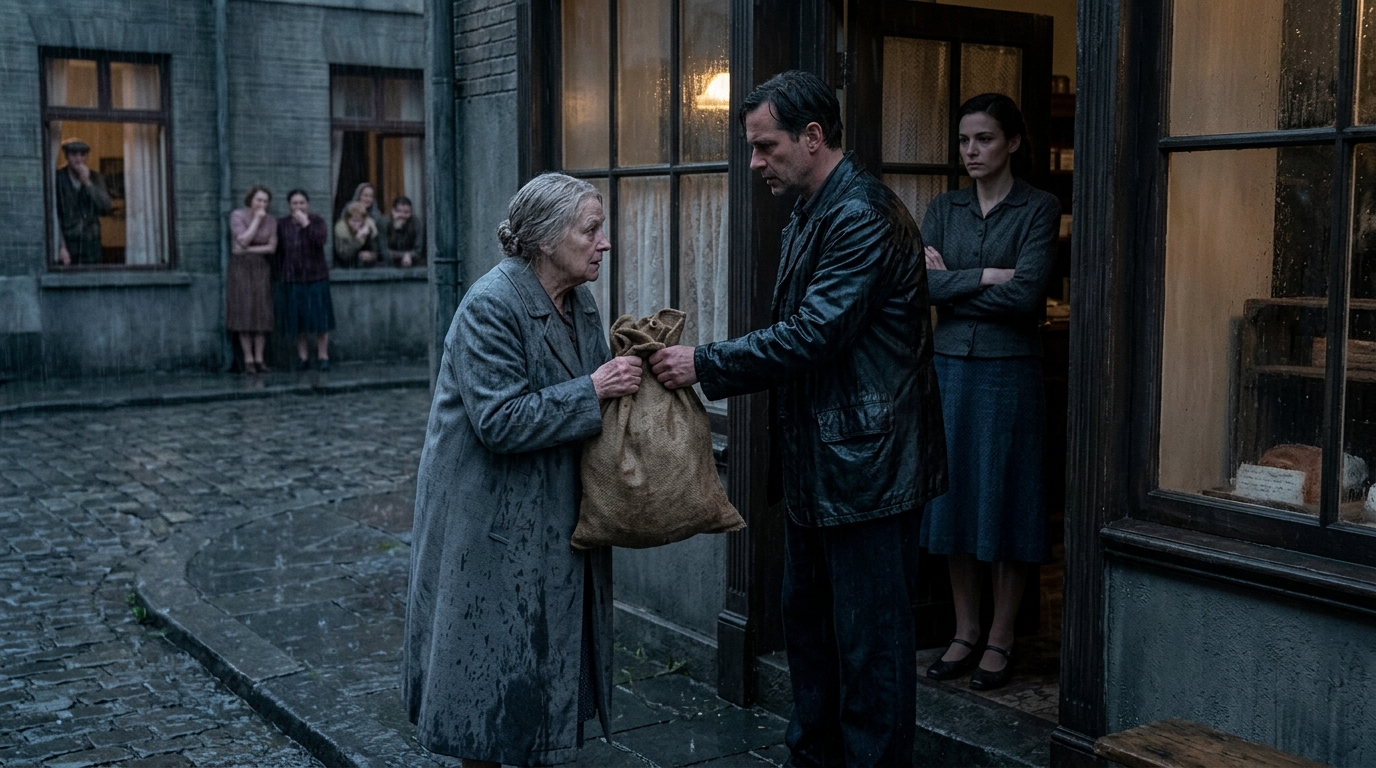
It came down hard that evening, striking the pavement in silver lines, running along the curb in muddy streams, dripping from the awning of my son’s townhouse like the house itself was ashamed.
The neighbors had gathered before I understood why.
Curtains moved.
Porch lights flicked on.
A woman across the street stopped halfway to her car, one hand covering her mouth as if she had stepped into the middle of someone else’s funeral.
Then my son pushed the bag into my arms.
A burlap sack.
Heavy.
Damp.
Smelling of rice, rainwater, and the old market where poor women bought food in bulk because measuring every meal was easier than admitting they were hungry.
“Take it and leave, Mom,” Daniel said.
His voice was loud.
Too loud.
The kind of loud a man uses when he wants witnesses.
For one terrible second, I did not understand him.
I looked at his face, searching for the boy I had raised. The boy who used to hide behind my skirt during thunderstorms. The boy who cried when he broke his first toy truck. The boy who once promised, with all the seriousness of a child, that when he became rich, I would never carry anything heavy again.
That boy was gone.
In his place stood a man in a pressed white shirt, jaw tight, eyes cold, rain running down his temples.
Behind him, in the doorway, his wife watched.
Vanessa.
Her arms were crossed.
Her lips were still.
Her eyes were not.
There was something in them I had never liked, though I had spent years scolding myself for thinking so. A mother is not supposed to dislike the woman her son chooses. A mother is supposed to step back, bless the marriage, and swallow the little signs.
The way Vanessa corrected him in public.
The way she touched his arm when he spoke too honestly.
The way she smiled at me as if I were an old chair she planned to remove once guests stopped noticing it.
“Daniel,” I whispered.
He shoved the bag harder against me.
“Take the rice and leave.”
Someone gasped.
A man muttered, “That’s his mother.”
Daniel heard it.
Everyone heard it.
He wanted them to.
I clutched the sack to my chest because if I did not hold on to something, I feared I might fall. The rain soaked through my cardigan. My shoes filled with cold water. My bones ached the way they do when grief enters before understanding.
Vanessa shifted behind him.
Just slightly.
A warning without words.
Daniel’s eyes flicked toward her.
Then back to me.
And for one brief moment, so brief I almost missed it, his face broke.
Not anger.
Not disgust.
Fear.
My son was afraid.
Then the mask returned.
“You can’t keep coming here,” he said. “We have our own family now.”
Our own family.
The phrase struck deeper than the rain.
I thought of the nursery upstairs.
Painted pale yellow.
Empty crib still covered with a white sheet.
The baby they told me had died two years earlier.
The grandson I never held.
The child Vanessa refused to discuss.
The loss that turned Daniel quiet and Vanessa sharper.
I nodded slowly.
Not because I understood.
Because mothers learn that sometimes a son’s cruelty is still a language.
“I’ll go,” I said.
My voice sounded small.
Vanessa’s mouth curved.
Not enough for the neighbors to notice.
Enough for me.
I turned away with the rice pressed against my chest. No one stopped me. No one offered an umbrella. The street watched me walk through the rain like a public sentence had just been carried out.
Step by step, I told myself what I had told myself through every hard season of my life.
He is just going through something.
He does not mean it.
A mother must endure.
But the bag grew heavier with every block.
Too heavy for rice.
By the time I reached my small room behind the laundromat, my hands were numb. I set the sack on the table under the single yellow bulb and stared at it for a long time.
Then I untied the knot.
Rice spilled across the table in a pale stream.
But beneath it was something else.
A white envelope.
My name was written across the front.
Mrs. Rose.
My son’s handwriting.
I opened it with shaking fingers.
Inside was a thick stack of hundred-dollar bills and a folded note.
The first line nearly took my legs from under me.
I had to disgrace you in front of her… because if she learned the truth, she would ruin everything.
I pressed one hand to my mouth.
Then I turned the page.
There was a second message beneath it.
Different handwriting.
Sharper.
Hurried.
Don’t trust your daughter-in-law. She already knows what happened to the baby.
The Note Beneath the Rice
For a while, I could not move.
The rain tapped against my window.
The bulb above the table hummed.
Rice lay scattered across the wood like tiny bones.
I read the second sentence again.
Don’t trust your daughter-in-law.
Then again.
She already knows what happened to the baby.
Not what happened at the hospital.
Not what happened during the delivery.
What happened to the baby.
My hands began to shake so badly the paper crackled.
The official story had been simple.
Cruel, but simple.
Vanessa went into labor early on a Tuesday morning. Daniel called me from the hospital parking lot, his voice torn open, telling me there were complications. By the time I arrived, a nurse stopped me at the maternity ward doors and said the baby had not survived.
I never saw him.
No one in our family saw him.
Vanessa said she was too devastated for visitors.
Daniel looked like a man whose soul had been taken out and replaced badly.
Three days later, the hospital provided a sealed urn.
A week after that, Vanessa sold the crib.
I told myself grief looked different in every person.
I told myself not to judge.
But there had always been details that did not settle.
No funeral.
No birth certificate.
No death certificate shown to me, only mentioned.
No photograph.
Not even a tiny handprint, though the hospital usually gave families something.
When I asked once, only once, Vanessa stared at me across the dinner table and said, “Some women know when to stop hurting their children.”
Daniel never raised his head.
After that, I stopped asking.
Or I told myself I stopped.
The truth was, the question stayed in me like a splinter.
I unfolded Daniel’s note fully.
Mom,
I know what this looked like. I needed it to look cruel. Vanessa has cameras at the front door and listens from the hallway. She checks my phone. She checks my accounts. She has already spoken to a lawyer about having you declared financially dependent and mentally unstable so she can keep you away from me permanently.
The money is yours. Hide it.
Do not come back to the house.
Do not answer calls from Vanessa.
Tomorrow morning, go to St. Agnes Community Clinic. Ask for Nurse Leona Pike.
Tell her I found the blue blanket.
My breath stopped.
The blue blanket.
I remembered it.
I had crocheted it myself when Vanessa was six months pregnant. Soft blue yarn. White border. A tiny stitched rose in one corner because Daniel said the baby should carry something from me.
Vanessa hated it.
She said it looked old-fashioned.
Daniel loved it.
He placed it in the crib himself.
After the baby “died,” I asked what happened to it.
Vanessa told me it was buried with him.
Now Daniel had found it.
Found it where?
Why did it matter?
And why had he not told me face to face?
I looked down at the cash again. There was enough to pay my rent for months. Enough to leave town if I needed to. Enough for a frightened son to buy his mother distance before something worse happened.
A third folded paper rested at the bottom of the envelope.
This one was not a note.
It was a photograph.
Grainy.
Printed from a phone.
It showed the inside of a closet.
A box.
And inside the box, folded neatly, was the blue blanket.
My blue blanket.
The little white rose visible in the corner.
But beside it was a hospital bracelet.
I brought the photograph closer to the light.
The name printed on the bracelet was not Baby Miller.
Not Daniel’s last name.
It read:
Infant Male. Unknown Transfer.
Date of birth: two days after Vanessa claimed he died.
I sat down hard.
The chair legs scraped against the floor.
A sound escaped me.
Not a cry.
Not yet.
Something deeper.
Something that had been waiting two years for permission.
I looked back at Daniel’s note.
Ask for Nurse Leona Pike.
Tell her I found the blue blanket.
At the bottom of the page, almost hidden beneath the fold, Daniel had written one final line.
If I disappear before morning, don’t believe Vanessa’s tears.
The Nurse Who Wouldn’t Say His Name
I did not sleep.
Every time I closed my eyes, I saw Daniel standing in the rain, forcing cruelty into his voice while fear lived behind his eyes.
I saw Vanessa watching from the doorway.
I saw the white envelope under the rice.
And I saw a baby wrapped in a blue blanket, carried somewhere he was never supposed to go.
At dawn, I tied the cash into an old flour sack and hid it beneath a loose floorboard under my bed. Then I placed Daniel’s note inside my coat, wrapped the photograph in a plastic grocery bag, and took the first bus to St. Agnes Community Clinic.
St. Agnes was not the hospital where Vanessa gave birth.
It was smaller.
Older.
A brick building with faded green doors and a statue of Mary near the entrance, her stone hands open as if she had been waiting for too many desperate women to count.
The waiting room smelled of disinfectant, coffee, and wet coats.
A young receptionist looked up when I entered.
“Can I help you?”
My throat tightened.
“I need to see Nurse Leona Pike.”
The receptionist’s expression changed before she could hide it.
“Do you have an appointment?”
“No.”
“What is this regarding?”
I looked around.
A pregnant girl sat in the corner with a toddler asleep against her shoulder. An old man coughed into a tissue. A television played weather updates no one watched.
I leaned closer.
“My son found the blue blanket.”
The receptionist went still.
She stood.
“Wait here.”
She disappeared through a side door.
Ten minutes passed.
Then twenty.
I nearly left twice.
Fear makes ordinary places feel staged. Every door opening sounded like someone coming for me. Every phone ringing felt like a warning.
Then an older nurse appeared in the hallway.
Leona Pike was small, gray-haired, and sharp-eyed. She wore navy scrubs and a white cardigan buttoned at the throat. Her face gave nothing away.
“Mrs. Rose Miller?”
I nodded.
She looked at my wet shoes.
Then at the coat pocket where I had hidden the photograph.
“Come with me.”
Her office was barely larger than a storage closet. Metal filing cabinets lined one wall. A cross hung above her desk. There were no family photos.
Women like Leona Pike did not leave loved ones where strangers could use them.
She closed the door and locked it.
“Show me.”
I placed Daniel’s note and the photograph on her desk.
She did not touch them at first.
She only stared.
When she finally picked up the photograph, her eyes closed.
“Oh, Daniel,” she whispered.
“You know my son?”
She opened her eyes.
“I know what he has been trying to prove.”
My hand gripped the edge of the chair.
“What happened to my grandson?”
Leona looked at me for a long time.
Then she said, “He did not die at birth.”
The room swayed.
I pressed one hand to my chest.
“Say that again.”
“He did not die at birth,” she repeated. “He was transferred.”
“Transferred where?”
Her jaw tightened.
“That is what I have been trying to find out for two years.”
I could not breathe properly.
My grandson.
Alive.
The word entered me carefully, painfully, like light through a boarded window.
Alive.
Leona opened the bottom drawer of her desk and removed a thin file.
No label.
No hospital seal.
Just papers held together with a black clip.
“Vanessa delivered at Westbridge Medical,” she said. “Private maternity wing. Expensive. Quiet. I was working there part-time that month because they were short-staffed.”
“Were you there that night?”
She nodded.
“The baby was healthy. Small, but healthy. I heard him cry.”
My hands flew to my mouth.
A cry.
My grandson had cried.
Someone had heard him.
Someone had known.
“Then why did they say he died?”
Leona looked down.
“Because the death record was created before delivery.”
The words made no sense at first.
Then they made too much sense.
“Before?”
She nodded.
“Someone planned it. The paperwork was already prepared. Stillbirth certification. Cremation request. Restricted visitation note. All waiting for signatures.”
“Who signed it?”
Leona hesitated.
I knew before she answered.
“Vanessa.”
The name felt like poison.
“And Daniel?”
“No,” she said firmly. “Your son was sedated.”
I stared at her.
“What?”
“Vanessa claimed he had a panic attack after complications began. A doctor gave him something to calm him. Too much, in my opinion. By the time the baby was moved, Daniel was barely conscious.”
My mind returned to that week.
Daniel slurring on the phone.
Daniel unable to stand at the hospital.
Daniel staring through me like grief had drugged him.
Maybe grief had not been the only thing.
Leona turned one page.
“There was another woman there.”
“Who?”
“A private adoption attorney named Margaret Voss. She arrived before the baby was born.”
My stomach tightened.
“Adoption?”
Leona shook her head.
“Not legal adoption. Not from what I saw.”
The office went silent.
Outside the door, someone laughed in the hallway. The sound felt obscene.
Leona pulled a second photograph from the file and slid it toward me.
It showed Vanessa in a hospital bed, holding the blue blanket but not the baby. Beside her stood a woman in a camel-colored coat, face turned partly away from the camera.
“That’s Margaret Voss,” Leona said.
“How did you get this?”
“Security stills. A friend owed me a favor before Westbridge deleted the footage.”
I stared at Vanessa’s face in the photo.
She did not look like a grieving mother.
She looked alert.
Impatient.
Almost relieved.
“Why would she do this?” I whispered.
Leona’s voice dropped.
“Because the baby was worth more gone than born.”
I looked up.
“What does that mean?”
Before she could answer, someone knocked on the office door.
Three slow taps.
Leona’s face changed.
She grabbed the file and pushed it into my hands.
“Bathroom. Now.”
“What?”
“Go.”
The knob turned.
Leona shoved me toward a narrow side door.
Just before I slipped through, I heard the office door open.
Then Vanessa’s voice, soft and pleasant.
“Leona. I was hoping Mrs. Miller might come here.”
The Woman at the Clinic Door
I stood in the tiny employee bathroom with one hand clamped over my mouth.
The side door was thin.
Too thin.
Every word came through.
Leona’s voice remained calm.
“Mrs. Miller?”
“Please,” Vanessa said, almost laughing. “Rose is not clever enough to vanish on her own.”
I stopped breathing.
There was no grief in that voice.
No warmth.
Not even anger.
Just contempt.
The same contempt I had felt for years but never allowed myself to name.
“What do you want, Vanessa?” Leona asked.
“I want whatever Daniel gave her.”
“I don’t know what you mean.”
A pause.
Then the sound of something sliding across the desk.
Paper.
Maybe money.
Maybe a threat.
“I admire loyalty,” Vanessa said. “But I pay better than guilt.”
Leona did not respond.
Vanessa continued, softer now.
“That old woman is confused. Daniel is unstable. He humiliated his own mother in public yesterday. Everyone saw it. If Rose starts repeating nonsense about the baby, I’ll have no choice but to protect my family.”
Protect.
Cruel people loved that word.
“Daniel found the blanket,” Leona said.
Silence.
Not long.
But sharp.
When Vanessa spoke again, the sweetness was gone.
“Where is he?”
My knees weakened.
She did not ask what blanket.
She did not ask what Leona meant.
She asked where Daniel was.
Leona had been right.
Vanessa already knew.
“I haven’t seen Daniel,” Leona said.
“You should hope that’s true.”
A chair scraped.
Footsteps crossed the office.
For one horrible second, I thought Vanessa was coming to the bathroom.
Instead, she stopped near Leona’s desk.
“You made one mistake,” Vanessa said.
“What was that?”
“You kept caring after the paperwork was done.”
Leona’s voice hardened.
“And you made one mistake too.”
Vanessa laughed quietly.
“What?”
“You thought a baby could disappear without ever growing a face.”
Another silence.
This one felt different.
Dangerous.
Then Vanessa said, “You found him.”
My heart slammed once.
Him.
My grandson.
Leona said nothing.
Vanessa’s voice lowered.
“Tell Daniel if he keeps digging, I will make sure his mother spends the rest of her life in a facility where no one believes a word she says.”
The office door opened.
Then closed.
I stayed in the bathroom until Leona knocked softly.
“She’s gone.”
When I came out, she was already packing the file into a brown envelope.
“You heard?”
I nodded.
My mouth felt too dry to form words.
Leona wrote something on the outside of the envelope.
An address.
“Daniel came to me three months ago,” she said. “He had started suspecting Vanessa after finding inconsistencies in the hospital bills. Payments to Margaret Voss. Restricted records. A storage unit in Vanessa’s maiden name.”
“Why didn’t he come to me?”
“Because Vanessa had already started building a case against you.”
I stared at her.
“What case?”
Leona’s expression softened.
“Financial dependency. Memory problems. Emotional instability. She planned to claim you were harassing them about a dead baby and trying to extort money from your son.”
The humiliation in the rain suddenly made terrible sense.
Daniel had not been throwing me away.
He had been making Vanessa believe I was broken enough to stop.
Cruel enough to be believable.
Public enough to satisfy her.
“He was protecting me,” I whispered.
“Yes.”
“Where is he now?”
Leona did not answer quickly enough.
Fear entered the room like cold air.
“Leona.”
“He called me at 2:13 this morning,” she said. “He said he found the storage unit. He said the blanket was not the only thing inside.”
“What else?”
“A transfer receipt. A name. A photograph of a little boy.”
I gripped the desk.
“A little boy?”
Leona nodded.
“About two years old.”
The room blurred.
“Where?”
She pointed to the address on the envelope.
“An old childcare center outside Fairview. Closed officially. Still operating privately, according to Daniel.”
My voice broke.
“Is my grandson there?”
“I don’t know.”
“Is Daniel there?”
Her eyes filled with something I did not want to see.
“I don’t know that either.”
My phone began to ring.
The sound made us both jump.
Daniel.
His name flashed on the screen.
I answered so quickly I nearly dropped it.
“Daniel?”
For three seconds, I heard only static.
Then my son’s voice came through.
Weak.
Breathless.
“Mom…”
I gripped the phone with both hands.
“Daniel, where are you?”
A long pause.
Then he whispered,
“She knows I found him.”
The Child Behind the Blue Door
The old childcare center sat beyond Fairview Road, half hidden behind overgrown hedges and a rusted chain-link fence.
Once, it had probably looked cheerful.
There were faded cartoon animals painted on the outside wall. A cracked plastic slide stood in the yard. The sign over the entrance had been removed, but pale letters remained where the sun had not touched the brick.
BrightSteps Learning Center.
The name sounded cruel now.
Leona drove.
I sat beside her with Daniel’s note in my lap and the brown envelope pressed against my stomach. She had called a detective she trusted, a man named Harris, but warned me that if Vanessa had connections at Westbridge, she might have connections elsewhere too.
“We wait for police,” Leona said as we parked across the road.
“No.”
“Rose—”
“My son is inside.”
“You don’t know that.”
“I heard his voice.”
She looked at me, and I think she understood then that motherhood is not courage.
It is something older.
Less reasonable.
Harder to stop.
We crossed the road under a gray sky that still smelled of rain. The front door was locked. Leona led me around the side, where a service entrance stood slightly open.
“Daniel must have forced it,” she whispered.
Inside, the building smelled of bleach, old carpet, and milk gone sour.
Small cubbies lined the wall.
Some still had names written on peeling tape.
Maddie.
Theo.
Lucas.
Noah.
I froze.
Noah.
That was the name Daniel had wanted.
I had suggested it after my late husband. Vanessa said it was too old-fashioned. Daniel said old names carried blessings.
Noah.
My hand reached toward the cubby before I could stop myself.
Inside was a tiny blue mitten.
Leona touched my arm.
“We need to move.”
Down the hall, a sound.
Soft.
A child crying.
Not loud.
Not dramatic.
Tired.
My heart began to pound so hard I could hear it.
We followed the sound past a room full of broken toys, past a wall painted with clouds, past a locked office with filing cabinets visible through dusty glass.
Then I saw it.
A blue door at the end of the hall.
Freshly painted.
Too new for the rest of the building.
From behind it came another cry.
I stepped forward.
Leona grabbed my wrist.
“Wait.”
But waiting had cost us two years.
I reached for the knob.
Locked.
Leona pulled a ring of keys from her pocket.
“How do you have those?”
“Daniel gave me copies,” she said.
Her hands shook as she tried the first key.
No.
Second.
No.
Third.
The lock clicked.
The door opened.
Inside was a small room with one window covered by a curtain. A space heater hummed in the corner. There were two toddler beds, a shelf of plastic toys, and a little boy standing near the wall, clutching a blue blanket to his chest.
My blue blanket.
The white rose stitched in the corner.
The child stared at us with wide brown eyes.
Daniel’s eyes.
My knees gave way.
I had to grip the doorframe.
“Noah,” I whispered.
The boy did not know me.
Of course he did not.
That pain came clean and sharp.
He stepped backward, frightened.
Leona crouched.
“It’s okay,” she said softly. “We’re not here to hurt you.”
Then I saw Daniel.
He was on the floor near the far wall, half sitting, half collapsed, one hand pressed against his side. Blood darkened his shirt.
“Daniel!”
I reached him in three stumbling steps.
His eyes opened.
“Mom?”
“I’m here.”
His mouth trembled.
“I found him.”
“I know. I know.”
He looked past me toward the little boy.
“He has Dad’s eyes.”
I pressed my hand over his wound.
“What happened?”
“Vanessa,” he breathed. “She came after me. She said he was never supposed to come back.”
Leona had already taken out her phone.
“Detective Harris, we need EMS now. BrightSteps. Child recovered. Adult male injured.”
Noah began to cry again.
That sound did it.
Not Daniel’s blood.
Not the locked room.
Not the years of lies.
The child’s cry tore something open in me.
I reached toward him slowly.
“I made that blanket,” I whispered. “For you.”
He stared at me.
His little fingers tightened around the blue yarn.
Then he took one step closer.
Tiny.
Uncertain.
Enough.
From the hallway came the sound of a door slamming.
Leona turned.
I heard heels on tile.
Slow.
Controlled.
Vanessa appeared in the doorway with a small black pistol in her hand.
She looked at Daniel.
Then at Noah.
Then at me.
Her face showed no panic.
Only annoyance.
“Rose,” she said. “You should have taken the rice and stayed gone.”
The Mother Who Finally Stopped Forgiving
For most of my life, I believed forgiveness was a mother’s duty.
Forgive the son who forgets to call.
Forgive the daughter-in-law who speaks sharply.
Forgive the family that leaves you out because they are young, busy, grieving, tired, stressed, trying.
Forgive.
Swallow.
Pray.
Endure.
But standing in that room, with my bleeding son on the floor and my stolen grandson clutching the blanket I made before he was born, I understood something I wish I had known earlier.
Forgiveness without truth is just permission.
Vanessa held the gun loosely, like she had already imagined this moment and decided we would all behave.
“Move away from him,” she told me.
I did not move.
Her eyes narrowed.
“Rose, don’t become stupid now.”
Daniel tried to sit up.
Vanessa pointed the gun at him.
“Stay down.”
Noah cried harder.
The sound irritated her.
Not frightened her.
I saw it clearly then.
This woman had carried a baby, sold his existence, buried a lie, watched my son collapse under grief, watched me mourn a grandchild who was alive, and still she looked at the crying boy as if he were an inconvenience.
“Why?” I asked.
The word came out quiet.
Vanessa laughed once.
“Because Daniel was going to leave me.”
My son closed his eyes.
She continued, almost bored.
“His father’s trust released a family inheritance when he had a child. But if we divorced, I got almost nothing. If the baby stayed, Daniel had leverage. If the baby died, grief kept him manageable. If the baby disappeared into a private placement, Margaret got paid, I got control, and Daniel stayed too broken to question me.”
Leona’s phone was still connected.
I saw it in her hand.
Vanessa did not.
Detective Harris was hearing everything.
I needed to keep her talking.
“And when Daniel started looking?”
Vanessa’s face hardened.
“He should have stayed sad.”
Daniel whispered, “You told me he was dead.”
“You believed me,” she snapped. “That is not my fault.”
Something in my son broke then.
Not loudly.
I felt it in the way his hand gripped mine.
He had blamed himself for two years.
For not asking.
For not fighting.
For mourning instead of investigating.
Vanessa had built a prison out of his grief and called it marriage.
Sirens sounded faintly in the distance.
Vanessa heard them.
Her eyes flicked toward the window.
Leona moved first.
She kicked the space heater toward Vanessa’s feet.
The cord tangled around Vanessa’s ankle.
The gun shifted.
Daniel grabbed my wrist and pulled me down.
The shot cracked through the room.
A shelf exploded behind us.
Noah screamed.
I crawled to him faster than I thought my old body could move. I wrapped myself around that child, blue blanket and all, and pressed his face against my shoulder.
“Don’t look,” I whispered. “Don’t look, baby.”
Another shout.
Heavy footsteps.
Police.
Vanessa tried to run.
She reached the hallway just as Detective Harris came through the side entrance with two officers behind him.
“Drop it!”
For the first time, Vanessa looked truly afraid.
Not sorry.
Never sorry.
Just afraid.
The gun hit the floor.
The officers forced her down against the faded cloud carpet while she screamed that everyone had misunderstood, that Daniel was unstable, that I had manipulated him, that Leona had forged records.
But her voice no longer had power.
Not here.
Not with the open blue door.
Not with Daniel bleeding.
Not with Noah alive.
Not with her own confession still connected through Leona’s phone.
At the hospital, Daniel survived.
The knife wound beneath his ribs was deep but not fatal. Vanessa had attacked him when he found the childcare center and refused to leave without the boy.
Noah was examined, fed, photographed, and wrapped in a clean blanket. He did not speak much at first. The people running BrightSteps had called him Liam. He had been moved between private homes and “temporary care” facilities funded through Margaret Voss’s illegal adoption network.
He was not the only child.
That truth came later.
In court documents.
In sealed indictments.
In mothers crying outside federal buildings with photographs clutched to their chests.
But Noah was the first one recovered from BrightSteps.
The first thread pulled loose.
Vanessa’s trial became a spectacle. She wore pale dresses and no jewelry, trying to look fragile. It did not work. The jury heard the clinic recording. The phone confession. The hospital paperwork. The false death record. The payments to Margaret Voss. The custody plan. The petition Vanessa had drafted to have me declared mentally unstable.
Daniel testified for two days.
I testified for one.
When the prosecutor asked why I opened the bag of rice, I told the truth.
“Because I am his mother,” I said. “And a mother knows when something is heavier than it looks.”
Vanessa was convicted on every major count.
Margaret Voss took a deal and named three doctors, two attorneys, and five private placement coordinators.
Leona Pike became the reason twelve families found answers.
As for the neighbors who watched Daniel disgrace me in the rain, they came by later with casseroles, apologies, and embarrassed faces. I accepted the casseroles. I did not need the apologies.
They had seen betrayal.
They had not understood sacrifice.
Months later, Daniel brought Noah to my little room behind the laundromat.
Not because he had to.
Because I asked him to.
I wanted Noah to see where the rice bag had been opened. Where the truth had first spilled out. Where a grandmother learned that the child she buried in her heart was still breathing somewhere.
Noah stood beside my table, cleaner now, rounder in the cheeks, still cautious with strangers but no longer silent.
He held the blue blanket in one hand.
The white rose had frayed from too much washing.
Daniel watched him with the haunted tenderness of a father rebuilding from ashes.
“I’m sorry, Mom,” he said quietly.
I touched his face.
The same face I had held when he was small.
“You got him home.”
“I hurt you.”
“You saved me first.”
His eyes filled.
Outside, rain began tapping the window again.
Gentler this time.
Noah looked up at the sound.
“Rain,” he said.
One word.
Small.
Perfect.
I knelt slowly in front of him. My knees protested. My back ached. Age is never polite about emotional moments.
“Yes,” I said. “Rain.”
He looked at the table.
Then at the old burlap sack folded on the chair.
Daniel had kept it.
I had asked him to.
Noah touched it with one finger.
“Rice?”
I smiled through tears.
“Yes, baby. Rice.”
He thought about that very seriously.
Then he lifted the blue blanket and placed it in my lap, as if returning a gift he finally understood had always belonged to both of us.
Daniel began to cry then.
Quietly.
The way men cry when the room is safe enough to let them become someone’s child again.
I held my grandson with one arm and reached for my son with the other.
For a long time, none of us moved.
The rain kept falling.
The city kept breathing.
And the little room that had once felt dim and forgotten filled with the one thing Vanessa had tried hardest to bury.
Family.
Not perfect.
Not untouched.
Not unbroken.
But alive.
And sometimes alive is the miracle that makes every cruel mile worth walking.