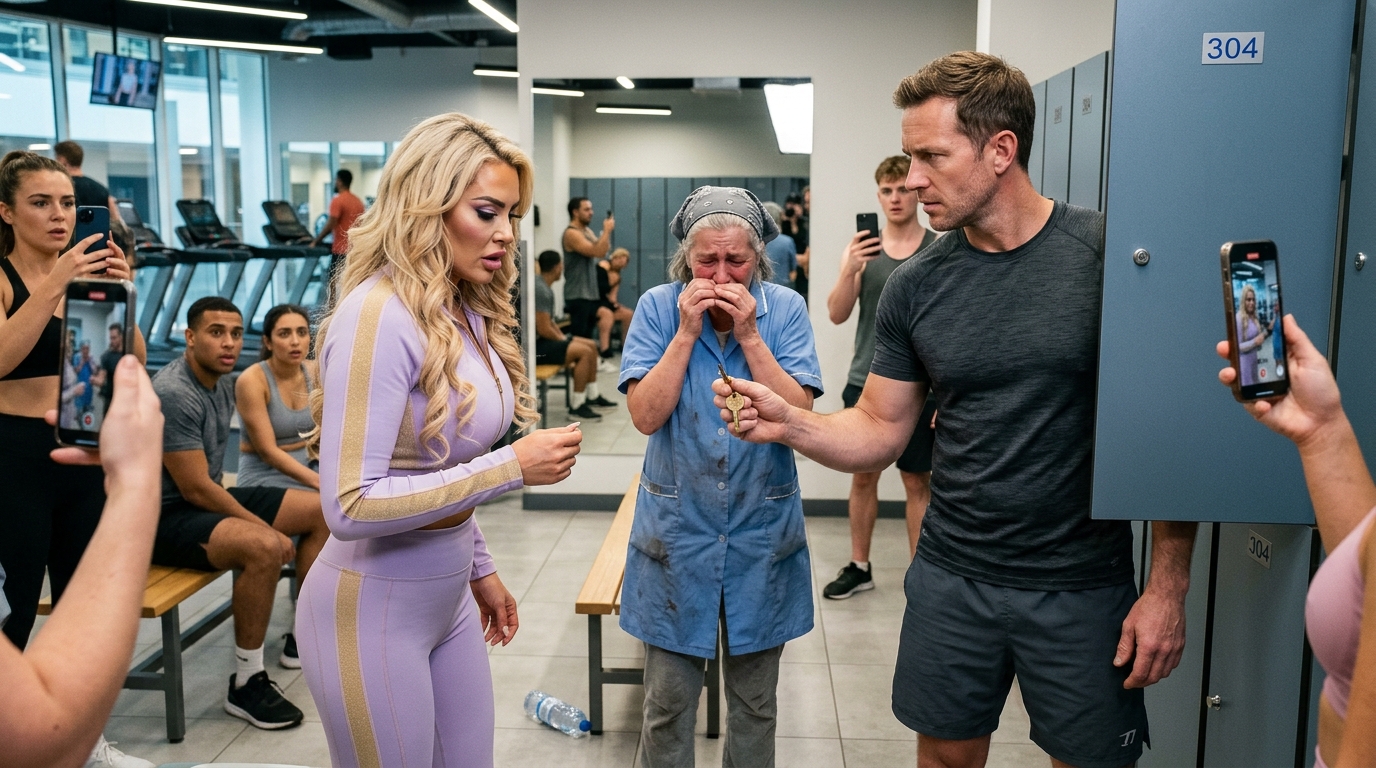
The Key on the Tile
“Don’t touch my things!”
The shout cracked through the gym like a whip.
For one stunned second, even the music seemed to fade.
The cleaning woman stumbled backward, one hand flying out to catch herself against the weight bench. A spray bottle rolled from her cart and spun across the glossy tile, its plastic body clicking loudly in the sudden silence.
Every mirror caught the scene.
Every face turned.
The woman who had shouted stood beside an open locker in the VIP changing area, chest rising and falling beneath a white designer workout set. Her dark hair was styled in perfect waves despite the early morning session. A diamond bracelet glimmered on one wrist. Her phone, still recording for some fitness story or lifestyle clip, lay propped against a water bottle.
Her name was Vanessa Cole.
To half the city, she was a wellness influencer.
To sponsors, she was a brand.
To the gym staff, she was a problem wrapped in perfume and money.
The cleaner stood in front of her, small and trembling.
Her name tag read Rosa.
She wore an old gray uniform, soft at the sleeves from too many wash cycles. Her hands were red from cleaning solution. Her hair was tucked under a faded cap. She looked more frightened than guilty, but that did not matter to the crowd forming around them.
Vanessa pointed at the locker.
“Then why was your hand in my locker?”
Rosa opened her mouth.
“I wasn’t—”
Vanessa stepped closer.
“Don’t lie. I saw you.”
Phones rose around them.
A man paused near the free weights.
Two women in matching leggings whispered near the vanity mirrors.
Someone from the treadmill area began filming openly.
Rosa’s eyes filled with tears.
“I only saw something fall.”
Vanessa laughed sharply.
“Something fall? From inside my private locker?”
“I was trying to—”
“To what?” Vanessa snapped. “Steal? Search? See what you could sell?”
The words landed with visible force.
Rosa’s face crumpled.
The manager, who had been hurrying across the room, slowed when he saw Vanessa’s expression. The gym depended on wealthy members. Vanessa had more followers than the gym had clients. He already looked afraid of choosing the wrong side.
Rosa’s shaking hand opened.
Something small slipped from her palm.
A tiny key fell to the tile.
Clink.
The sound was thin.
Sharp.
Somehow louder than the accusation.
Every phone camera followed it.
The key skidded once, turned, and stopped near a man’s shoe.
He had been standing beside the stretching area, a towel around his neck, his face still from the moment Vanessa shouted. He was in his late thirties, broad-shouldered, with tired eyes and a scar near his jaw. He bent down slowly and picked up the key.
At first, his expression showed only confusion.
Then he turned it over.
On the small brass head was an engraved number.
Locker 18.
The man froze.
Vanessa’s face changed.
Only for a second.
But Rosa saw it.
The man saw it too.
He looked from the key to Vanessa.
“That locker…” he said quietly.
Vanessa straightened.
“You’re mistaken.”
He did not blink.
“I know that number.”
The gym held its breath.
Rosa took a step back, tears running freely now, as if she had sensed the storm before anyone else understood its shape.
The man tightened his grip around the key.
His voice dropped low enough that everyone leaned in to hear.
“That locker belonged to my sister,” he said. “The week she disappeared.”
The silence that followed was no longer embarrassment.
It was fear.
Vanessa’s confident expression drained away.
The manager stopped walking.
The people filming no longer looked entertained.
And Rosa, the cleaning woman accused of theft, covered her mouth with both hands and whispered:
“She said someone would come back for it.”
The Missing Woman Named Claire
The man with the key was Daniel Ross.
For twelve years, he had lived with one number carved into his memory.
Locker 18.
It was ridiculous, really.
A person should remember voices, birthdays, favorite songs, the smell of a sister’s shampoo, the sound of her laughing at her own jokes.
Daniel remembered all of those too.
But he also remembered Locker 18.
Because that was the last place anyone knew his sister had been.
Claire Ross was twenty-six when she disappeared.
She worked two jobs then: mornings at a physical therapy clinic, evenings teaching beginner yoga classes at this same gym, though back then it had a different name and far fewer marble sinks in the VIP changing room.
Claire was not famous.
Not rich.
Not dramatic.
She was the kind of woman people described as reliable because they never noticed how tired reliability made her.
She called Daniel every Sunday.
She sent their mother flowers on the anniversary of their father’s death.
She had a habit of writing reminders on her wrist because she forgot paper notes but never forgot her own skin.
And she hated being late.
That was how Daniel knew something was wrong the night she vanished.
Claire was supposed to meet him for dinner after her last yoga class.
She never came.
Her phone went straight to voicemail.
Her apartment was locked.
Her car was in the gym parking lot.
Her bag was found in Locker 18.
But Claire was gone.
The police investigation had been messy from the start.
The gym’s old cameras had not been working in the hallway near the locker rooms. Staff statements contradicted each other. One manager claimed Claire seemed upset. Another said she left alone. A third employee remembered hearing an argument near the back exit but could not identify the voices.
Daniel remembered Vanessa too.
Back then, she was not Vanessa Cole, wellness empire and luxury fitness icon.
She was Vanessa Lane, an ambitious instructor who taught high-intensity classes and openly resented Claire’s growing list of private clients.
Claire had once told Daniel, half joking, “Vanessa wants to turn breathing into a competition.”
But the tension had become less funny in the final months.
Claire had developed a rehabilitation routine for women recovering from injury and postpartum complications. The program was gentle, practical, and surprisingly popular. The gym owner wanted to promote it.
Vanessa wanted it too.
Two weeks after Claire disappeared, Vanessa launched a new signature program online.
Different name.
Same structure.
Same phrases.
Same handouts Claire had shown Daniel at their kitchen table.
When he confronted her, Vanessa cried.
She said Claire had shared the material with her.
She said Claire was unstable.
She said Claire had talked about leaving the city.
“She wanted a fresh start,” Vanessa told police.
Daniel never believed her.
But disbelief is not evidence.
Years passed.
The gym changed ownership.
The locker room was renovated.
Locker 18 was removed during remodeling, or so Daniel had been told.
Vanessa became famous.
Claire became a cold case.
And Daniel became the brother people pitied for not moving on.
Then, one ordinary morning, he came to the gym for a consultation with an old client.
He heard Vanessa shouting.
He saw the cleaner pushed.
He picked up the brass key.
Locker 18 had returned to his hand.
Rosa’s Promise
Rosa Alvarez had worked in the building longer than any current manager.
She started when the gym still had peeling paint in the back hallway and old metal lockers that stuck in humid weather. She cleaned floors, emptied bins, folded towels, scrubbed showers, replaced toilet paper, and learned more secrets than anyone ever intended to give her.
People forgot cleaners were present.
That was their mistake.
Rosa had seen marriages crack beside vanity mirrors. She had heard businessmen lie into phones while washing their hands. She had found pills, cash, love letters, broken watches, pregnancy tests, and once a diamond earring hidden behind a drain.
She had seen Claire Ross too.
Kind Claire.
The instructor who thanked Rosa by name.
The young woman who once stayed after closing to help Rosa mop because the old woman’s wrist was swollen.
The young woman who brought Rosa soup when she learned Rosa’s husband was sick.
On the night Claire disappeared, Rosa had been working late.
She remembered the storm.
Rain hammered the back alley. The power flickered twice. The old manager yelled at everyone to hurry closing because the weather was getting worse.
Rosa was cleaning near the laundry room when she heard voices by the staff corridor.
One was Claire’s.
Angry.
The other was Vanessa’s.
Sharper.
Rosa did not hear every word.
Only pieces.
“You stole it.”
“It was never yours.”
“You can’t prove anything.”
Then a man’s voice entered.
Low.
Threatening.
Rosa froze with her hand on the mop handle.
The man said, “Give her the drive.”
Claire said, “I sent copies.”
Then there was a crash.
A gasp.
A sound Rosa never forgot.
A body hitting lockers.
She wanted to move.
She wanted to call out.
But fear pinned her in place.
Rosa was not proud of that.
For twelve years, she carried the shame of that frozen moment.
When she finally gathered courage and stepped into the corridor, Claire was on the floor, conscious but dazed. Blood touched her hairline. Vanessa was gone. The man was gone.
Claire grabbed Rosa’s wrist.
“Don’t call the manager,” she whispered.
“Miss Claire, you need help.”
“They’re involved.”
Rosa did not understand.
Claire shoved something into her hand.
A tiny brass key.
“If anything happens to me,” Claire said, voice shaking, “keep this. Not in the office. Not with police unless Daniel asks. Daniel Ross. My brother. Tell him Locker 18 wasn’t empty.”
Rosa began crying.
“I don’t understand.”
Claire looked toward the back exit.
Footsteps sounded.
She closed Rosa’s fingers around the key.
“Promise me.”
Rosa promised.
Then the lights went out.
Only for ten seconds.
When they came back, Claire was gone.
Rosa told herself she would go to police the next day.
But the next day, Vanessa was crying in front of officers, saying Claire had been unstable. The manager warned staff not to spread rumors. A man Rosa recognized from the hallway stood outside the office speaking with police like he belonged there.
Rosa had a sick husband.
No savings.
No citizenship papers fully settled yet.
A manager who could fire her with one sentence.
And a promise burning in her pocket.
So she hid the key.
At first, in a flour tin at home.
Then inside the lining of her winter coat.
Then, years later, when the gym renovated and new lockers replaced old ones, Rosa returned one night to the closed storage area where the old lockers had been dumped before removal.
Locker 18 was there.
Dent near the side.
Scratches near the lock.
Claire’s locker.
Rosa used the key.
Inside, taped beneath the upper shelf, she found a second key, a small black memory card, and a folded note wrapped in plastic.
The note had only one sentence:
If Daniel finds this, tell him Vanessa knows where the blue door is.
Rosa kept everything.
But she never found Daniel.
Not until the morning Vanessa pushed her in front of the mirrors.
Vanessa’s Locker
Vanessa had not expected the old key to appear.
That was why her face betrayed her.
She had been careful for twelve years.
Careful with words.
Careful with sympathy.
Careful with the story of Claire Ross.
She learned early that the public adored grief when it was polished correctly. After Claire disappeared, Vanessa posted soft messages about “losing a colleague to darkness.” She spoke about mental health. She dedicated classes to women “who disappear inside their pain.”
Then she took Claire’s program, rebuilt it under her own name, and sold it to thousands.
She became rich from a dead woman’s work.
Famous from a dead woman’s gentleness.
Admired for compassion she had stolen along with the curriculum.
But she never completely relaxed.
Because there had been a drive.
Claire’s drive.
The one with early files, messages, contracts, and recordings.
Vanessa thought the drive vanished with Claire.
Then, three months ago, an anonymous email arrived.
Locker 18 wasn’t empty.
No signature.
No demand.
Just that.
Vanessa panicked quietly.
She contacted the one person she swore she would never contact again: Marcus Vale, the former gym investor who had helped silence Claire the night she disappeared.
Marcus told her to stay calm.
Then he told her to search.
The old lockers had been removed years ago, but some hardware had been stored during renovations. Vanessa bribed a maintenance employee. She found a small brass duplicate key in an old labeled box.
Or thought she did.
It was not the original.
It opened nothing.
Still, she kept it in her current locker, wrapped in a towel, intending to give it to Marcus that afternoon.
That was when Rosa saw it.
The locker door had been slightly open. Vanessa’s designer bag sat inside. A towel had slipped, and the old brass key had fallen near the locker edge.
Rosa recognized the number immediately.
Locker 18.
For one impossible second, she thought Claire’s ghost had placed it there.
Then she reached in to pick it up.
Vanessa saw her.
And instead of quietly taking the key back, Vanessa did what guilty people sometimes do when surprised.
She attacked first.
“Don’t touch my things!”
She thought the cleaner would shrink.
She thought the crowd would see a poor woman and a wealthy victim.
She thought the phones would protect her.
Instead, the key fell.
And Daniel Ross bent down.
The Brother Demands the Truth
Daniel’s voice shook only once.
When he said Claire’s name.
After that, he became dangerously calm.
He looked at Rosa.
“What do you know?”
Rosa’s face crumpled.
“I’m sorry.”
Daniel took one step toward her, then stopped himself.
He saw how frightened she was.
“How do you know my sister?”
Rosa clasped both hands at her chest.
“She was kind to me.”
Vanessa snapped, “This is insane. She’s trying to save herself from being fired.”
Daniel turned toward her.
“You haven’t changed.”
Her face hardened.
“You have no idea what you’re talking about.”
“I know you launched Claire’s program two weeks after she disappeared.”
“That program was collaborative.”
“She hated you.”
Vanessa flinched.
Daniel saw it.
So did everyone filming.
The manager finally found his voice.
“Maybe we should all move to the office—”
“No,” Daniel said.
The manager froze.
Daniel held up the key.
“This started in public. We’re staying in public until police arrive.”
Vanessa laughed sharply.
“Police? Over an old key?”
Rosa whispered, “I have the card.”
The entire room turned toward her.
Daniel’s face changed.
“What card?”
Rosa looked terrified now, as if the words had escaped before she could stop them.
Vanessa moved toward her.
“Shut up.”
Daniel stepped between them.
The motion was quick.
Protective.
Final.
“Don’t speak to her.”
Vanessa’s eyes flashed.
“You don’t know what she’s done.”
“I know what you accused her of doing. And I know that key belonged to my sister.”
Rosa began sobbing.
“She told me to keep it. She told me Daniel would ask. I waited. I’m sorry. I waited too long.”
Daniel’s composure cracked.
He closed his eyes for a second.
When he opened them, they were wet.
“What card, Rosa?”
She looked around at the phones.
At the mirrors.
At Vanessa.
Then she whispered:
“The card from Locker 18.”
Vanessa lunged.
Not far.
Not successfully.
A man near the squat rack caught her arm on instinct. Another woman gasped. The manager shouted something useless.
Daniel did not move.
His eyes stayed on Vanessa.
And in that moment, everyone in the gym understood.
This was no misunderstanding.
Vanessa Cole was afraid of what a cleaning woman had kept.
The Memory Card
Police arrived within twelve minutes.
By then, the gym had split into two groups: those who had filmed enough to realize they were witnesses, and those who suddenly wanted to claim they had seen nothing.
Officer Dana Miles took one look at Vanessa, Daniel, Rosa, the key, and the crowd, then requested detectives.
Vanessa called her lawyer.
Daniel called Marcus Hale, the private investigator who had helped him search for Claire years earlier.
Rosa asked for water.
No one asked her to continue standing.
That small kindness nearly made her cry again.
The memory card was not at the gym.
Rosa had hidden it at home in a sewing box beneath old buttons. Detectives escorted her there that afternoon.
Daniel waited at the station while the files were copied.
He had spent twelve years imagining evidence.
A confession.
A camera clip.
A final text.
A body.
He had learned not to hope because hope had become a blade.
But when Detective Miles entered the room three hours later with a laptop and a face too serious to read, Daniel stood so quickly his chair fell backward.
“Is it hers?”
The detective sat.
“There are files created by Claire Ross.”
Daniel gripped the edge of the table.
“What kind?”
“Program documents. Emails. Audio recordings. A video file.”
The room became very small.
“Show me.”
Detective Miles hesitated.
“It may be difficult.”
Daniel laughed once without humor.
“My sister has been missing for twelve years.”
The detective nodded.
The first files were exactly what Daniel expected.
Claire’s program materials.
Drafts.
Notes.
Evidence that Vanessa had stolen the work.
Then the emails.
Vanessa pressuring Claire to sign over joint ownership.
Claire refusing.
Marcus Vale, then a silent investor in the gym, threatening breach-of-contract claims.
The old manager warning Claire she was “not untouchable.”
Then came the audio.
The sound quality was poor but clear enough.
Vanessa’s voice:
“You think people care who built it? They care who sells it.”
Claire:
“I care.”
Marcus Vale:
“Then you’re not as smart as I hoped.”
Another recording, from the night she disappeared.
A hallway.
Rain in the background.
Vanessa:
“Give me the drive.”
Claire:
“No.”
A struggle.
A crash.
Rosa gasped from where she sat beside the detective, hearing again the sound that had haunted her.
Then Claire’s voice, weak but fierce:
“If I disappear, Daniel will know.”
Marcus:
“Your brother will know whatever we tell him.”
Daniel stopped breathing.
The video file came last.
It showed Claire in what looked like a storage room. Her face was bruised. Her hair was wet. She held the camera low, probably using a phone.
“If this gets to Daniel,” she whispered, “I’m sorry. Locker 18 has the copy. Vanessa took the program, but that’s not why I’m scared. Marcus is using the gym accounts to move money through the wellness brand. I found invoices. The blue door is where they keep the records. If I don’t come back, don’t believe I ran.”
The video ended abruptly.
Daniel sat frozen.
Then he covered his face with both hands.
For twelve years, people had told him Claire left.
Claire broke.
Claire vanished into her own darkness.
But Claire had fought.
Claire had prepared.
Claire had spoken his name into the dark.
The Blue Door
The phrase from Claire’s note became the center of the investigation.
The blue door.
At first, it meant nothing.
The gym had no blue doors now.
But Rosa remembered one.
Before renovation, there had been a back stairwell door painted deep blue near the laundry area. It led to a basement storage level that most staff rarely entered.
The current owners claimed the basement had been sealed during remodeling.
That was almost true.
A section had been sealed.
Another section had been hidden behind a false wall in the new staff supply room.
The police found it after obtaining a warrant.
Behind the wall was a narrow staircase leading down to a basement corridor.
At the end stood an old metal door.
Blue paint still visible beneath dust.
Inside were filing cabinets, old gym records, broken equipment, and boxes labeled with names of shell companies connected to Marcus Vale.
There were financial records.
Membership fraud documents.
Offshore transfer confirmations.
And one locked freezer-sized storage unit that had been unplugged for years.
Daniel did not go down there.
Detective Miles would not let him.
He waited upstairs with Rosa, who prayed silently into her hands.
The search team worked for hours.
When Detective Miles returned, her expression told Daniel before she spoke.
They had found remains.
Not enough for certainty that night.
Enough for dread.
A necklace.
A cracked watch.
A small bracelet with a silver charm shaped like a moon.
Daniel had given Claire that bracelet for her twenty-first birthday.
He turned away and struck the wall once with the side of his fist.
Not hard enough to break bone.
Hard enough to feel something other than the hole opening inside him.
Rosa began crying.
“I should have told,” she whispered. “I should have told.”
Daniel looked at her.
For one terrible second, anger wanted a target.
She was there.
Living.
Apologizing.
Easy to blame.
Then he remembered Claire’s hand closing around Rosa’s.
Promise me.
He remembered fear.
Power.
Poverty.
A woman cleaning rich people’s messes while carrying a secret that could destroy her life.
He sat beside Rosa.
“My sister trusted you.”
Rosa sobbed harder.
“I failed her.”
Daniel’s voice broke.
“No. You kept what she gave you.”
It was not full forgiveness.
Not yet.
But it was truth.
And truth had been rare for twelve years.
Vanessa Falls
Vanessa Cole’s empire did not collapse in one day.
It unraveled.
First came the viral clip of her pushing Rosa and accusing her of theft.
Then the footage of Daniel holding up the key.
Then rumors about Claire Ross.
Then confirmation that police had reopened the case.
Sponsors paused partnerships.
Followers demanded answers.
Vanessa released a tearful video claiming she had been “emotionally overwhelmed by a personal safety violation.”
It lasted six minutes.
She did not mention Claire’s name once.
That was a mistake.
People noticed.
The police found evidence tying Vanessa to the stolen program and financial fraud, but proving direct involvement in Claire’s death was harder. Marcus Vale became the key. He was older now, living in a gated property outside the city, still rich enough to believe consequences were for other people.
Until investigators found his fingerprints on storage files.
Until bank records connected him to payments made after Claire disappeared.
Until one former gym manager, facing charges of his own, testified that Marcus ordered him to erase hallway camera logs and say Claire left alone.
Vanessa claimed she never knew Claire died.
She said Marcus told her Claire had been paid to leave.
She said she was scared.
She said she made mistakes.
The audio recordings said otherwise.
At the very least, Vanessa knew Claire was injured that night. She knew evidence was hidden. She knew the program she built her fame on was stolen from a woman who never came home.
During questioning, Detective Miles played Claire’s video.
Vanessa looked away.
The detective paused it on Claire’s bruised face.
“Look at her.”
Vanessa whispered, “I want my lawyer.”
“Of course you do,” Miles said. “Claire wanted her brother.”
Vanessa’s mask cracked then.
Not into remorse.
Into panic.
There is a difference.
Rosa’s Testimony
Rosa testified at the preliminary hearing.
She wore her best dress, though it was ten years old and slightly too tight at the waist. Daniel sat behind the prosecution table. He had asked if she wanted him there.
She said yes.
When Rosa took the stand, Vanessa did not look at her.
Marcus Vale did.
That was worse.
Rosa’s hands shook so badly the judge offered her water.
She described the night.
The argument.
The crash.
Claire bleeding.
The key.
The promise.
The fear.
The years of silence.
The anonymous email she had sent to Vanessa after finally deciding to force the truth out, though she admitted she had been too frightened to send more.
“I thought if she knew the key still existed, maybe she would make a mistake,” Rosa said.
The prosecutor asked, “And did she?”
Rosa looked at Vanessa.
“Yes.”
The defense tried to make Rosa look unreliable.
Why wait twelve years?
Why hide evidence?
Why not trust police?
Rosa answered each question with painful honesty.
“I was afraid.”
“My husband was sick.”
“I thought no one would believe a cleaner.”
“I saw rich people lie and be believed.”
“I was wrong to wait.”
“But I did not lie.”
The courtroom was silent after that.
Daniel lowered his head.
Because for the first time, someone had said aloud what had shaped the entire case.
People believed Vanessa because she looked like success.
People ignored Rosa because she looked like service.
People doubted Claire because Vanessa gave them a cleaner story.
And in that space between appearance and truth, a woman had vanished.
Claire’s Name Returns
Claire’s remains were identified six weeks after the basement search.
Daniel received the call at 7:42 p.m.
He knew before answering.
Still, when Detective Miles said the words, he sat down on the kitchen floor and pressed the phone against his forehead.
For twelve years, he had lived between grief and hope.
Now hope was gone.
But so was the not knowing.
That was its own kind of mercy.
A cruel one.
But real.
Claire’s funeral was held on a rainy morning in May.
The room was full.
Some people came because they had loved her.
Some because they felt guilty.
Some because the news had made them curious.
Daniel did not care.
He placed her photograph at the front — not the missing-person flyer photo that had haunted him for years, but one from a summer trip before everything changed. Claire laughing, hair blown across her face, one hand raised as if telling the camera to stop.
Rosa sat in the back.
Daniel noticed.
During the service, he spoke only briefly.
“My sister did not disappear because she was weak,” he said. “She disappeared because people with power decided truth was inconvenient.”
The room went still.
“She left evidence. She fought. She said my name when she was afraid. For twelve years, I thought I failed to find her. Now I know she was trying to find her way back to us the entire time.”
His voice broke.
He looked toward Rosa.
“And someone kept the key.”
Rosa covered her face.
After the burial, Daniel walked to her.
She tried to apologize again.
He stopped her gently.
“Come with me.”
They went to Claire’s grave.
Daniel placed the brass key on the stone.
Then he took it back.
Rosa looked confused.
Daniel said, “It doesn’t belong in the ground.”
He pressed it into her palm.
“You kept it alive. Now help me make sure it opens something better.”
The Locker 18 Fund
The lawsuit against the gym, the old ownership group, and Vanessa’s company lasted years.
Daniel hated every deposition.
Every delay.
Every cold legal phrase.
Wrongful death.
Concealment.
Fraudulent enrichment.
Emotional damages.
They sounded too clean.
None of them captured a sister laughing over noodles, a phone going unanswered, a mother dying before knowing what happened to her daughter.
Daniel’s mother had passed five years after Claire disappeared.
Still believing, at least publicly, that Claire might walk through the door one day.
Daniel sometimes thought the truth would have killed her.
Other times, he thought the uncertainty did.
When settlements finally came, Daniel did not keep most of the money.
He used it to create the Locker 18 Fund.
Its mission was simple:
Support low-wage workers, janitors, cleaners, attendants, and service staff who witness crimes or misconduct in workplaces dominated by powerful clients and employers.
Legal aid.
Emergency housing.
Immigration support.
Whistleblower protection.
Anonymous evidence reporting.
Rosa became the first advisor.
She protested.
“I clean floors,” she said.
Daniel smiled sadly.
“You also carried evidence for twelve years because no one made it safe to tell the truth.”
She looked down.
“That is not something to honor.”
“It is something to learn from.”
The fund’s logo was a small brass key.
Not glamorous.
Not dramatic.
Just a key.
Because sometimes justice does not arrive as a sword.
Sometimes it is small enough to fall from a trembling hand and loud enough to stop a room.
The Gym After
The gym changed ownership again.
For a while, people avoided it.
Then curiosity faded.
People returned to their workouts, their mirrors, their routines.
The VIP locker room was redesigned.
No locker bore the number 18 anymore.
Daniel visited once before the renovation.
He stood where Vanessa had shoved Rosa.
The tiles were clean.
The mirrors polished.
The air smelled of eucalyptus towels and expensive soap.
Nothing about the room revealed what had happened there.
That disturbed him.
How easily places recover their surfaces.
How quickly polished floors forget.
Rosa came with him.
She carried a small cloth bag.
Inside was a plaque.
Not large.
Not dramatic.
The new owner had agreed to install it near the staff entrance, where employees would see it every day.
It read:
In memory of Claire Ross.
May every worker be believed before power decides the truth.
Daniel touched the letters.
“Good?” Rosa asked.
He nodded.
“Good.”
She looked toward the row of lockers.
“I still hear her sometimes.”
Daniel did not ask what she meant.
He understood.
“I do too,” he said.
Rosa wiped her eyes.
“Do you hate me?”
The question came so suddenly he turned.
Her face was open with fear.
Old fear.
The kind that had survived even justice.
Daniel took a breath.
“No.”
She began crying.
“I hated myself.”
“I know.”
“I should have been braver.”
He looked at the plaque.
“Maybe. But the people who made bravery dangerous carry more blame than the frightened person they trapped.”
Rosa looked at him.
That sentence did not free her.
But it gave her somewhere to begin.
The Influencer’s Last Post
Vanessa’s last public post remained online for years.
It was not the tearful denial video.
Not the brand apology.
Not the statement about “mental health struggles” after the charges.
Her last real post before the gym incident was a polished video in front of a mirror.
She wore white.
Smiled perfectly.
The caption read:
Own your story before someone else does.
People mocked it after the truth came out.
Daniel did not.
He found it too sad.
Not sad for Vanessa.
Sad for the culture that had rewarded her for turning everything into ownership.
A stolen program became content.
A missing colleague became branding.
A cleaner’s fear became an accusation.
A dead woman’s work became a wellness empire.
Own your story.
Claire had tried.
She recorded it in a storage room with a bruised face and shaky hands.
She hid it behind a locker number.
She trusted a cleaner.
She trusted her brother.
For twelve years, others owned the story.
Then the key fell.
And Claire took it back.
Years Later
Years later, Daniel spoke at the first national conference for service-worker witness protection.
He hated public speaking.
Claire had loved it.
So he did it for her.
Rosa sat in the front row, now retired, wearing a blue scarf Daniel’s wife had given her for Christmas. She had become part of his family in a way neither of them had expected and both had needed.
Daniel stood at the podium with the brass key in his hand.
“This key opened nothing by the time I found it,” he said.
The audience grew quiet.
“The locker was gone. The room had been renovated. The people responsible thought time had done its work.”
He lifted the key.
“But evidence is not only what a court can catalog. Sometimes evidence is a person who remembers. A worker who heard something. A cleaner who saw fear. A staff member who knows which door should not have been locked.”
He looked toward Rosa.
“For too long, we ask the least protected people to carry the most dangerous truths. Then we question why they were afraid.”
Rosa lowered her eyes.
Daniel continued.
“My sister’s case was not solved by a hero in a dramatic moment. It was solved because a frightened woman kept a promise longer than anyone should have had to keep one.”
After the speech, people stood.
Rosa cried.
Daniel placed the key back into its case.
On the front, engraved beneath Claire’s name, were four words:
Locker 18 wasn’t empty.
The Sound of the Key
People who watched the gym video remembered the shove.
The influencer’s shout.
The cleaner stumbling.
The phones rising.
Daniel remembered the sound of the key.
That tiny metallic strike against tile.
Clink.
A small sound.
But it cut through twelve years.
It cut through wealth, branding, fear, silence, stolen work, false sympathy, and polished lies.
It cut through the assumption that Rosa was guilty because she was poor and Vanessa was innocent because she was beautiful.
It cut through the story everyone had accepted because accepting it was easier than questioning the powerful.
After Claire was buried, Daniel returned home and played the original gym video once.
Only once.
He paused at the moment the key hit the floor.
Rosa’s hand open.
Vanessa’s face beginning to change.
His own body bending down, unaware that the next second would divide his life into before and after.
He closed the laptop.
Then he sat in the quiet.
For the first time in twelve years, the silence did not feel empty.
It felt like Claire had finally been heard.
The cleaner had not been stealing.
She had been reaching for the truth.
And when the key fell from her shaking hand, the whole room finally had to look down.