The Window in the Heat
The scream came first.
Sharp.
Thin.
Terrified.
It cut across the parking lot so violently that people turned before they even understood why.
The black Bentley sat near the entrance of the luxury shopping plaza, shining under the brutal afternoon sun. Its windows were tinted dark, the kind of dark that made expensive cars look untouchable.
But behind the glass, something moved.
A tiny hand.
Then a face.
Red.
Sweating.
Mouth open in a cry that barely made it through the sealed car.
A baby was strapped into the back seat.
Alone.
The air inside the car seemed to shimmer.
People froze.
Someone said, “Is there a baby in there?”
Someone else shouted, “Call 911!”
But nobody moved fast enough.
Except the boy.
He couldn’t have been more than twelve.
Thin.
Dirty shirt.
Scuffed sneakers.
A backpack hanging from one shoulder.
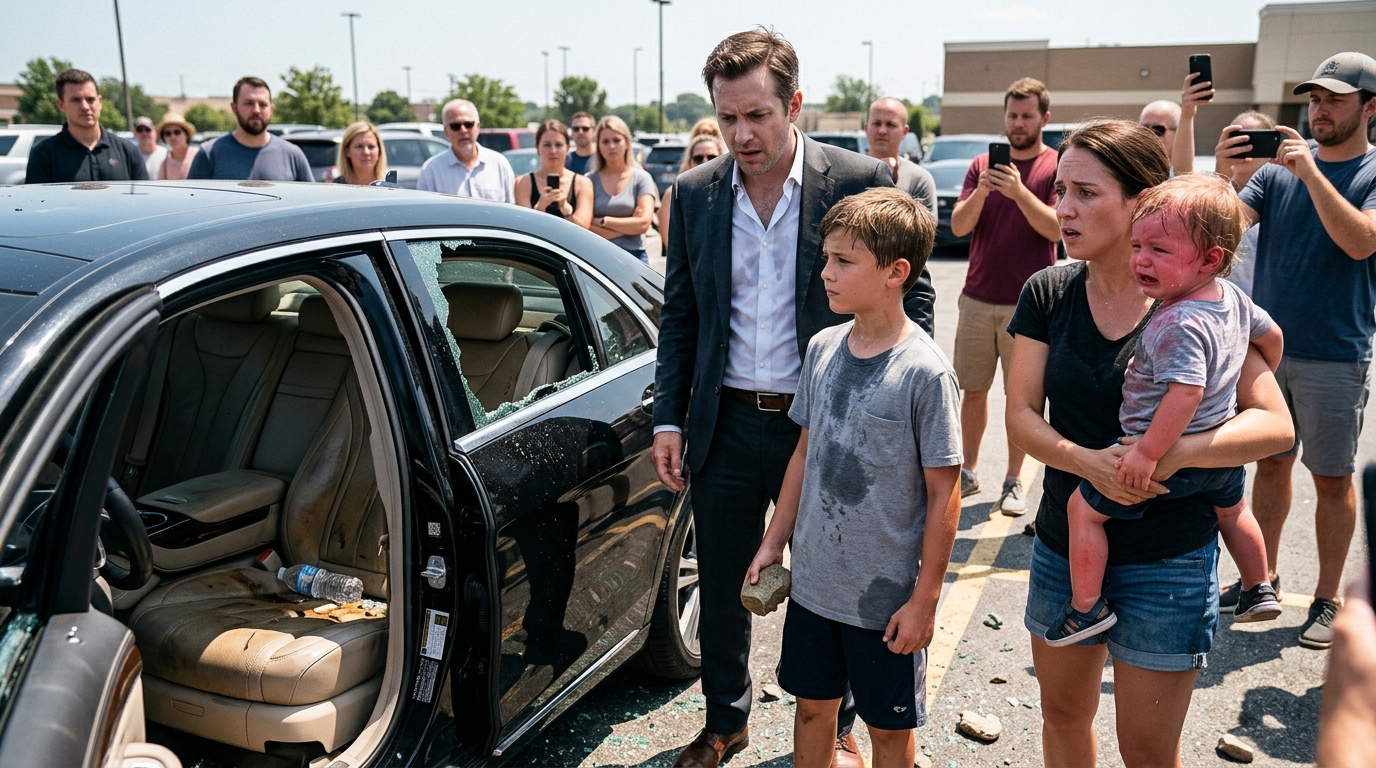
He appeared from near the row of delivery trucks, saw the baby, grabbed a landscaping stone from beside a planter, and ran.
A woman screamed, “Don’t touch that car!”
He didn’t listen.
He raised the stone with both hands.
CRASH.
The window shattered inward.
Glass burst across the leather seat.
Alarms exploded.
The boy reached through the broken window, unlocked the door, and climbed halfway inside. A second later, he pulled the baby free, pressing the child against his chest while backing away from the heat pouring out of the car like an oven.
“He couldn’t breathe,” the boy gasped. “He couldn’t catch his breath.”
The baby kept crying.
But the sound had changed.
Alive.
Still fighting.
The crowd rushed closer.
Phones lifted.
A security guard shouted for space.
Then a woman came running from the plaza entrance.
Blonde.
Elegant.
White blouse.
Diamond bracelet flashing on her wrist.
“Hey! What are you doing?”
Her voice was furious.
Then she saw the baby in the boy’s arms.
And froze.
Completely.
All color drained from her face.
The boy held the baby tighter.
“He was locked inside.”
The woman did not answer.
Her eyes were fixed on the child.
Not with confusion.
With recognition.
Then a man pushed through the crowd.
Tall.
Red-faced.
Expensive suit.
“Are you out of your mind?” he shouted. “That’s my car!”
He looked at the shattered Bentley window, then at the boy.
“You little criminal—do you know what that costs?”
The boy didn’t flinch.
He only said, “Look inside.”
The man’s anger sharpened.
“What?”
The boy pointed toward the back seat.
“Look inside.”
The crowd went silent.
The man turned toward the car.
The back seat was a mess of broken glass and sunlight. A baby bottle had rolled beneath the seat. A blanket lay twisted near the floor. The leather was hot enough that the plastic edge of a toy had warped.
The woman whispered, “He could’ve died.”
Her voice cracked.
Real fear.
The man looked at her.
Then at the baby.
Then back at the car.
His expression shifted.
Anger first.
Then confusion.
Then something colder.
“That’s not my baby,” he said.
The words stunned everyone.
The crying seemed louder now.
The boy looked at the man.
Then at the woman.
Then at the child.
Something was wrong.
The woman reached slowly toward the baby’s blanket.
The boy stepped back.
“Don’t.”
Her lips trembled.
“I know him.”
The man turned sharply.
“Clara.”
She didn’t look at him.
She only stared at the baby’s wrist.
A tiny hospital bracelet had slipped free from beneath the blanket.
The printed name was faded from sweat.
But still readable.
BABY HAYES.
The woman covered her mouth.
“No…”
The man’s face drained.
The boy looked between them.
“You said it wasn’t yours.”
The woman’s voice barely came out.
“It’s my sister’s baby.”
The parking lot went silent.
Then the man whispered:
“Your sister’s baby died.”
The Child Who Was Supposed to Be Gone
The woman’s name was Clara Whitmore.
Everyone in that plaza knew her, though most knew her from charity photos and society pages. She was married to Julian Whitmore, the man yelling about the Bentley, and she came from one of the wealthiest families in the city.
Her younger sister, Elena Hayes, had died three months earlier.
At least, that was the story.
A car accident outside the city.
A premature delivery.
A newborn who “didn’t survive the night.”
A grieving family.
A quiet funeral.
Clara had worn black for two weeks and then stopped appearing in public until that afternoon.
Now she was standing beside her husband’s shattered Bentley, staring at a baby wearing her sister’s hospital bracelet.
Julian grabbed her arm.
“Clara, don’t start this.”
She pulled away.
“Don’t touch me.”
The boy looked down at the baby.
The child’s cries had softened into exhausted hiccups. His hair was damp with sweat. His tiny fists opened and closed against the boy’s shirt.
A security guard arrived with a bottle of water and towels.
“Paramedics are coming,” he said.
The boy nodded but refused to hand the baby to anyone.
“What’s your name?” Clara asked him.
The boy hesitated.
“Milo.”
“Milo,” she said carefully, “where did you see this car before?”
Julian snapped, “Why are you asking him questions? He broke my window.”
Milo looked at him.
“Because there was a baby dying in it.”
A murmur moved through the crowd.
Julian’s face tightened.
Clara took one step toward Milo.
“Please. Tell me.”
Milo swallowed.
“I sleep behind the service alley sometimes. Near the loading docks.”
Julian scoffed.
“Wonderful. A vagrant witness.”
Clara turned on him.
“Be quiet.”
The words were soft.
But the fury behind them made Julian stop.
Milo continued.
“I saw a woman put the baby in the car. Not her.”
He nodded toward Clara.
“Another woman.”
“What woman?” Clara asked.
Milo looked toward the plaza entrance.
“Gray coat. Red bag. She had keys.”
Julian’s face changed.
Only for a second.
But Milo saw it.
So did Clara.
“What keys?” she asked.
Milo pointed at Julian.
“His.”
The crowd shifted.
Julian laughed too quickly.
“That’s ridiculous.”
Milo adjusted the baby in his arms.
“She dropped something when she closed the door.”
He reached into his pocket and pulled out a small silver keychain.
A black leather fob.
On it were initials.
J.W.
Julian stared at it.
Clara looked at her husband.
“Why did another woman have your keys?”
Julian said nothing.
The baby whimpered.
Clara reached for the hospital bracelet with trembling fingers.
“Elena’s baby,” she whispered.
Then her face changed.
Not grief now.
Memory.
“When Elena was pregnant, she told me she wanted to name him Noah.”
Milo glanced down at the bracelet.
“It says something else too.”
Clara carefully turned the baby’s wrist.
The underside of the bracelet held a second line.
NOAH E. HAYES.
Her knees buckled.
The security guard caught her before she hit the pavement.
Julian stepped backward.
“No,” Clara whispered. “They told me he died before she could name him.”
Milo’s eyes narrowed.
“Who told you?”
Clara slowly looked at Julian.
The parking lot went still again.
Then the police sirens arrived.
The Woman With the Red Bag
The paramedics checked the baby first.
Dehydrated.
Overheated.
But alive.
Barely in time.
Milo stood nearby, arms wrapped around himself now that the baby had been taken gently from him. He looked smaller without the child in his arms.
Clara refused to leave the ambulance door.
Julian tried to walk away twice.
Police stopped him both times.
Officer Reyes, the first responder on scene, held the keychain in an evidence bag.
“Mr. Whitmore, you said this is your vehicle.”
“Yes,” Julian said coldly.
“Were you aware there was an infant inside?”
“No.”
“Who else had access to your keys?”
“My wife. My driver. Maybe valet service.”
Milo spoke from behind the officer.
“And the woman with the red bag.”
Julian turned.
“You need to stop talking.”
Milo stared back.
“No.”
Officer Reyes looked at the boy.
“You saw her?”
“Yes.”
“Can you describe her?”
“Brown hair. Gray coat. Red bag. She was crying.”
Clara stiffened.
“What?”
Milo nodded.
“She kept saying, ‘I’m sorry, Elena.’ Then she put him in the car.”
Clara covered her mouth.
“Marian.”
Julian’s expression hardened.
Officer Reyes turned to her.
“Who is Marian?”
Clara’s voice shook.
“Marian Vale. She was Elena’s private nurse.”
Julian said, “Former nurse.”
Clara looked at him sharply.
“Why do you know that?”
His jaw clenched.
Officer Reyes noticed.
So did everyone.
Clara turned to the officer.
“My sister Elena died after a crash three months ago. Her baby was declared dead. Marian was with her at the hospital.”
Milo interrupted.
“The woman said the baby wasn’t supposed to be here.”
The officer looked at him.
“What exactly did she say?”
Milo closed his eyes, remembering.
“She said, ‘He was supposed to stay hidden until Julian fixed the paperwork.’”
Clara slowly turned toward her husband.
The crowd’s phones stayed up.
Julian’s face had gone pale now, but his voice remained controlled.
“This is absurd. You’re letting a street kid invent a conspiracy in a parking lot.”
Milo stepped toward him.
“I didn’t invent the baby.”
That silenced everyone.
Officer Reyes radioed for detectives.
Then he asked Clara, “Do you have any documentation about your sister’s child?”
Clara nodded.
“At home.”
Julian said quickly, “She’s emotional. She shouldn’t answer questions without—”
Clara cut him off.
“Without you?”
For the first time, Julian looked afraid of her.
Not because she was shouting.
Because she wasn’t.
She turned back to the officer.
“My sister left me a voicemail before the crash. I thought it was grief talking. She said Julian wanted the baby gone.”
Julian snapped, “Clara.”
She ignored him.
“She said he had convinced our father the child would complicate the Hayes inheritance. I didn’t understand. Then they told me both Elena and the baby were gone.”
Officer Reyes’s face changed.
“Mrs. Whitmore, we need that voicemail.”
“You’ll have it.”
Milo looked toward the ambulance.
“Is the baby going to live?”
The paramedic looked at him.
“Because of you, he has a chance.”
Milo looked down.
No pride.
No smile.
Just relief so heavy it seemed painful.
Then a woman screamed from across the lot.
Everyone turned.
A woman in a gray coat stood near the plaza entrance.
Red bag in hand.
Marian Vale.
She saw Clara.
Saw Julian.
Saw the police.
Then she ran.
The Chase Through the Service Alley
Milo moved first.
He knew the service alleys better than anyone in that parking lot.
“Back way!” he shouted.
Then he ran.
Officer Reyes cursed and followed.
Two security guards took the main walkway.
Clara tried to go too, but a paramedic held her back.
Julian stayed still.
Too still.
Clara saw that.
“You’re not surprised she ran.”
He looked at her.
“You’re in shock.”
“No,” she said. “I was in shock three months ago. This is something else.”
Marian ran behind the restaurants, past dumpsters, delivery carts, and a row of locked utility doors. Milo cut across the loading ramp and blocked the narrow exit before she reached the street.
She stopped so fast she nearly slipped.
Her eyes widened when she saw him.
“You.”
Milo’s breath came hard.
“You left him.”
Marian clutched the red bag.
“I saved him.”
Officer Reyes came up behind her.
“Hands where I can see them.”
Marian started crying.
Not loudly.
Not like a woman caught.
Like a woman who had been waiting to break.
“I didn’t mean for the car to get hot,” she said. “I thought someone would find him faster.”
Milo stared at her.
“He was screaming.”
“I know.”
“Then why didn’t you open the door?”
She covered her face.
“Because Julian said if I touched the child again, he would make sure no one believed Elena’s baby was alive.”
Officer Reyes moved closer.
“Where did you get the baby?”
Marian looked toward the parking lot.
“From the clinic.”
“What clinic?”
“The one Julian pays for.”
Milo swallowed.
“The baby was hidden?”
Marian nodded.
“He was never dead.”
Officer Reyes cuffed her carefully.
Not because she was innocent.
Because she was shaking so hard she could barely stand.
Back at the ambulance, Clara watched Marian return in handcuffs.
Her face was unreadable.
Marian looked at her.
“I’m sorry.”
Clara’s voice was ice.
“For which part?”
Marian lowered her head.
“For all of it.”
Julian tried to walk away again.
This time, Detective Laura Quinn had arrived.
She stepped in front of him.
“Mr. Whitmore, we need to have a conversation.”
He smiled thinly.
“Am I under arrest?”
“Not yet.”
“That sounds like a threat.”
“No,” she said. “That sounds like an opportunity you’re about to waste.”
Then she turned to Clara.
“Where is the voicemail?”
Clara unlocked her phone with shaking hands.
Elena’s voice played through the parking lot speaker.
Weak.
Terrified.
“Clara, if anything happens, don’t trust Julian. The baby changes the trust. He knows. Dad knows. Marian said they’re moving me after the birth. Please, if I’m wrong, forgive me. If I’m not, find Noah.”
The recording ended.
The entire parking lot was silent.
Julian’s lawyer voice vanished.
His real voice came out low.
“Your sister was unstable.”
Clara looked at him.
“No. She was warning me.”
The Clinic That Hid the Baby
The investigation moved quickly after that.
The baby, Noah Elena Hayes, was taken to St. Mercy Children’s Hospital under police protection.
Clara went with him.
Milo refused to leave until a nurse promised to update him.
Then he sat in the hallway with a juice box in both hands, still looking like someone might decide he didn’t belong there.
Detective Quinn questioned Marian through the night.
By morning, the story was worse than Clara feared.
Elena Hayes had survived the crash.
Long enough to deliver the baby.
Long enough to realize something was wrong.
Long enough to tell Marian not to let Julian near her son.
Then Elena died during complications.
Or that was what the paperwork said.
But Noah lived.
Julian and Clara’s father, Richard Hayes, had both known.
The Hayes family trust had a clause: if Elena left a living child, her portion of the estate would pass directly to that child under independent guardianship.
If there was no child, control reverted to Richard and could be merged into a development deal with Julian’s company.
Noah was not a baby to them.
He was an obstacle with a heartbeat.
Marian helped hide him in a private clinic.
She claimed she did it because Julian threatened her.
That was partly true.
But she had also accepted money.
That was also true.
People are rarely only one thing.
Three months later, the paperwork still wasn’t finished. Julian was growing impatient. Richard wanted the trust transfer completed before Clara began asking more questions.
Marian panicked.
She took Noah from the clinic and drove him to the plaza because she knew Clara would be there for a charity luncheon.
But when she saw Julian’s Bentley parked near the entrance, she made the worst decision of the child’s life.
She placed Noah in the back seat, thinking Clara or Julian would find him within minutes.
Then the heat rose.
The tinted glass hid him.
And everyone walked past.
Everyone except Milo.
Detectives raided the clinic that afternoon.
They found hidden infant records, unsigned death certificates, cash payment logs, and a private room where Noah had been kept under another name.
They also found Elena’s personal effects.
A torn hospital gown.
A bracelet.
A note written in shaky handwriting.
Clara, his name is Noah. Don’t let them tell you he died.
Clara read it in the hospital chapel.
Then folded over as if the note had entered her body.
Milo sat beside her.
He did not know what to do with a grieving rich woman.
So he handed her the rest of his juice box.
Clara looked at it.
Then laughed and cried at the same time.
“Thank you.”
He shrugged.
“You looked thirsty.”
That was how Milo became part of the story.
Not as a witness in a report.
As the child who broke a window no adult had dared to break.
The Boy Who Broke the Glass
Julian was arrested two days later.
Richard Hayes followed within the week.
Marian took a plea deal and testified.
The case became national news.
Not because a child had been found in a hot car.
That tragedy happens often enough for people to shake their heads and keep scrolling.
This case spread because of the trust.
The wealth.
The hidden clinic.
The baby declared dead.
The luxury car.
The barefoot boy holding a landscaping stone.
The video of Milo smashing the Bentley window replayed everywhere.
Some called him a hero.
He hated that.
When a reporter found him outside the shelter and asked why he broke the glass, Milo looked confused.
“Because the baby was inside.”
That answer did more than any interview.
It made every adult in the crowd look smaller.
Clara took legal custody of Noah after proving Elena’s wishes through the note, hospital recordings, and Marian’s testimony. The trust was placed under independent court supervision.
The money could wait.
Noah’s breathing could not.
For months, Clara stayed at the hospital, then at home, learning how to care for the child her sister had begged her to find.
Sometimes she cried when he slept.
Sometimes she apologized to him for not knowing.
Sometimes she whispered Elena’s name over his crib like a promise.
Milo visited often.
At first, he came for updates.
Then for sandwiches.
Then because Clara asked where he was sleeping and did not like the answer.
He resisted help.
Hard.
Children who survive on their own do not trust open doors.
But Clara was patient.
Not perfect.
Patient.
Eventually, Milo moved into a youth home supported by a foundation Clara funded after selling the Bentley.
She sold it exactly as it was.
Broken window repaired but documented.
The auction listing included one sentence:
This car was part of a crime. Its sale will fund children no one stopped to see.
It sold for more than expected.
Milo said rich people were weird.
Clara agreed.
The Child Who Was Seen
A year later, the plaza installed shaded emergency call stations across the parking lot.
Security patrol rules changed.
Restaurants added staff training.
The clinic network was shut down.
Richard Hayes died before trial.
Julian did not.
He was convicted of conspiracy, fraud, child endangerment, falsifying death records, and obstruction.
At sentencing, Clara read Elena’s note aloud.
Then she added only one sentence of her own.
“My sister trusted us to find her child, and we trusted paperwork more than fear.”
The courtroom stayed silent.
Milo testified by recorded statement.
When asked what he remembered most, he said:
“The baby stopped crying for a second. That was worse.”
People cried when they heard it.
Milo did not.
He had already spent too many tears on survival.
Years later, Noah grew into a bright, laughing little boy who loved toy cars in a way that made Clara flinch at first.
Then she let him love them.
Children should not lose innocent things because adults used them badly.
On Noah’s fourth birthday, Clara invited Milo to the party.
He was taller now.
Still guarded.
Still allergic to praise.
Noah ran to him with frosting on both hands and shouted, “Window!”
That was what he called Milo.
Window.
Everyone laughed except Milo, who pretended to be annoyed.
Clara handed him a small box.
He opened it.
Inside was the black leather key fob from the Bentley.
The initials had been removed.
In their place were two words engraved in silver.
LOOK INSIDE.
Milo stared at it.
“I don’t want car keys.”
“They’re not car keys,” Clara said. “They’re a reminder.”
“Of what?”
She looked toward Noah, who was trying to feed cake to a toy fire truck.
“That you saw him when everyone else saw a car.”
Milo closed the box carefully.
For once, he did not shrug it off.
That afternoon, Clara stood near the garden fence while Noah played. Milo came beside her, hands in his pockets.
“Do you still think about the car?” she asked.
He nodded.
“Do you?”
“Every day.”
He looked uncomfortable.
Then said, “I thought the man was going to hit me.”
“Julian?”
“Yeah.”
Clara’s eyes hardened.
“He never will.”
Milo looked at her.
“You sure?”
“Yes.”
He nodded.
Not fully convinced.
But closer.
That was healing sometimes.
Closer.
Clara looked at him.
“Why did you tell him to look inside?”
Milo thought about it.
“Because he only cared about the outside.”
The answer stayed with her for years.
Because that was the whole story.
The car.
The family.
The trust.
The marriage.
The reputation.
Everything had looked polished from the outside.
Inside, a child was dying.
And the only person who acted fast enough was a boy the plaza had almost ignored.
The crowd saw a luxury car.
Milo saw a baby.
The owner saw a broken window.
Milo saw breath.
The family saw an inheritance problem.
Milo saw a child with a name.
Noah lived because someone looked inside.
And that was the lesson Clara carried from then on.
Whenever a room seemed too polished, too calm, too certain, she remembered the heat behind the tinted glass.
She remembered the stone.
The crash.
The crying.
The boy standing there without fear, saying the one thing no one else had thought to do.
Look inside.