The Locket on the Counter
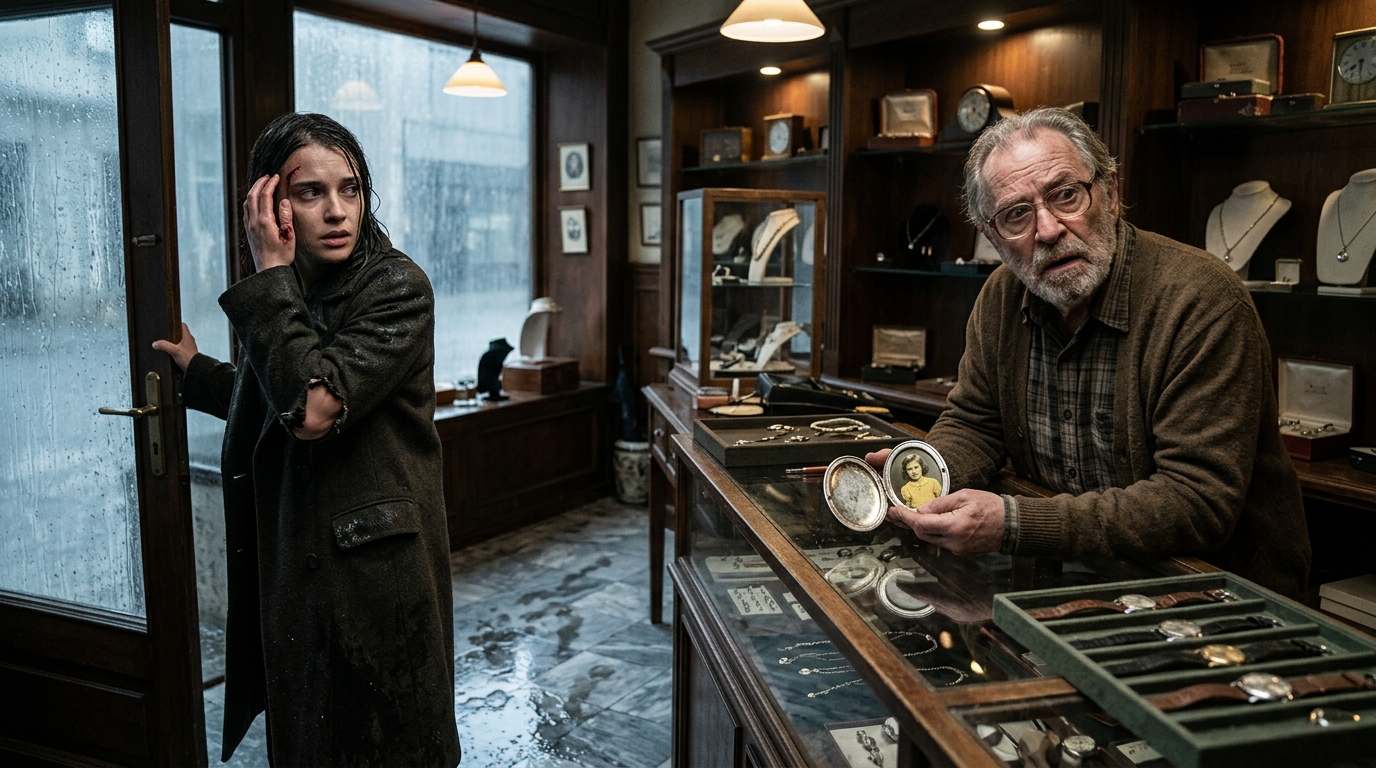
The jewelry shop door burst open with rain behind her.
Cold water ran from the girl’s hair onto the marble floor. Her coat was torn at one sleeve. One hand pressed against a small cut near her temple, and her lips trembled from the kind of cold that had gone deeper than skin.
The old jeweler looked up from behind the glass counter.
He did not look worried.
Only annoyed.
“I’ll give you fifty,” he said. “Not a dollar more.”
The girl didn’t argue.
She only reached into her pocket and placed a small silver locket on the counter.
Her fingers stayed on it for one extra second.
Like letting go hurt.
“Okay,” she whispered.
The jeweler picked it up like it was nothing.
Old chain.
Scratched metal.
Cheap clasp.
The kind of sentimental piece desperate people brought in during storms, hoping memory weighed more than silver.
He turned it beneath the lamp.
“Forty,” he said.
The girl’s face crumpled, but she nodded.
Then he opened it.
Inside was a faded photograph of a little girl in a yellow dress.
The old man stopped breathing.
The rain filled the silence behind her.
His hand began to tremble.
“Clara?”
The girl’s head snapped toward the door.
Fast.
Too fast.
As if that name was not supposed to be spoken in this place.
The jeweler’s voice broke.
“That locket belonged to my daughter.”
The girl froze at the threshold.
One foot already outside.
Then she looked back.
Now she was terrified.
“If Clara was your daughter…”
Her voice shook.
“Why did she make me promise never to bring it back to you?”
The jeweler, Edmund Vale, gripped the edge of the counter.
For twenty years, he had believed his daughter hated him.
For twenty years, he had believed Clara stole from his shop, emptied the family safe, and ran into the night with a man twice her age.
For twenty years, he had kept her photograph hidden in a drawer because looking at it felt like touching a wound that refused to close.
Now a rain-soaked girl stood in his shop with Clara’s locket and Clara’s fear in her eyes.
“What is your name?” he asked.
The girl swallowed.
“Mara.”
The name hit him almost as hard as the photograph.
Mara.
Clara’s mother’s name.
Edmund’s late wife.
He moved out from behind the counter.
The girl stepped back immediately.
“Don’t.”
He stopped.
“I’m not going to hurt you.”
Her eyes flicked toward the street.
“You don’t know who followed me.”
At that exact moment, a black car rolled slowly past the shop window.
Mara saw it.
Her face went white.
She grabbed for the locket.
“I have to go.”
Edmund closed his hand around it.
“No. Not until you tell me where Clara is.”
Mara’s eyes filled.
“She said you’d say that.”
“Where is she?”
The girl’s voice cracked.
“At St. Mercy.”
Edmund’s knees nearly gave out.
St. Mercy was not a hospital people went to when they had choices.
It was a charity clinic by the old rail line.
The place people went when money, family, and luck had all run out.
“What happened to her?”
Mara looked at the black car slowing again outside.
“She’s sick.”
Then she whispered:
“And the man who made her run is looking for this.”
The Daughter He Thought Betrayed Him
Edmund locked the shop door with shaking hands.
Mara flinched at the sound.
That told him more than he wanted to know.
He led her into the back room, away from the front windows. The space smelled of metal polish, old velvet, and coffee gone cold. Rain hammered against the glass roof above the repair bench.
Mara stood near the door, ready to bolt.
Edmund placed the locket on the table between them.
“Tell me everything.”
She looked at him with a child’s suspicion and an adult’s exhaustion.
“Clara said you wouldn’t believe me.”
“Clara is alive?”
Mara nodded.
He closed his eyes.
For a moment, he was not an old jeweler.
He was a father again, standing at the foot of the stairs twenty years earlier, shouting his daughter’s name into a house that had already lost her.
Clara had been seventeen when she disappeared.
Bright.
Stubborn.
Always sketching jewelry designs in the margins of school notebooks.
She loved old lockets, hidden hinges, secret compartments. She said jewelry should never reveal everything at first glance.
Then one night, the shop safe was opened.
A tray of antique diamonds vanished.
Clara disappeared.
And Edmund found a note on the counter.
Dad, don’t look for me. I’m tired of living under your rules.
The handwriting looked like hers.
Close enough.
His brother, Victor, had been the one who found it.
Victor, who helped run the shop.
Victor, who held Edmund by the shoulders and said, “She made her choice.”
Edmund believed him because grief needed a shape, and betrayal was easier to understand than terror.
Mara reached into her wet coat and pulled out a folded piece of paper wrapped in plastic.
“Mom said if I ever had to bring the locket here, I should give you this too.”
Mom.
The word struck him.
“Clara is your mother?”
Mara nodded.
Edmund sat down slowly.
His granddaughter stood in front of him.
Thin.
Hurt.
Soaked from the rain.
Trying to sell the only thing her mother had left.
He took the paper.
The handwriting was older, shakier, but unmistakable.
Clara.
Dad,
If this reaches you, then Mara had no other choice. Do not blame her for breaking her promise. I made her promise never to return the locket because I believed the man who destroyed us was still beside you.
Edmund’s hands shook.
He kept reading.
I did not steal from you. I found Victor moving stones through private buyers. I was going to tell you that night. He caught me in the workshop. He said if I spoke, he would tell you I had stolen from the safe. Then he showed me a police report already drafted in my name.
Edmund’s breath turned ragged.
He told me you had signed it.
“No,” Edmund whispered.
Mara watched him carefully.
“He said you did,” she said.
Edmund looked up.
“I never signed anything against Clara. Never.”
Mara’s face shifted.
Not trust.
Not yet.
But something in her fear loosened.
He read the next line.
Victor said if I came home, I would be arrested before I reached the door. He said you chose the business over me. I was seventeen. I was pregnant. I ran.
The paper blurred.
Pregnant.
Mara.
His granddaughter.
The locket clicked softly beneath his trembling fingers.
Mara whispered, “She said there’s something inside it. But she could never open the second part.”
Edmund looked down.
Clara loved hidden hinges.
He turned the locket toward the lamp.
There, near the inner rim, was a tiny notch so small most jewelers would miss it.
But Edmund had made this locket himself.
For Clara’s tenth birthday.
He pressed the notch with his thumbnail.
A second compartment opened.
Mara gasped.
Inside was not another photograph.
It was a folded sliver of paper, yellowed with age.
And a tiny diamond.
Not large.
Not valuable compared to the missing tray.
But marked with a blue ink dot on the underside.
Edmund knew that mark.
It was from the stolen collection.
His brother had told him every stone was gone.
Clara had hidden one.
Proof.
The paper held three words in Clara’s teenage handwriting:
Victor has copies.
The bell above the front door rang.
Impossible.
Edmund had locked it.
Mara grabbed his sleeve.
“He’s here.”
The Brother at the Door
Victor Vale stepped into the shop as if he still owned half of it.
He was older now, heavier, his hair silver at the temples, but his smile had not changed.
Smooth.
Patient.
Deadly.
“Edmund,” he called. “You should answer your phone.”
Edmund stepped out from the back room, keeping Mara behind him.
Victor’s eyes went first to Edmund’s face.
Then to his hand.
Then to the locket.
His smile faded.
“Where did you get that?”
Edmund’s voice came out low.
“From my granddaughter.”
Victor went still.
Only for a second.
But Edmund saw it.
Twenty years of brotherhood cracked in that single pause.
“Granddaughter?” Victor repeated softly.
Mara stepped out from behind Edmund.
Victor’s gaze landed on her.
Recognition did not appear.
Calculation did.
That frightened Edmund more.
Victor had known she existed.
“You followed a child here,” Edmund said.
Victor adjusted his gloves.
“I followed stolen property.”
Mara flinched.
Edmund placed one hand gently in front of her.
“This locket belongs to Clara.”
“Clara stole from this shop.”
“No,” Edmund said. “You did.”
The room went silent.
Rain battered the front windows.
Victor sighed like Edmund had become inconvenient.
“She has filled the girl’s head with stories.”
“She wrote me a letter.”
“Forgery.”
“The locket had a hidden compartment.”
Victor’s face hardened.
Edmund opened his palm.
The tiny diamond lay there under the shop light, blue ink dot visible.
For the first time, Victor looked afraid.
Not of the diamond.
Of what it connected.
Edmund remembered everything now.
Victor insisting Clara had run.
Victor handling the insurance claim.
Victor pushing to sell the original shop location after the scandal.
Victor saying the police would only humiliate the family further.
Victor standing beside him at Clara’s empty bedroom door, saying, “Let her go.”
Edmund moved to the old wall safe behind the counter.
Victor stepped forward.
“Don’t.”
Mara whispered, “Grandpa…”
The word nearly broke Edmund.
But he did not stop.
He opened the safe and removed a sealed file he had not touched in years.
The original theft report.
The one Victor said Clara forced them to file.
Edmund opened it.
His signature sat at the bottom.
Or something like it.
The shape was close.
But not his.
He had been too broken to look carefully twenty years ago.
Now he saw the lie immediately.
Victor had forged his name.
Edmund looked up.
“You told my daughter I signed this.”
Victor’s voice cooled.
“She would have ruined everything.”
“She was seventeen.”
“She was reckless.”
“She was my child.”
Victor laughed once.
“And you were weak enough to let her make a fool of us.”
Mara stepped back.
Edmund saw Victor’s hand move toward his coat pocket.
Then the shop door burst open again.
This time, not from rain.
From police.
Detective Laura Quinn entered with two officers behind her.
Mara let out a sob of relief.
Victor turned sharply.
“What is this?”
Mara lifted her chin.
“I called them before I came in.”
Edmund looked at her.
She wiped her face with her sleeve.
“Mom said if I ever broke the promise, I should make sure someone else heard the truth.”
The Clinic by the Rail Line
Victor was not arrested immediately.
Men like him rarely fall the first time the door opens.
But his phone was taken.
His car was searched.
The forged report was copied.
The diamond was sealed as evidence.
And Edmund, who had spent twenty years thinking grief made him empty, discovered rage had been waiting beneath it the whole time.
He drove Mara to St. Mercy himself.
She sat in the passenger seat wrapped in his coat, holding the locket with both hands.
At first, neither spoke.
Then Mara asked, “Did you really not know?”
Edmund kept his eyes on the wet road.
“No.”
“She waited.”
His throat tightened.
“I know.”
“She cried every birthday.”
His vision blurred.
“I know.”
“She said maybe you hated her less by now.”
He pulled the car to the curb because he could not keep driving through that sentence.
Mara looked at him.
He looked back.
“I never hated her.”
The girl’s face trembled.
“She told me not to believe that.”
“I don’t blame her.”
That was the truth.
It hurt.
But it was truth.
At St. Mercy, Clara Vale lay in a narrow bed near the window.
Older.
Pale.
Too thin.
But alive.
When Edmund entered, she turned her head.
For one second, she was seventeen again.
His little girl in a yellow dress.
Then her eyes filled.
“Dad?”
Edmund crossed the room and dropped beside the bed.
No dignity.
No careful words.
Only twenty years collapsing at once.
“I didn’t sign it,” he said.
Clara covered her mouth.
“I didn’t sign it, baby. I swear to God.”
She broke.
So did he.
Mara stood near the door, crying silently as mother and grandfather reached for each other like people pulled from opposite sides of the same grave.
Clara was sick from years of untreated heart complications, made worse by poverty and fear. She had worked under false names, moved whenever Victor’s men found her, and kept the locket hidden until there was nothing left to sell.
“I told Mara never to bring it back,” Clara whispered. “I thought you chose him.”
Edmund held her hand.
“I chose wrong by not looking harder. But I never chose him over you.”
Clara closed her eyes.
“That may take me time to believe.”
“I’ll spend whatever time I have proving it.”
That was all he could offer.
Not a clean reunion.
Not instant forgiveness.
Only presence.
The Hidden Stones
The investigation widened quickly.
The tiny diamond led to old insurance files.
The files led to private buyers.
The buyers led to Victor’s accounts.
And Victor’s accounts led to something Edmund had never expected.
Clara had not been the only one.
Over two decades, Victor had used family employees, clients, and desperate sellers as shields for stolen stones. When inventory disappeared, someone poorer was blamed. A cleaner. A courier. A teenage apprentice. Clara had been the first and most painful lie, but not the last.
Detective Quinn found Victor’s copies in a storage unit outside the city.
Just as Clara’s hidden note said.
Ledgers.
Photographs.
Forged signatures.
A list of stones sold under false provenance.
And one folder marked:
C.V.
Clara Vale.
Inside were letters she had sent home over the years.
Unopened.
Some addressed to Edmund.
Some to her mother before Edmund’s wife died.
Some contained baby photos of Mara.
Victor had intercepted all of them.
Edmund read them in the police station with both hands shaking.
In one, Clara had written:
Dad, if you truly signed the report, I will never bother you again. But if Victor lied, please find me. I am so tired.
The letter had been mailed nineteen years earlier.
Edmund pressed it to his forehead and wept like an old man who finally understood the full size of what had been stolen.
Victor was arrested within the week.
Forgery.
Fraud.
Evidence tampering.
Insurance theft.
Criminal intimidation.
And later, after witnesses came forward, charges connected to the people he had framed.
At trial, Victor’s lawyers tried to paint Clara as unstable and Edmund as a guilty old man desperate for redemption.
Then prosecutors opened the locket.
The hidden compartment.
The marked diamond.
The note.
The jury saw the photograph of little Clara in the yellow dress, the forged report, the intercepted letters, and the records Victor kept because arrogant men often preserve evidence as if documentation makes theft legitimate.
Mara testified briefly.
She hated the courtroom.
Hated the microphones.
Hated Victor looking at her.
But when asked why she came to the jewelry shop, she said:
“Because my mom was dying and the locket was the only thing she still believed might make someone listen.”
That sentence ended the room.
Victor was convicted on most charges.
Good.
But prison did not return twenty years.
It did not give Clara back her youth.
It did not give Mara a childhood without running.
It did not give Edmund the birthdays, graduations, first steps, first words, or ordinary dinners stolen by one forged signature.
Justice came.
But it came late.
Late is better than never.
Late still hurts.
The Locket in the Window
Clara survived.
Barely at first.
Then slowly.
Edmund paid for doctors, but he learned quickly that money was not the same as repair. Clara did not trust comfort. Mara did not trust closed doors. Both of them watched exits in every room.
So he stopped trying to fix everything with speed.
He listened.
He showed them the shop records.
He gave Clara access to every account.
He put Mara’s name on a room upstairs and told her she did not have to sleep there until she wanted to.
For three weeks, she slept on the couch near the front door.
Then one rainy night, she went upstairs.
That was how healing looked sometimes.
Not hugs.
Not speeches.
A child choosing a bed.
Clara returned to designing jewelry after her hands grew stronger.
Her first new piece was a locket.
Silver.
Plain.
With a hidden hinge.
Inside, she placed no photograph.
Only a word:
Home.
Edmund displayed it in the front window, not for sale.
Beside it, he placed the old locket with the photo of Clara in the yellow dress.
Mara asked why he wanted everyone to see something so painful.
Edmund answered, “Because hiding it helped the wrong man.”
Years later, the shop changed its name.
It had once been Vale Brothers Fine Jewelry.
Edmund had Victor’s name removed from the sign.
The new sign read:
Vale & Daughter
Clara cried when she saw it.
Mara pretended not to.
On the anniversary of the night she first came through the door, rain fell again.
Not as hard.
But enough to shine on the marble floor.
Mara stood behind the counter, older now, healthier, her hair tied back as she repaired a clasp under the lamp.
Edmund watched her from the workbench.
She looked up.
“What?”
“You hold the tools like your mother.”
She smiled faintly.
“She says I hold grudges like you.”
He laughed.
That still felt new.
The bell above the door rang.
A woman entered, soaked from the rain, holding a broken bracelet.
For half a second, Mara and Edmund both froze.
Then Mara stepped forward gently.
Not annoyed.
Not dismissive.
Not like the old man behind the counter had been that first night.
“How can we help?”
Edmund looked toward the window, where the two lockets rested beneath warm light.
He often thought about the sentence Mara had asked him in the rain.
If Clara was your daughter, why did she make me promise never to bring it back to you?
The answer was simple and unbearable.
Because a lie had worn his face.
Victor had made Clara believe her father chose the shop, the money, the family name over her.
And Edmund had let grief make him too blind to question the story.
That was the part he carried.
Not as punishment.
As responsibility.
So he kept the locket where he could see it every day.
A reminder that love is not proven by mourning someone after they vanish.
It is proven by refusing to let anyone else explain their silence too easily.
That night, a girl came in from the rain to sell a scratched piece of silver.
The old jeweler thought it was worth fifty dollars.
He was wrong.
It was worth twenty stolen years.
A daughter.
A granddaughter.
A truth hidden behind a second hinge.
And the first chance to finally bring Clara home.