The Moment the Courtroom Changed
The courtroom buzzed with the kind of tension that made every small sound feel dangerous.
Papers rustled.
Someone coughed.
A reporter whispered into a recorder near the back row.
I stood beside the defense table with my hands clasped so tightly my nails pressed crescents into my palms. My name was Sofia Reyes, but for the past six months, the newspapers had called me something else.
The Harlan Maid.
Not a woman.
Not a mother.
Not someone who had worked twelve years cleaning the same marble floors, folding the same linen sheets, and making soup for the same frightened child.
Just the maid.
The one accused of attacking ten-year-old Noah Harlan inside his family’s mansion.
The one accused of stealing from the safe.
The one accused of locking a child in the old east room and leaving him there until he nearly stopped breathing.
The prosecutor stood in front of the jury, her voice polished and certain.
“Ladies and gentlemen, the defendant was trusted inside the Harlan home. She had access. She knew the family’s routines. And when a child discovered her crime, she tried to silence him.”
I closed my eyes.
Noah sat two rows behind the prosecutor, thin and pale in a dark suit too stiff for his small shoulders. His wrist was still wrapped. A faint scar curved near his temple.
He had not looked at me all morning.
I did not blame him.
Victor Harlan sat beside him.
Uncle Victor.
Sharp suit.
Silver cufflinks.
Calm expression.
He kept one hand near Noah’s chair, close enough to seem protective.
Close enough to remind the boy who controlled him.
The prosecutor lifted a photograph of the basement door.
“This is where Noah Harlan was found. Locked inside. Injured. Terrified. And who had the key?”
She turned toward me.
“The defendant.”
My throat closed.
Yes.
The key had been in my hand.
Because Victor had shoved it there.
Because when I found Noah gasping behind that door, I had tried to open it.
Because when Victor came down the stairs, he smiled and said:
“Now we both know what story the police will believe.”
My lawyer, Mr. Grant, leaned toward me.
“Stay calm.”
Calm.
I had been calm through the arrest.
Calm when my daughter called from college crying because reporters had found her dorm.
Calm when my mother’s care facility asked whether I would still be able to pay.
Calm while Victor Harlan sat in court wearing grief like a tailored jacket.
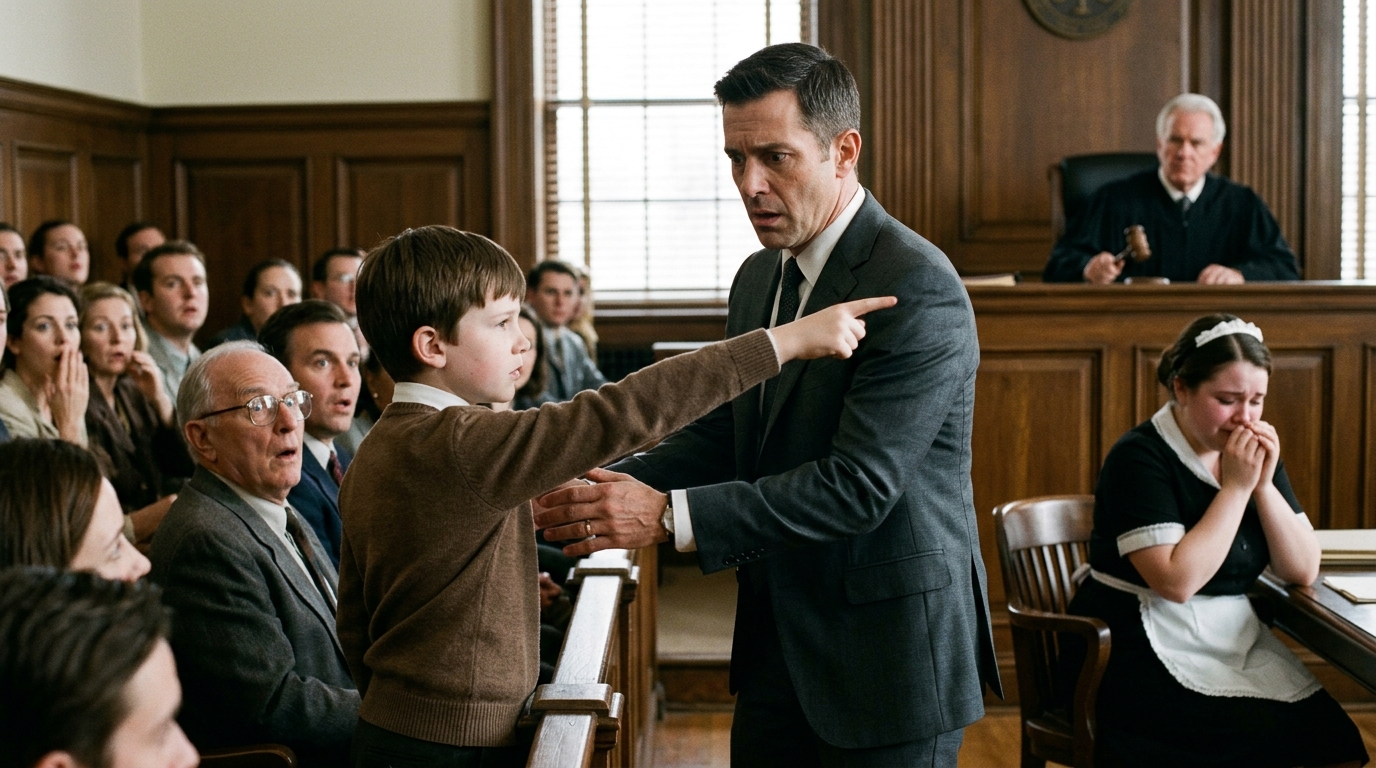
Then a chair screeched across the floor.
The sound sliced through the courtroom.
Noah stood.
His entire body trembled.
But his voice rang out.
“It wasn’t her—I saw it all!”
Everything stopped.
The judge slammed the gavel.
“Sit back down, young man!”
Noah did not sit.
His face was white, but his eyes were fixed on me.
“She was defending me!”
A wave of gasps rolled through the room.
The prosecutor froze.
My knees weakened.
Victor stood quickly, too quickly.
He reached for Noah’s arm and gripped it hard enough that the boy flinched.
“Enough,” Victor said through his teeth. “Sit down.”
For the first time, the mask cracked.
Noah looked at his uncle’s hand.
Fear flickered across his face.
Then something stronger replaced it.
He yanked his arm free.
“The one who’s guilty is right here!”
The courtroom erupted.
Victor’s expression changed.
Only for a second.
But I saw it.
So did the judge.
So did the jury.
“He’s confused,” Victor said, forcing his voice back into place. “He doesn’t understand what he’s talking about.”
Noah pointed straight at him.
“You did.”
Silence crashed down.
His voice dropped.
Soft.
Shaking.
But more powerful than the gavel.
“You locked the door… Uncle Victor.”
Victor froze.
The color drained from his face.
And in that moment, the truth became louder than any evidence they had stacked against me.
The Door in the East Wing
The east room had been locked for years.
That was what the staff was told.
Mr. Harlan—Noah’s father—had kept old family files inside. After he died, Victor said no one was allowed near it.
No one questioned him.
People like Victor did not need to raise their voices often. His money did most of the shouting.
I had worked for the Harlan family long enough to know which rooms held grief and which held secrets.
The east room held both.
Noah’s father, Daniel Harlan, had died eleven months earlier in what everyone called a boating accident. After that, Victor became Noah’s temporary guardian and took control of the estate until Noah turned eighteen.
At least, that was the public version.
Inside the house, things changed quickly.
Noah stopped eating dinner at the table.
His piano lessons were canceled.
The old nanny was dismissed.
His father’s office was locked.
Victor began holding meetings behind closed doors with lawyers, bankers, and men who lowered their voices when I entered with coffee.
Noah noticed everything.
Children always do.
One night, he came into the kitchen while I was washing dishes.
His pajamas were too big. His hair was messy. His face looked scared in a way no child should ever learn.
“Sofia,” he whispered, “can a person steal a house if the owner is dead?”
I dried my hands slowly.
“Why do you ask?”
He looked toward the hallway.
“Uncle Victor says Dad signed papers before the accident. But Dad told me never to let him open the blue folder.”
My heart sank.
“What blue folder?”
“The one in the east room.”
I told him to go upstairs.
He didn’t.
“He said if I tell anyone, you’ll get sent away.”
That was Victor’s style.
He did not threaten only the person in front of him.
He threatened everyone they loved.
Two nights later, I heard something from the east wing.
A thud.
Then a muffled cry.
I followed the sound.
The hallway lights were off.
At the end of the corridor, the east room door was shut.
From behind it came Noah’s voice.
“Sofia!”
I ran.
“Noah?”
“He locked me in!”
I grabbed the handle.
Locked.
Then footsteps came behind me.
Victor stood at the corner of the hallway.
No jacket.
No tie.
Just a calm face in the dark.
“What are you doing here?” he asked.
“Noah is inside.”
Victor walked closer.
“I know.”
The words chilled me.
I stepped in front of the door.
“Open it.”
He smiled slightly.
“You forget your place.”
“No. I remember there is a child behind this door.”
Something hard entered his eyes.
“He found papers that don’t belong to him.”
“They are his father’s papers.”
Victor moved too fast.
He grabbed my arm and shoved me against the wall. Pain shot through my shoulder. Noah screamed from inside the room.
I fought him.
I scratched his wrist.
I tried to reach the key ring on his belt.
That was when Victor opened the door—not to free Noah, but to drag him out.
Noah stumbled forward coughing.
There was dust on his face, blood near his temple, and a blue folder clutched to his chest.
Victor reached for it.
I stepped between them.
“No!”
He struck me.
I fell against the table near the hallway.
Noah ran.
Victor caught him by the collar and threw him backward. Noah hit the doorframe and collapsed.
For one second, Victor only stared.
Then he became calm again.
That calm was the most frightening thing about him.
He picked up the key.
Pressed it into my hand.
Then he knelt beside me and whispered:
“You were stealing from the family safe. The boy caught you. You locked him in. I found you both.”
I shook my head.
“No one will believe that.”
He smiled.
“They will believe me.”
Then he called the police.
The Boy Who Was Supposed to Stay Silent
After the judge cleared the jury from the courtroom, everything moved quickly.
The prosecutor demanded order.
My lawyer demanded protection for Noah.
Victor demanded a private family recess.
The judge gave him none of it.
“Noah Harlan,” the judge said carefully, “do you understand that this is a court of law?”
Noah nodded.
“Yes, Your Honor.”
“You understand you must tell the truth?”
“I am.”
Victor stood again.
“Your Honor, my nephew is traumatized. He has been manipulated.”
The judge’s gaze hardened.
“Mr. Harlan, sit down.”
Victor sat.
For the first time, he looked smaller.
Noah’s voice trembled as he spoke.
“He locked me in the east room because I found Dad’s folder. Sofia tried to open the door. She didn’t hurt me. She tried to stop him.”
My hands covered my mouth.
The courtroom blurred.
The judge leaned forward.
“What was in the folder?”
Noah looked at Victor.
Then at me.
“Papers about Dad’s will. And a video.”
Victor’s jaw clenched.
My lawyer stood.
“Your Honor, we request an immediate warrant to preserve and search the Harlan estate, specifically the east room and any files connected to Daniel Harlan’s will.”
The prosecutor looked shaken.
She had built her case around Victor’s testimony.
Now that testimony was cracking in front of everyone.
The judge ordered a recess.
Then he ordered Noah removed from Victor’s custody immediately.
A deputy stepped between uncle and nephew.
Victor’s face darkened.
“Noah, tell them you’re confused.”
Noah flinched.
But he did not obey.
Instead, he said:
“You said Dad should have drowned sooner.”
The room went completely still.
Victor’s lips parted.
No words came out.
That was the second crack.
The first had been the door.
The second was Daniel Harlan’s death.
And by the end of that day, the whole mansion would begin giving up what Victor had buried.
The Blue Folder
The police searched Harlan House that afternoon.
Not the way they had the first time.
The first time, Victor had guided them.
This time, no one asked his permission.
They opened the east room.
Behind the locked door were filing cabinets, old estate boxes, Daniel Harlan’s desk, and a wall safe hidden behind a painting of the family’s lake house.
Noah had remembered the code.
His father had taught it to him as a game.
Inside the safe was the blue folder.
And inside the blue folder was the beginning of Victor’s ruin.
Daniel Harlan’s real will.
A recorded statement.
Bank transfer records.
A letter to the family attorney.
And a flash drive labeled:
If Victor Takes Control
The video showed Daniel Harlan sitting at the same desk, tired but clear-eyed.
“If this is being viewed, then my brother has likely attempted to override my estate plan. Victor has been pressuring me to consolidate Noah’s trust into Harlan Holdings. I have refused. If anything happens to me, investigate him before accepting any accident report.”
My lawyer later told me the room went silent when the detectives played it.
Then came the lake house footage.
Victor had tried to erase it.
He failed.
The video did not show everything, but it showed enough.
Daniel and Victor arguing on the dock.
Victor grabbing Daniel’s jacket.
Daniel stumbling.
A fall.
Water.
Victor standing there.
Watching.
Not calling for help.
Not jumping in.
Just watching.
For thirty-nine seconds.
Thirty-nine seconds was enough to turn an accident into a crime.
The police also found the original east room key in Victor’s study, hidden inside a hollow book.
The key he claimed I had stolen.
The one he pressed into my palm after hurting Noah.
And at the bottom of Daniel’s blue folder, under all the legal papers, detectives found a note written in Daniel’s hand.
Noah sees more than Victor thinks. Believe my son.
I was released from custody the next morning.
No apology could repair what had been done.
The charge was dismissed, but the accusation had already touched everything.
My daughter had left college for a week because reporters followed her.
My mother had spent three nights believing I would die in prison.
My neighbors had looked at me as if my poverty made guilt easier to imagine.
Still, when I stepped out of the courthouse, Noah was there.
He ran to me.
His new guardian, his grandmother Margaret Harlan, tried to stop him gently.
He slipped past her and threw his arms around my waist.
“I’m sorry,” he cried. “I was scared.”
I knelt in front of him.
“You told the truth when you could.”
“I should have said it sooner.”
“You were a child.”
He shook his head.
“So were you scared?”
I almost laughed through my tears.
“Yes.”
“Did you tell the truth?”
“Eventually.”
He seemed to consider that.
Then he nodded.
“Then me too.”
The Man Who Lost His Name
Victor Harlan was arrested two weeks later.
He did not look frightened when they took him from his office.
He looked offended.
That was worse.
Men like Victor believed arrest was something that happened to other people—people without attorneys waiting in conference rooms, people without family names carved into hospitals and university halls.
But this time, the name did not protect him.
It became part of the evidence.
The trial for Daniel’s death and Noah’s assault lasted nearly a year.
Victor’s lawyers tried everything.
They called Noah confused.
They called me resentful.
They said Daniel had been depressed.
They said the dock footage was incomplete.
They said the estate documents were complicated.
Then the prosecutor played the courtroom footage from my trial.
Noah standing.
Victor grabbing his arm.
The boy pointing.
“You locked the door… Uncle Victor.”
The jury watched Victor’s face change.
That did more than any polished argument could.
Truth is sometimes visible before it is proven.
Noah did not testify in open court the second time. His recorded interview was enough. The judge refused to let Victor’s lawyers tear into him for spectacle.
I testified.
I told the jury about the hallway.
The locked door.
The key.
The threat.
The way Victor had smiled when he said people would believe him.
When his lawyer asked why I didn’t speak sooner, I answered honestly.
“Because people like Mr. Harlan count on women like me knowing what the world believes first.”
The courtroom went quiet.
Victor was convicted of manslaughter in Daniel’s death, assault against Noah, evidence tampering, witness intimidation, and fraud related to the estate.
When the verdict was read, he looked at Noah’s grandmother.
Not at Noah.
Not at me.
At her.
As if even then, he expected the family to save him from what he had done to it.
Margaret Harlan lowered her eyes.
Not in fear.
In refusal.
Afterward, she came to me outside the courthouse.
She was old, elegant, and thinner than I remembered.
“I believed my son,” she said.
I said nothing.
Her eyes filled.
“I should have believed my grandson.”
Still, I said nothing.
Then she looked at me.
“And I should have believed you.”
That time, I answered.
“Yes.”
She nodded.
A hard truth accepted is worth more than a soft apology.
Months later, Margaret created a legal fund for domestic workers accused by powerful employers. She asked if she could name it after me.
I said no at first.
Then my daughter said, “Mom, let them put your name where they tried to put shame.”
So I agreed.
The Reyes Worker Defense Fund began in the same city where I had nearly been convicted because a rich man said I was guilty and everyone almost believed him.
The Door Left Open
Years passed.
Noah grew taller.
His scar faded, though not completely.
Some scars should remain visible.
They tell the truth when people try to smooth the story.
He came to our apartment every Sunday for dinner. At first, he sat quietly and asked permission before taking more food. Later, he argued with my daughter about music and stole extra plantains from the kitchen when he thought I wasn’t watching.
I always watched.
Not because I distrusted him.
Because I loved seeing him safe enough to steal food from a plate instead of fear from a room.
The Harlan mansion was eventually sold.
Before the sale, Noah asked me to come with him one last time.
We walked through the empty halls together.
No servants.
No polished vases.
No Victor.
Just echoing rooms and sunlight on floors I had once cleaned on my knees.
At the east wing, Noah stopped.
The door stood open.
The room had been emptied.
No safe.
No blue folder.
No dust.
No locked child.
He reached into his pocket and pulled out the old key.
The one from evidence.
The one Victor had used.
The one everyone once said I had stolen.
Noah looked at it for a long time.
Then he placed it on the floor inside the room.
“Should we throw it away?” I asked.
He shook his head.
“No. Someone might forget.”
Then he stepped back.
And left the door open.
That was enough.
People sometimes ask me when justice happened.
Was it when Noah stood up?
When the charges against me were dropped?
When Victor was sentenced?
When the fund opened?
I never know how to answer.
Justice did not arrive like thunder.
It came in pieces.
A chair scraping.
A boy refusing to sit.
A hidden folder.
A door opened.
A key left on the floor.
A child learning that fear does not make truth weaker.
And me learning that surviving a lie is not the same as being untouched by it.
I still remember the courtroom before Noah stood.
The whispers.
The rustling papers.
The way the prosecutor said “the maid” like my name was not worth the air.
I remember Victor’s hand on Noah’s arm.
I remember the judge’s gavel.
I remember thinking the world had already decided what I was.
Then a child stood up shaking.
“It wasn’t her—I saw it all!”
He was afraid.
Of course he was.
Courage is not the absence of fear.
Sometimes courage is a small boy pointing at the most powerful man in the room and saying:
“You locked the door.”
And once he said it, the door began to open.
Not just for him.
For all of us.