The Night Shadow Wouldn’t Come Inside
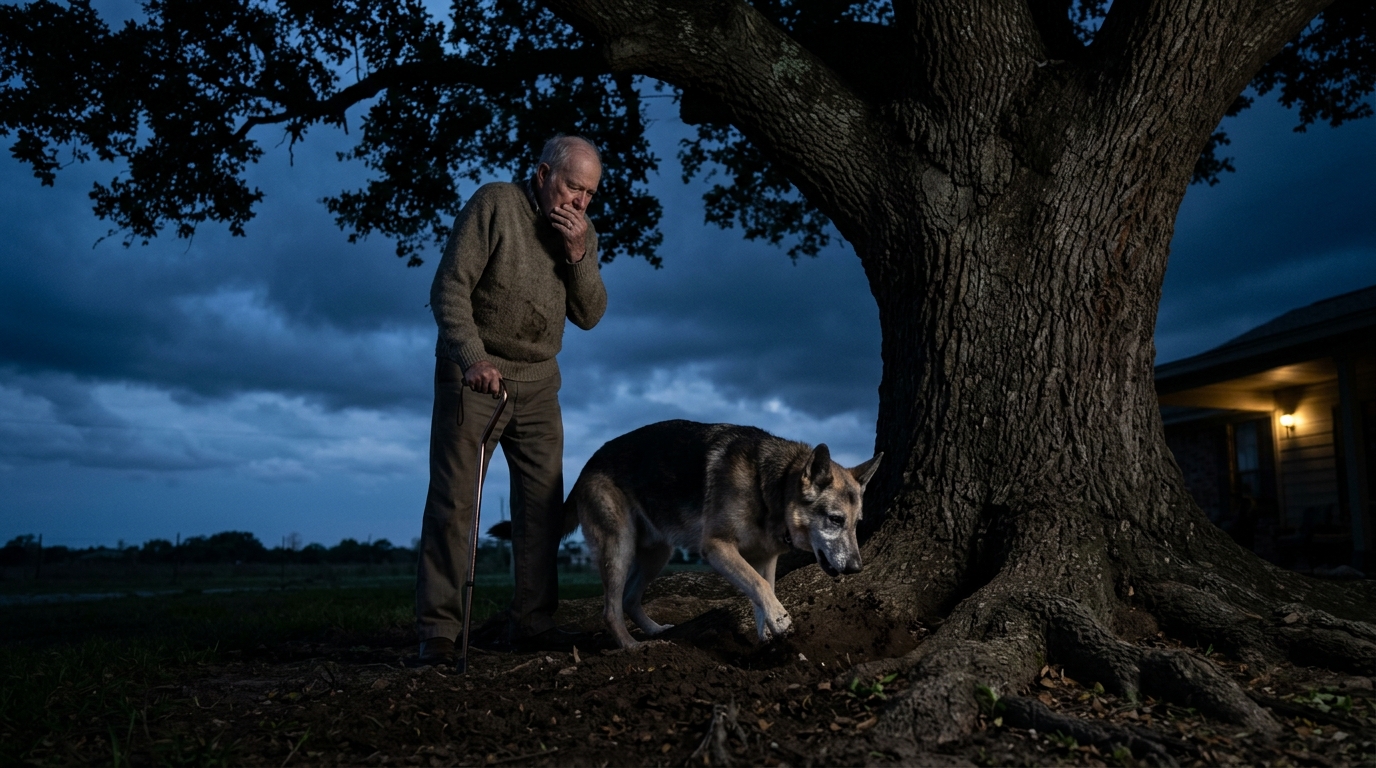
The old dog wouldn’t stop digging.
It was late, the sky had turned the color of iron, and thunder rolled over the fields beyond Henry Whitaker’s small house.
“Shadow!” Henry called from the back porch. “Come back inside!”
The German Shepherd didn’t listen.
He was old now.
Silver around the muzzle.
Cloudy-eyed.
Slow on cold mornings.
Nearly blind, according to the vet.
But that night, he dug beneath the oak tree with the urgency of a younger dog, his paws churning through wet soil as if something beneath the roots had been waiting too long.
Henry gripped the porch railing.
At seventy-eight, his hands shook more than he liked to admit. His knees ached in storms. His breath came shorter than it used to. And the old farmhouse, once full of his wife’s humming and the smell of cinnamon bread, had become too quiet since Eleanor died.
Shadow was supposed to be the one thing that made the silence bearable.
The shelter had called him “unadoptable.”
Too old.
Bad eyes.
Bad hips.
Too attached to grief, one volunteer joked softly.
Henry had looked at the dog sitting alone in the corner of the kennel, head lowered, as if he had already accepted being passed over.
And Henry had understood him.
So he brought Shadow home.
For six months, the old dog followed him from room to room, slept beside Eleanor’s empty chair, and rested his head on Henry’s knee during the long evenings when the television talked to no one.
But tonight, Shadow acted different.
Wild.
Determined.
Almost desperate.
Lightning split the sky.
For one bright second, Henry saw something beneath the oak roots.
A small rusted box.
Half-buried.
Mud-caked.
Shadow pawed at it again, then looked back toward Henry with a soft whine.
Henry stepped down from the porch.
Rain began to fall.
“Good Lord, boy,” he whispered. “What did you find?”
He knelt with difficulty beside the hole, using both hands to pull the box free. It was heavier than he expected, sealed with rust, its edges wrapped in roots as if the oak itself had tried to keep it safe.
Shadow nudged Henry’s arm.
The old man carried the box inside.
On the kitchen table, beneath the yellow light Eleanor had always said made everyone look kinder, Henry pried it open with a screwdriver.
Inside was a photograph.
He froze.
It was him and Eleanor.
Forty years younger.
Standing beneath the same oak tree on the day they planted it.
Henry in a rolled-up white shirt.
Eleanor in a blue dress, laughing at something he must have said.
Behind the photo was a folded letter.
His name was written across the front.
Henry.
His breath caught.
The handwriting was Eleanor’s.
The room seemed to tilt.
Shadow sat beside his chair, tail thumping once against the floor.
Henry opened the letter with trembling fingers.
My dearest Henry,
If you are reading this, then Shadow found the box. That means you listened to him. I knew you would eventually, even if you grumbled the whole way.
Henry pressed a hand to his mouth.
Eleanor had been dead for two years.
Yet her voice rose from the paper so clearly it felt as if she had only stepped into the next room.
He kept reading.
I buried this beneath our oak because it was the first place we promised each other we would grow old honestly. I need you to do one more honest thing for me.
Do not close the door just because I am gone.
Follow Shadow.
Henry looked down at the dog.
Shadow stared back with those cloudy, loyal eyes.
“What does that mean?” Henry whispered.
The dog simply leaned his head against Henry’s knee.
And in that still moment, with rain tapping the windows and Eleanor’s letter trembling in his hand, Henry understood something he had not allowed himself to believe.
This dog hadn’t come to be rescued.
He had come to rescue him.
The Box Beneath the Roots
Henry did not sleep much that night.
He sat at the kitchen table until the storm passed, Eleanor’s letter unfolded before him, the old photograph beside his coffee cup.
Shadow slept near the door.
Not deeply.
Every time the wind moved through the trees, the dog lifted his head, listening.
Henry read the letter again.
Then again.
There were no clear instructions beyond those two words.
Follow Shadow.
That was exactly like Eleanor.
She had never explained more than needed. She believed people paid better attention when they had to do some of the walking themselves.
Henry turned the photograph over.
There was another line on the back, one he had missed at first.
When the oak remembers, go where the river bends.
Henry stared at it.
The river bend.
There was only one place Eleanor could mean.
An old stone building sat near the bend of Blackwater Creek, half a mile beyond town. Years ago, it had been the Mill House, where farmers brought grain and children fished from the bank while their parents talked business.
Later, it became a storage property.
Then abandoned.
Then forgotten.
Henry hadn’t been there in years.
Eleanor had loved that place.
When they were young, she used to say someone should turn it into a shelter, not for one kind of lost soul, but all of them.
“People, dogs, cats, whoever needs a warm room,” she would say.
Henry always laughed.
“You plan to rescue the whole county?”
“If the county behaves badly enough, yes.”
He smiled at the memory.
Then the smile faded.
Eleanor had spent her last years quieter than usual.
Not sad.
Secretive.
She took calls in the hallway. Kept papers in her sewing basket. Asked Henry strange questions about property taxes, charitable trusts, and whether old buildings could still have good bones.
He thought it was just a way for her to keep busy while illness stole her strength.
Now he wondered if she had been building something while he was busy losing her.
By dawn, Henry’s body ached from the hard chair.
He stood slowly.
“Shadow,” he said.
No answer.
The dog’s blanket by the door was empty.
Henry frowned.
“Shadow?”
He checked the living room.
The bedroom.
The mudroom.
The porch.
Nothing.
The back door was open.
Just a crack.
Cold morning air slipped inside.
Henry’s heart lurched.
Outside, the yard was wet from the storm. Pawprints marked the mud near the porch steps.
Shadow’s prints.
They led away from the house.
Toward the road.
Toward town.
Henry grabbed his coat with shaking hands.
“No, no, no,” he muttered. “Not today, boy.”
Shadow was old.
Nearly blind.
The creek would be swollen after the storm.
And if he had gone where Henry thought he had gone—
Henry didn’t finish the thought.
He took Eleanor’s letter, tucked it into his coat pocket, and followed the pawprints into the cold morning.
Where the River Bends
The whole town knew Henry Whitaker walked slowly.
That morning, he did not.
He moved down the wet road with a cane in one hand and fear in his chest, following Shadow’s tracks through mud, across the shoulder, and past the old post office.
A neighbor called from her porch.
“Henry? Everything all right?”
“Dog got out,” he answered.
“Want me to call someone?”
He almost said no.
Then Eleanor’s words came back.
Do not close the door just because I am gone.
Henry swallowed.
“Call Sheriff Dunn,” he said. “Tell him Shadow went toward the creek.”
By the time Henry reached the edge of town, two people had joined him.
Then four.
Then seven.
That was how small towns worked when the right kind of worry moved through them.
Martha from the bakery came with a flashlight.
Old Mr. Bell brought a coil of rope.
A teenager named Caleb arrived on a bicycle, breathless and eager to help.
They found the first sign of Shadow near the old rail path.
A smear of mud.
A broken branch.
Then a faint bark in the distance.
Henry froze.
“Shadow!”
Another bark.
Weak.
But clear.
They followed it toward Blackwater Creek.
The storm had swollen the water into a churning brown force. It rushed over rocks and slapped against the banks, carrying branches, leaves, and debris from upstream.
The old Mill House stood near the bend, darker than Henry remembered, its stone walls wet and moss-streaked, its roof sagging on one side.
Shadow stood at the entrance.
Soaked.
Shivering.
Tail low.
But alive.
Henry nearly collapsed from relief.
“You old fool,” he whispered, hurrying toward him. “You scared ten years off me.”
But Shadow did not come to him.
The dog turned and barked toward the building.
Then pawed at the door.
Martha stepped closer.
“What’s he doing?”
Shadow barked again.
Not at Henry.
Not greeting.
Alerting.
Henry’s stomach tightened.
The Mill House door was stuck, swollen from the rain.
Mr. Bell and Caleb forced it open with a rusted iron bar.
The smell inside was old wood, damp stone, and something else.
Smoke?
No.
Lantern oil.
Henry stepped inside.
Dust sheets covered old equipment. Rainwater dripped through a roof leak into a metal bucket. In the center of the room, arranged carefully on a wooden table, were boxes.
Not abandoned boxes.
Labeled ones.
Legal folders.
Photographs.
Keys.
A stack of blankets.
A collar.
A dog collar.
Shadow moved straight toward it and lay down beside the table as if his work had finally brought everyone to the right place.
Henry reached for the top folder.
His name was written on it.
So was Eleanor’s.
Inside was a deed.
The Mill House property.
Transferred five years earlier.
To the Eleanor Whitaker Memorial Trust.
Henry stared.
His knees weakened.
Martha touched his arm.
“Henry?”
He couldn’t answer.
Beneath the deed was another letter.
Again, Eleanor’s handwriting.
If Shadow brought you here, it means he still remembers the route. Good boy.
Henry, I bought the Mill House before I told you I was sick. I wanted to make it into what we always talked about. A place for old animals, lonely people, and children who need somewhere warm after school.
I couldn’t finish it.
But maybe you can.
Henry sat down hard on an old wooden chair.
The room blurred.
Eleanor had not simply left him a memory.
She had left him a mission.
Then Caleb, the teenager, called from the back room.
“Mr. Whitaker? You need to see this.”
The Room Eleanor Kept Secret
The back room of the Mill House had been cleaned.
Not recently.
But carefully.
Shelves lined one wall. On them sat canned food, medical supplies, old towels, children’s books, dog bowls, and file boxes sealed in plastic.
Henry lifted one lid.
Inside were letters.
Dozens of them.
Some addressed to Eleanor.
Some written by her.
Martha picked one up and read silently. Her hand flew to her mouth.
“What is it?” Henry asked.
She looked at him with wet eyes.
“She helped my sister.”
Henry blinked.
“What?”
Martha held out the letter.
Years ago, Martha’s sister had fled an abusive husband with two children and nowhere to go. Everyone in town thought she had left because of family money from a cousin.
She hadn’t.
Eleanor had paid for the motel.
Eleanor had contacted a lawyer.
Eleanor had bought the bus tickets that got them safely to another state.
Henry stared at the letter.
Then Mr. Bell opened another folder.
His face changed.
“This is my hospital bill.”
He looked at Henry.
“After my stroke. I thought the church covered it.”
Henry sat in silence.
More people arrived.
Sheriff Dunn.
The mayor.
Neighbors.
A few curious townsfolk who had followed the noise.
One by one, they found pieces of Eleanor hidden in that room.
A grocery receipt for a widow who had pretended not to need help.
A scholarship check for a boy whose parents said he earned it through a “local program.”
Veterinary records for stray dogs Eleanor had quietly rescued.
A stack of adoption papers from shelters across three counties.
And in a box marked Shadow, Henry found the truth about the old dog.
Shadow had once belonged to a veteran named Thomas Gray, who lived near the creek after coming home from war with more pain than he could explain. Eleanor had been bringing him meals for years without telling anyone.
When Thomas died, Shadow refused to leave the Mill House.
The shelter tried taking him twice.
Both times, he escaped and returned to the old building.
Eleanor eventually trained him to walk from the Mill House to Henry’s home and back, using treats, scent cloths, and pieces of her old blue scarf.
Henry covered his face.
“She sent him to me,” he whispered.
Sheriff Dunn quietly lifted a photograph from the box.
It showed Eleanor sitting in a chair outside the Mill House, thin from illness but smiling.
Shadow lay beside her with his head in her lap.
On the back, she had written:
When I can’t bring Henry back to the world, maybe Shadow can.
Henry wept then.
Not quietly.
Not politely.
He wept like a man who had spent two years mistaking loneliness for loyalty.
He thought staying inside the old house meant staying close to Eleanor.
But Eleanor had known him better.
She had known grief would bury him if something loyal did not dig him out.
Shadow nudged Henry’s knee.
The old dog was soaked, exhausted, and trembling.
Henry dropped to the floor beside him and wrapped both arms around his neck.
“You found it,” Henry whispered.
Shadow sighed against him.
But the town’s shock was not finished.
At the bottom of the final box was a sealed envelope marked:
For the day they try to sell the Mill House.
Sheriff Dunn opened it carefully.
Inside were documents proving someone had been trying to take the property.
The development company that claimed to own the land by the creek had filed papers six months earlier.
The same company that wanted to tear down the Mill House and build luxury cabins.
The same company the mayor had nearly approved the week before.
The room went silent.
The mayor went pale.
Because the documents in Eleanor’s box proved the company had no legal claim.
The Mill House belonged to the trust.
And the trustee’s name was Henry Whitaker.
Shadow’s Last Gift
The story spread through town before noon.
Not just that Henry had found Eleanor’s secret room.
Not just that the old Mill House belonged to him.
But that Eleanor Whitaker—the quiet woman who baked pies, wore blue cardigans, and always sat in the third pew at church—had spent years saving people without letting them thank her.
By evening, nearly half the town had gathered outside the Mill House.
Some came with cleaning supplies.
Some came with tools.
Some brought dog food, blankets, folding chairs, coffee, and old photographs of Eleanor.
Martha hung a handwritten sign on the door:
Eleanor’s Place
Henry stood beneath it for a long time.
Shadow slept on a blanket near the entrance, too tired to lift his head but wagging his tail whenever someone said his name.
The vet arrived and checked him over.
“Old boy’s worn out,” she said gently. “But proud of himself, I think.”
Henry smiled through tears.
“He has reason to be.”
The developer’s claim collapsed within days.
The mayor, embarrassed and eager to appear useful, fast-tracked the trust paperwork.
Volunteers restored the Mill House through the winter.
The front room became a warm gathering space for seniors who had nowhere to go during the day.
The side room became an after-school reading corner.
The old storage area became a small animal rescue room with heated kennels for senior dogs no one wanted.
Henry insisted on that.
“Old dogs know things,” he said.
By spring, Eleanor’s Place opened.
Not with a ribbon-cutting ceremony.
Henry hated those.
Instead, they served soup.
Children read books in the corner.
A widow sat with tea near the window.
Three old dogs slept in soft beds by the stove.
And Shadow lay in the center of it all, wearing a new collar with a small brass tag:
Founder of Digging Operations
People laughed when they saw it.
Henry said Eleanor would have loved it.
For several months, Shadow seemed younger.
He walked slowly through the rooms, checking on everyone. He rested his head on children’s knees. He barked when the soup pot boiled over. He slept beside Henry every afternoon in the chair Eleanor had chosen long ago.
Then, one warm evening, Shadow led Henry outside to the oak tree.
Not the one by the Mill House.
The one behind Henry’s home.
The one where everything had begun.
The grass was soft.
The sky glowed pink.
Shadow lowered himself beneath the branches with a tired sigh.
Henry sat beside him.
“You ready to rest, old friend?”
Shadow placed his head on Henry’s knee.
No drama.
No fear.
Just peace.
Henry stroked the silver fur between his ears until the dog’s breathing slowed.
Then stopped.
The next morning, the town gathered beneath the oak tree.
They buried Shadow beside the roots, near the place where he had found Eleanor’s box.
Henry placed the old rusted box above him for a moment before taking it back inside.
Martha brought flowers.
Caleb brought a drawing of Shadow wearing a medal.
The vet cried openly.
Sheriff Dunn cleared his throat three times and never managed to speak.
Henry finally did.
“Shadow was an old dog nobody thought had much left to give,” he said. “Turns out he had one more job. He brought me back to my wife. Then he brought all of us back to what she started.”
He looked around at the people Eleanor had helped.
Some knew it now.
Some were still discovering it.
All of them stood beneath the tree she and Henry had planted forty years earlier.
“He didn’t come to be rescued,” Henry said softly. “He came to rescue us.”
Years later, people in town still told the story.
About the storm.
The old dog digging beneath the oak.
The rusted box.
The photograph from forty years ago.
The vanished dog.
The Mill House.
The secret room.
The truth Eleanor left behind.
But Henry told it differently.
He said grief is like being buried alive in a room no one else can see.
And sometimes love does not arrive with speeches or miracles.
Sometimes it arrives old, half-blind, muddy-pawed, and stubborn.
Sometimes it digs until you finally understand where to look.
Every morning after that, Henry opened Eleanor’s Place himself.
He unlocked the door.
Turned on the lights.
Started the coffee.
Fed the senior dogs.
Then he touched the small photograph hanging by the entrance.
Eleanor beneath the oak.
Shadow beside her.
On the frame were the words she had left him:
Do not close the door just because I am gone.
Henry never did again.