Chapter 1: The Girl No One Noticed
She didn’t spill it by accident.
I knew it.
She knew it.
And within seconds, half the ballroom knew it too.
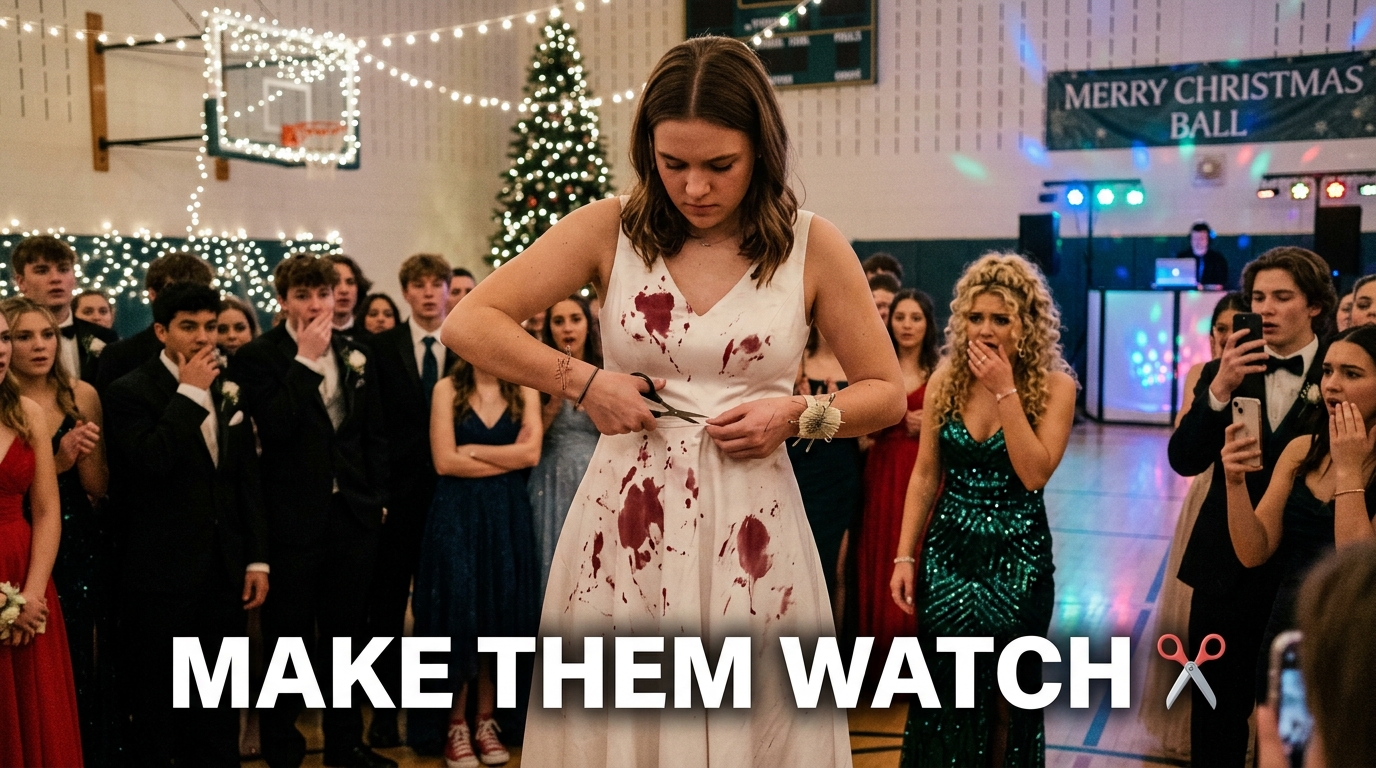
The glass tilted slowly in her manicured hand, catching the golden lights above us for one cruel, glittering second.
Then the red wine poured straight down the front of my white dress.
Cold.
Dark.
Unforgiving.
It spread across the fabric like a wound.
Across the bodice.
Down the skirt.
Over the tiny hand-stitched flowers I had spent three weeks sewing beneath a weak desk lamp after school, long after my mother had fallen asleep from her double shift.
For a moment, the whole Christmas ball went silent.
The music kept playing, but no one danced.
No one laughed.
No one even breathed properly.
Then came the sound Vanessa Hart had been waiting for.
A gasp.
Then a whisper.
Then a giggle.
Then phones rising, one after another, like little black mirrors eager to capture my humiliation from every angle.
I stood there in the center of the decorated gymnasium, red wine dripping from my dress onto the polished floor.
White snowflake lights hung overhead.
Silver balloons swayed near the stage.
The DJ booth glowed blue.
And under all of it, I became exactly what Vanessa wanted me to be.
A spectacle.
A warning.
A girl who should have known better than to look beautiful in a room where beauty was supposed to belong to someone else.
Vanessa looked me up and down with a smile so sweet it could have fooled anyone who didn’t know poison could wear lip gloss.
“Maybe now,” she said, loud enough for everyone around us to hear, “you’ll stop pretending you belong here.”
A few girls behind her covered their mouths.
Not to hide horror.
To hide laughter.
I heard someone whisper:
“Oh my God, Maya’s going to cry.”
Maya.
That was my name.
Not that most people used it.
To them, I was just the quiet girl.
The scholarship girl.
The girl who always had thread stuck to her sweater and pencil smudges on her fingers.
The girl who ate lunch in the art room because the cafeteria tables seemed to have invisible name tags, and none of them said mine.
I wasn’t hated.
That would have required attention.
I was simply background.
A wallflower.
And Vanessa Hart was everything I was not.
Perfect hair.
Perfect teeth.
High-end heels.
A father whose name appeared on donor plaques around the school.
A mother who organized charity galas and smiled like she owned every room she entered.
Vanessa didn’t walk through St. Catherine’s Academy.
She floated through it as if the halls had been built for her.
Teachers softened around her.
Girls copied her outfits.
Boys watched her like she was a prize they had no chance of winning but still wanted to be near.
And tonight, she had been waiting to be crowned Winter Queen.
Everyone knew it.
No one said it out loud.
Because when girls like Vanessa expect something, the world usually hands it over and calls it tradition.
But then I walked in wearing the white dress.
And for the first time all night, the room looked away from her.
That was my mistake.
Or maybe it was hers.
Chapter 2: The Dress I Made in Secret
The dress was not expensive.
That was what no one understood.
From far away, maybe it looked like something from a boutique.
Soft white fabric.
A fitted bodice.
A full skirt that moved gently when I walked.
Silver embroidery along the waist.
Small pearl beads catching the light.
But it had not come from a boutique.
It came from clearance fabric, old curtains, thrifted lace, and the kind of stubborn hope that makes poor girls stay awake long after midnight because dreams don’t come pre-made in their size.
I had made every inch of it myself.
Not because I wanted to impress anyone at school.
At least, that was what I told myself.
The truth was more complicated.
I wanted one night where I didn’t look like someone trying to disappear.
One night where my clothes didn’t whisper that money was tight.
One night where I could walk into a room and feel like my own hands had built something beautiful enough to protect me.
My mother worked at a small alterations shop downtown.
When I was little, I used to sit beneath the cutting table after school, watching fabric fall around me like colored rain.
That was where I learned stitches before multiplication.
Hemlines before essays.
How to hide a tear.
How to strengthen a seam.
How to turn cheap cloth into something that could hold its head up under bright lights.
My mother never called sewing “women’s work.”
She called it architecture.
“People think dresses are soft,” she used to say. “They don’t understand structure. A good dress is a building. If the foundation is right, it can survive more than people expect.”
So when I decided to make my own Christmas ball dress, I built it carefully.
Layer by layer.
A plain cotton lining.
A reinforced waist.
A removable front overlay.
Hidden seams.
Small pockets.
Emergency thread tucked inside the hem.
Not because I expected disaster.
Because my mother always taught me:
“If you can’t afford replacement, you plan for repair.”
For three weeks, I worked on that dress.
After homework.
After chores.
After my mother slept.
Sometimes my fingers cramped so badly I had to soak them in warm water.
Sometimes I pricked myself and left tiny dots of blood on scrap fabric.
Sometimes I wanted to quit.
But then I imagined walking into the ballroom.
Not as the girl with secondhand shoes.
Not as the girl teachers praised for “working hard despite circumstances.”
Not as the quiet scholarship girl Vanessa and her friends used as proof that charity looked good in brochures.
Just as me.
Maya Chen.
A girl who could make beauty out of almost nothing.
When I finally tried the dress on the night before the ball, my mother stood in the doorway of our apartment bedroom and said nothing.
For a second, I thought she hated it.
Then I saw her eyes.
They were full of tears.
“Oh, Maya,” she whispered. “You made yourself wings.”
I laughed because if I didn’t, I would cry too.
“They’re just sleeves.”
She shook her head.
“No. They’re wings.”
The next evening, I walked into the Christmas ball wearing those wings.
And for the first thirty minutes, I almost believed they worked.
Chapter 3: Vanessa Hart Notices
People noticed the dress before they noticed me.
That was the strange part.
A freshman girl near the entrance stopped mid-sentence and whispered:
“Your dress is so pretty.”
I turned, unsure she was speaking to me.
She was.
“Thank you,” I said.
Then one of the art teachers, Mrs. Langley, looked up from the refreshment table and stared.
“Maya,” she said, stepping closer. “Did you make this?”
My face warmed.
“Yes.”
She walked around me slowly, not in a rude way, but like she was studying a piece in a gallery.
“The beadwork is hand-done?”
I nodded.
“And the embroidery?”
“Yes.”
Her expression changed.
Not pity.
Not surprise exactly.
Respect.
“This is extraordinary.”
That was the first dangerous moment.
Because Vanessa heard.
She was standing ten feet away, surrounded by her friends, wearing a gold dress that probably cost more than our monthly rent.
The gold dress was beautiful.
I will not pretend it wasn’t.
It fit her perfectly.
It shimmered every time she moved.
It looked like something made for a girl who expected applause.
But when Mrs. Langley praised my dress, Vanessa’s smile tightened.
Only slightly.
Most people would have missed it.
I didn’t.
Girls like me learn to read danger early.
Not danger like fists.
Danger like silence.
Like narrowed eyes.
Like a smile that stops reaching the cheeks.
Vanessa drifted closer.
“How creative,” she said.
The word sounded like a compliment.
It wasn’t.
Her eyes moved over the seams, the lace, the tiny pearls.
“Did you make it from scratch?”
“Yes.”
“That’s cute.”
One of her friends giggled.
Vanessa tilted her head.
“I mean, not everyone can buy a real dress, right? It’s nice that you tried.”
I felt the heat rise in my face.
Mrs. Langley’s expression cooled.
“Vanessa.”
Vanessa widened her eyes innocently.
“What? I said it was nice.”
Then she smiled at me.
“Really, Maya. It’s very… resourceful.”
Resourceful.
That was one of those words people used when they wanted to make poverty sound like a personality trait.
I forced myself to smile.
“Thanks.”
Vanessa leaned closer.
“Just be careful. White is risky.”
Then she walked away.
I should have known then.
Maybe part of me did.
But the music was warm, and the lights were soft, and for the first time in years, people were asking me questions because they admired something I made.
So I let myself enjoy it.
Just a little.
That was all Vanessa needed.
Chapter 4: The Spill
The crowning announcement was supposed to happen at nine.
At 8:47, the DJ played a slow remix of an old Christmas song.
Couples moved onto the floor.
Groups took photos near the decorated arch.
I stood near the edge of the dance area with a paper cup of water, watching the room with a strange feeling in my chest.
I wasn’t popular.
I wasn’t suddenly transformed into someone else.
But I also wasn’t invisible.
Not tonight.
A girl from my history class asked if I could help her alter a thrifted prom dress.
A sophomore asked if I had a fashion page.
Mrs. Langley mentioned a regional student design competition.
For the first time, a door I hadn’t known existed seemed to open slightly.
Then Vanessa approached with a glass of red wine.
Technically, students weren’t supposed to have wine.
But her parents were donors.
Rules bent around money all the time.
She moved through the room with two friends behind her, smiling like she had already won something.
I saw her coming.
My stomach tightened.
“Maya,” she said sweetly. “There you are.”
I looked at the glass.
Then at her.
“Vanessa.”
Her eyes sparkled.
“You’ve been getting so much attention tonight.”
I said nothing.
She stepped closer.
“That must feel new.”
Her friends exchanged looks.
I held my cup tighter.
“I’m just enjoying the ball.”
“Oh, I’m sure.”
She looked at my dress again.
Then sighed.
“It’s funny. Some people spend their whole lives trying to look like they belong somewhere.”
My throat went dry.
“But the thing is,” she continued, “people can always tell.”
I should have walked away.
I know that now.
But sometimes when you have spent your life stepping aside, there comes a moment when your feet refuse.
“I’m not bothering you, Vanessa.”
Her smile vanished for half a second.
Then returned sharper.
“No,” she said. “You’re just confused.”
She lifted the glass.
Slowly.
Deliberately.
I saw the decision before it happened.
But seeing something doesn’t always mean you can stop it.
The red wine poured down my dress.
Cold liquid hit my chest first.
Then ran down the white fabric.
Gasps burst around us.
My cup slipped from my hand and hit the floor.
The stain spread like fire.
Vanessa lowered the empty glass.
Her smile returned.
“Oops.”
Then she leaned closer and said the words that made half the room go silent.
“Maybe now you’ll stop pretending you belong here.”
For a moment, I could not move.
My ears rang.
My vision blurred.
My dress was ruined.
My mother’s sleepless nights.
My aching fingers.
Every tiny flower.
Every careful stitch.
All of it soaked in red.
Someone laughed.
Someone else said, “That was brutal.”
A phone flash went off.
I looked down at the stain.
And I almost broke.
Not because of the dress.
Because for one second, I believed her.
Maybe I didn’t belong.
Maybe beauty made by poor hands would always be treated like something disposable.
Maybe no matter how carefully I stitched myself together, someone like Vanessa could ruin it with one tilt of a glass.
Then I remembered my mother.
If something tears, don’t panic.
Look at it longer.
Sometimes the mistake is trying to tell you what it wants to become.
I took one breath.
Then another.
Then I reached into my bag.
Chapter 5: The Sewing Kit
The room expected tissues.
I could feel it.
They expected me to dab at the stain helplessly.
They expected me to cry.
They expected me to run to the bathroom and call my mother.
Vanessa expected all of that most.
Her friends had already positioned themselves for the final shot.
The ruined dress.
The crying girl.
The victorious queen.
But my fingers closed around something small and familiar.
My emergency sewing kit.
A tiny metal box.
Needles.
Thread.
Pins.
Seam ripper.
Small scissors.
I carried it everywhere.
Vanessa had mocked it once in the hallway.
“What are you, someone’s grandmother?”
No.
I was someone’s daughter.
The daughter of a seamstress who believed repair was a kind of power.
I opened the kit.
The little scissors glinted under the Christmas lights.
A murmur moved through the crowd.
Vanessa’s grin faltered.
“What are you doing?”
I didn’t answer her.
I turned toward the DJ booth.
My voice shook, but it held.
“Can you keep the music going?”
The DJ blinked.
“What?”
“Please,” I said. “Don’t stop the music.”
People shifted closer.
The DJ looked from me to Vanessa to the widening circle of students.
Then he slowly raised the volume.
A beat filled the ballroom.
Not too fast.
Not too slow.
Steady enough to cut to.
I looked at the stained dress.
The red wine had destroyed the front overlay.
But not the structure beneath.
Because I had built the dress in layers.
Because I had planned for repair.
Because some part of me had always known the world was not gentle with girls like me.
I took the scissors.
And made the first cut.
A clean slice through the stained outer layer.
The room gasped.
Vanessa stepped back.
“You’re insane.”
Maybe.
Or maybe I was done letting her decide what the room was allowed to see.
I cut along the line of the stain.
Not randomly.
Carefully.
Following its shape.
The red had flowed diagonally across the skirt, so I let the cut follow that angle.
I removed one ruined panel and held it up.
Dark red against white.
A disaster in one hand.
A possibility in the other.
Then I folded it.
Twisted it.
Pinned it at my waist.
A rough rosette.
Not perfect.
But alive.
Someone whispered:
“She’s turning it into a flower.”
I heard Vanessa’s breath catch.
I cut another piece.
Folded.
Pinned.
Stitched.
My fingers moved faster.
The room moved closer.
Phones stayed raised, but the reason changed.
They were no longer filming my humiliation.
They were filming the moment it refused to remain humiliation.
I used the red-stained fabric to create a diagonal sash across the bodice.
I cut the lower layer unevenly, transforming the skirt into an asymmetrical fall.
I pulled silver thread from the hem and used it to secure the flowers.
The stain became contrast.
The torn panel became texture.
The ruined dress became something sharper.
Less innocent.
More powerful.
The white dress Vanessa had tried to destroy disappeared before everyone’s eyes.
In its place, something new emerged.
White and red.
Soft and defiant.
Elegant and wounded.
Beautiful because it had survived being harmed.
Chapter 6: The Room Changes Sides
At first, no one clapped.
They were too stunned.
The transformation happened in less than ten minutes, but time felt strange.
The music pulsed under the murmurs.
The red flowers grew across my waist.
The cut skirt moved differently now, revealing the silver lining beneath.
I used the last stained strip to wrap one shoulder, creating a dramatic sweep that looked intentional because I decided it was.
That was the secret.
Not that the dress was perfect.
It wasn’t.
Some pins were hidden badly.
Some stitches were temporary.
One flower was larger than the others.
But confidence can make an unfinished thing look like a choice.
When I finally lowered the scissors, the room was silent.
Then a freshman girl whispered:
“That looks better than before.”
Vanessa snapped toward her.
“What did you say?”
The girl shrank back.
But someone else said:
“She’s right.”
Then another voice:
“It’s actually incredible.”
Mrs. Langley pushed through the crowd.
Her eyes were fixed on the dress.
“Maya…”
For one terrifying second, I thought she would scold me for cutting fabric in the middle of the ballroom.
Instead, she looked at Vanessa’s empty glass on the floor.
Then at the red flowers.
Then at me.
“Did you plan any of this?”
I almost laughed.
“No.”
Mrs. Langley smiled.
“Then that may be the most impressive part.”
The crowd stirred.
Vanessa looked around, realizing something had shifted.
The laughter that had belonged to her was gone.
The phones that were supposed to capture my downfall had captured my skill instead.
The room had not become kind.
Not exactly.
But it had become awake.
Mrs. Langley turned to the DJ.
“Bring the lights up slightly.”
The DJ obeyed.
White light spread across the ballroom.
The red flowers glowed deeper.
The silver thread flashed.
Mrs. Langley raised her voice.
“Everyone, step back.”
Students moved without thinking.
A runway opened through the center of the floor.
My heart slammed against my ribs.
Mrs. Langley looked at me.
“Maya, would you walk?”
My mouth went dry.
“What?”
“Walk,” she said gently. “Let them see the whole design.”
Vanessa let out a sharp laugh.
“You cannot be serious.”
Mrs. Langley turned to her.
“I am very serious.”
The crowd parted farther.
My knees shook.
I had never walked like that before.
Never wanted to.
But I looked down at the dress.
At the red stain Vanessa had meant to use as proof that I didn’t belong.
Then I looked up.
At the room.
At the phones.
At Vanessa.
And I walked.
Chapter 7: The Walk
The first step was the hardest.
My legs felt weak.
The ballroom seemed too bright.
Every eye in the room followed me.
For years, I had trained myself to avoid attention.
Keep my head down.
Move quietly.
Take up less space.
Speak only when called on.
Smile when uncomfortable.
Leave before anyone could decide I was in the way.
But that night, I walked straight through the center of the ballroom in the dress Vanessa tried to ruin.
The skirt moved around me in sharp, uneven waves.
The red fabric flowers curved across my waist like a line of battle marks.
The silver lining flashed with every step.
Someone clapped.
Once.
Then again.
Then more.
A few students cheered.
The sound startled me so badly I almost stopped.
But I didn’t.
I kept walking.
At the end of the room, I turned.
Not perfectly.
Not like a model.
Like a girl learning in real time that being seen would not kill her.
When I walked back, I saw faces differently.
The freshman who had complimented me was crying.
A boy from chemistry looked embarrassed, probably because he had laughed earlier.
Vanessa’s friends were no longer standing close to her.
They had drifted apart, as if cruelty had become contagious and no one wanted to be photographed touching it.
Vanessa stood alone near the dessert table.
Her face burned red.
Not from shame.
From rage.
I stopped in front of her.
The applause faded.
She lifted her chin.
“You think this makes you special?”
My hands were still shaking, but my voice was calm.
“No.”
Her eyes narrowed.
I looked down at the dress, then back at her.
“It just makes you careless.”
A ripple moved through the crowd.
Someone whispered, “Oh.”
I continued, softer:
“You threw color at someone who knows how to use it.”
That was when her face changed.
Because for the first time that night, she understood the thing she had tried to destroy had never been just fabric.
It was training.
Memory.
Work.
Inheritance.
Everything my mother taught me.
Everything I taught myself.
Everything Vanessa could not buy, borrow, or bully out of existence.
Mrs. Langley stepped beside us.
“Vanessa,” she said coldly, “my office. Now.”
Vanessa laughed.
“You’re taking her side?”
Mrs. Langley’s face hardened.
“I am taking the side of the student who was publicly humiliated and still managed to turn it into art.”
Vanessa looked around for support.
None came.
Not from her friends.
Not from the boys who had laughed.
Not from the girls who had spent the whole semester orbiting her like she was the only sun in the room.
For the first time, Vanessa Hart looked small.
She stormed out.
But the room did not follow her.
It stayed with me.
Chapter 8: What Vanessa Didn’t Know
The next morning, the video was everywhere.
By 7 a.m., three clips had been posted.
By 9 a.m., someone had edited the transformation with dramatic music.
By noon, the comments had exploded.
She really said scissors over tears.
That dress got baptized in drama and came back stronger.
Vanessa tried to ruin her and accidentally launched her fashion career.
The quiet girl ATE.
At first, I wanted to hide.
My phone wouldn’t stop buzzing.
Students who had never spoken to me were suddenly sending messages.
Some kind.
Some curious.
Some fake.
A few girls apologized for laughing.
I didn’t answer most of them.
Not because I was mean.
Because I didn’t yet know what forgiveness was supposed to look like when the same people who watched you drown suddenly praised how well you swam.
My mother found out from one of her coworkers.
She came home early with flour on her sleeve and panic in her eyes.
“Maya.”
I was sitting at the kitchen table, the dress spread out before me.
Now that the adrenaline was gone, I could see the rushed stitches.
The crooked pins.
The wine still dried into parts of the fabric.
My mother touched the red flowers gently.
“Did she hurt you?”
I stared at the dress.
“Yes.”
My mother sat beside me.
“Did you cry?”
“Not there.”
She nodded.
“Good.”
I looked at her, surprised.
She smiled sadly.
“I don’t mean good that you held it in. I mean good that she didn’t get to decide where your tears belonged.”
That broke me.
I cried then.
Hard.
My mother held me beside the dress.
After a long while, she said:
“This needs permanent stitching.”
I laughed through tears.
“It’s ruined.”
She shook her head.
“No. It’s unfinished.”
So we fixed it together.
All weekend.
We removed the emergency pins.
Reinforced the sash.
Reshaped the red flowers.
Added deep burgundy thread.
Balanced the asymmetrical skirt.
By Sunday night, the dress looked like it had always been meant to become what it became.
That was when Mrs. Langley called.
She had shown the video to a friend who worked with a regional youth arts foundation.
They wanted the dress for the spring student design showcase.
Not a school hallway display.
A real showcase.
Design students.
Local press.
Scholarship judges.
My mother covered her mouth when I told her.
I thought about Vanessa saying I didn’t belong.
Then I looked at the dress hanging on our closet door.
Maybe belonging was not something people like Vanessa gave.
Maybe it was something you stitched together and walked into.
Chapter 9: Vanessa’s Fall
Vanessa did not return to school for three days.
When she did, the hallway changed around her.
Not dramatically.
No one threw red wine.
No one shouted.
That would have been too obvious.
The change was quieter.
People stopped moving aside as quickly.
Her friends spoke to her, but carefully, like standing too close might pull them into the story.
Teachers watched her with less patience.
The school opened an investigation because too many videos showed the spill clearly.
Vanessa’s parents arrived in expensive coats, furious not that their daughter had humiliated someone, but that the humiliation had failed publicly.
They called it a misunderstanding.
Then a prank.
Then an overreaction.
Then “a difficult moment between girls.”
Mrs. Langley refused every soft word.
She brought the video.
The empty glass.
Witness statements.
And the school handbook section on harassment.
For once, Vanessa’s last name could not erase what everyone had seen.
She was removed from the Winter Court.
She lost her leadership position on the gala committee.
She had to issue a written apology.
The apology was terrible.
Three paragraphs of polished nothing.
I regret that Maya felt embarrassed by what happened.
I read that line twice.
Then stopped.
My mother saw my face.
“What?”
“She’s not sorry.”
My mother returned to her sewing machine.
“Some people only regret the mirror.”
I didn’t understand at first.
Then I did.
Vanessa wasn’t sorry she hurt me.
She was sorry everyone saw her clearly.
A week later, she cornered me near the art room.
No friends.
No phone.
Just her.
For a moment, I felt the old fear return.
She looked tired.
Angry.
Humiliated.
“You ruined my year,” she said.
I stared at her.
It was such a strange sentence that I almost laughed.
“I ruined your year?”
Her eyes flashed.
“Everyone thinks I’m some monster now.”
I looked at her carefully.
“No, Vanessa.”
Her expression shifted.
“They think you’re what you showed them.”
She swallowed.
For one second, I thought she might say something real.
Something human.
Instead, she said:
“You’ll never really be one of them, you know.”
There it was.
The last weapon she had.
I smiled.
Not because it didn’t hurt.
Because it didn’t work anymore.
“Maybe not,” I said. “But now they know I don’t need to be.”
I walked past her into the art room.
This time, I didn’t look back.
Chapter 10: The Showcase
Three months later, my transformed dress stood under gallery lights.
Not in the school gym.
Not beside folding tables and punch bowls.
In a regional student design showcase downtown.
The dress was displayed on a mannequin in the center of the room.
White fabric.
Red sculpted flowers.
Silver thread.
A small plaque beside it read:
“Accidental Bloom” — Maya Chen
Medium: thrifted textiles, hand embroidery, altered live during performance.
Performance.
That word made me laugh when I first saw it.
I hadn’t performed.
I had survived.
But maybe survival in front of an audience becomes performance whether you want it to or not.
People walked around the dress slowly.
Some admired the construction.
Some asked about the story.
Some wanted to know if the red fabric had been dyed intentionally.
I said:
“Not at first.”
That always made them lean closer.
Mrs. Langley stood nearby, proud enough to embarrass me.
My mother wore her best blouse and cried every time someone complimented the stitching.
Then a woman from the youth arts foundation approached me.
Her name was Diana Pierce, a designer who ran a summer fashion mentorship in New York.
She had seen the video.
She had also seen the finished dress.
“You have instinct,” she told me.
I didn’t know what to say.
She continued:
“Not just talent. Instinct. You understand how to respond to material under pressure.”
My mother squeezed my hand.
Diana offered me a scholarship for the summer program.
Travel included.
Housing included.
Supplies included.
I read the email three times before I believed it.
That night, after the showcase, my mother and I took the bus home because taxis were too expensive and we were still us.
But something had changed.
I leaned my head against the window, watching city lights smear across the glass.
My mother held the scholarship packet in her lap like it was fragile.
After a long silence, she said:
“She tried to stain you.”
I looked at her.
My mother smiled.
“And accidentally gave the world contrast.”
Chapter 11: The Dress Was Never Just a Dress
People like simple stories.
They wanted mine to be about revenge.
A mean girl ruined my dress.
I fixed it.
Everyone clapped.
The end.
But that wasn’t the whole truth.
The truth was that I had been invisible long before Vanessa poured that wine.
The truth was that I had spent years shrinking myself so no one would notice my shoes, my lunch, my old backpack, my mother’s tired eyes when she came to parent-teacher night still smelling faintly of steam and fabric dye.
The truth was that Vanessa only said out loud what a lot of people quietly believed:
That some girls belong under chandeliers.
And some girls belong cleaning up after them.
That night, she tried to put me back in my place.
But she didn’t understand.
My place had never been where she pointed.
My place was wherever my hands could build something true.
The white dress was not just a dress.
It was every lesson my mother taught me.
Every late night.
Every repaired hem.
Every time we made something last because we couldn’t afford to replace it.
Every quiet refusal to let lack become shame.
And when Vanessa stained it, she did not erase that.
She revealed it.
She forced the whole room to watch what happens when a girl raised by repair refuses to remain ruined.
So if you ask whether I would go back and avoid the spill, I don’t know.
Part of me wishes I could have worn the white dress all night exactly as I made it.
Innocent.
Soft.
Untouched.
But another part of me knows the red version told the truth better.
Because I was not untouched.
I had been laughed at.
Underestimated.
Looked through.
Talked down to.
But I was still standing.
Still stitching.
Still walking.
And this time, everyone had to see.
Chapter 12: Team Walk Away or Team Make Them Watch?
At the end of senior year, people still talked about the Christmas ball.
Not every day.
Stories fade.
New drama comes.
New scandals replace old ones.
But sometimes, a freshman would stop me near the art room and ask:
“Are you the girl who fixed the dress?”
I would smile and say:
“I’m the girl who made it.”
That mattered.
Because the fixing was only the part everyone saw.
The making came first.
The work came first.
The skill came first.
The dream came first.
Vanessa transferred before graduation.
I heard different reasons.
Her parents wanted a “fresh environment.”
She needed a “less toxic social atmosphere.”
People were “unfairly obsessed with one mistake.”
Maybe all of that was true in her version.
In mine, she left because she could no longer control the room after the room saw her clearly.
As for me, I still carry a sewing kit.
Always.
Not because I expect someone to ruin my clothes.
Because I know life sometimes spills things on you in front of everyone.
Cruelty.
Embarrassment.
Failure.
Loss.
Shame.
And when it does, you get a choice.
You can walk away.
Sometimes that is the right choice.
There is dignity in leaving places that only want to watch you bleed.
But sometimes…
Sometimes you stay.
Sometimes you pull out the scissors.
Sometimes you cut away what they ruined.
Sometimes you turn the stain into flowers.
Sometimes you make them watch.
So tell me—
If someone tried to humiliate you in front of everyone…
Would you walk out crying?
Or would you stay, pick up the scissors, and turn their cruelty into the most unforgettable thing in the room?
Team WALK AWAY or Team MAKE THEM WATCH?